

Why Business Agility is Your Competitive Edge
Business agility consulting helps organizations transform how they work, respond to change, and deliver value in today’s digital environment. If you’re evaluating consultants, look for these key qualities:
- Custom solutions custom to your specific context, not one-size-fits-all frameworks
- Holistic approach addressing strategy, structure, and culture across the organization
- Proven experience with measurable outcomes like faster time-to-market
- Leadership development capabilities to champion and sustain the change
- Incremental change methodology that minimizes disruption to operations
Now more than ever, businesses must evolve rapidly. The statistics are sobering: over 80% of digital changes fail to deliver their expected benefits. Yet, organizations that get it right see remarkable results—180% improvement in customer satisfaction, 4x faster time to market, and 80% cost reduction in projects.
Business agility isn’t just about new processes. It’s a holistic, company-wide approach that harnesses creativity to open up your business’s full potential. An agile organization has the visibility to respond quickly and effectively to both opportunities and threats.
The challenge is that many leaders struggle to keep up with rapid technological change. The stakes are high, as a poorly managed shift can destabilize operations and revenue. This is where the right consulting partner makes all the difference—helping you establish a change strategy for your context and implementing it in an iterative, incremental way.
I’m Chris Robino, and I help organizations leverage business agility principles to steer digital change. My approach centers on integrating emerging technology with practical change management to deliver measurable results.

The Blueprint for Change: From Strategy to Execution
Business agility is your organization’s ability to adapt and respond to change quickly without losing sight of your strategic goals. In today’s environment, the organizations that adapt fastest don’t just survive—they dominate.
Understanding Core Principles and Methodologies
Business agility consulting changes how your company works at its core. It’s a shift toward iterative planning and delivery, where every decision circles back to customer needs. This customer focus, or “outside-in” thinking, is the compass that guides everything.
Value stream mapping helps you see the entire journey from idea to delivery, revealing hidden bottlenecks and friction points that slow you down. Once you can see them, you can eliminate them.
Instead of creating rigid, year-long plans, iterative planning and delivery means you work in small, manageable cycles. Each cycle provides feedback, and each feedback loop helps you learn and improve. The whole system runs on continuous improvement, where experimentation is expected. This requires psychological safety—an environment where your team can try new things and even fail fast without fear. That’s where real innovation happens.

Methodologies like Scrum), Kanban, and Lean management bring these principles to life. They work beautifully across Sales, Marketing, and Operations—anywhere teams need to deliver value quickly.
The shift from traditional management to business agility is fundamental:
| Feature | Traditional Management | Business Agility |
|---|---|---|
| Planning Horizon | Annual or multi-year, rigid | Iterative, short cycles, adaptive |
| Organizational Structure | Hierarchical, siloed | Networked, cross-functional teams |
| Decision-Making | Centralized, top-down | Decentralized, empowered teams |
| Focus | Efficiency, cost reduction | Value creation, customer outcomes |
| Change | Avoided, slow response | Accepted, rapid adaptation |
| Leadership Style | Command and control | Servant leadership, coaching |
Through our work in Agile Tech Consulting and Business and Technology Consulting, we help bridge this gap, ensuring your technology and business strategies work together seamlessly.
Overcoming Common Challenges and Pitfalls
The path to business agility isn’t smooth. Resistance to change tops the list, as people naturally push back against shifts in their routines. Legacy systems and bureaucratic structures also create headaches, making rapid adaptation feel impossible, especially when scaling agile beyond a few pilot teams.
Without strong leadership support, even the best-planned change will stall. Leaders must visibly champion the change, not just announce it. A common pitfall is focusing on process over people. You can’t just implement Scrum ceremonies and expect magic. The real change happens in how people think and work together. Similarly, implementing frameworks without changing the underlying mindset leads to “cargo cult agile”—going through the motions without achieving real results.
However, organizations that accept agile prioritization often see a 21% reduction in scope—not by cutting corners, but by getting smarter about what actually matters. Our expertise in Innovation Strategy Development and understanding Future Business Technology Trends helps anticipate these challenges.
Measuring Success and Driving Innovation
You can’t improve what you don’t measure. The metrics that matter go beyond traditional KPIs:
- Time to market tells you how quickly you can deliver new features. One company achieved 4x faster time to market through agile adoption.
- Customer satisfaction shows if customers notice the difference. We’ve seen changes lead to a 180% improvement in customer satisfaction scores.
- Team health and employee satisfaction matter enormously. A leading bank saw a 60% improvement in team health scores after embracing agile.
- Financial impact can be stunning. An oil and gas company achieved an 80% cost reduction in projects and a 75% reduction in time to decision.
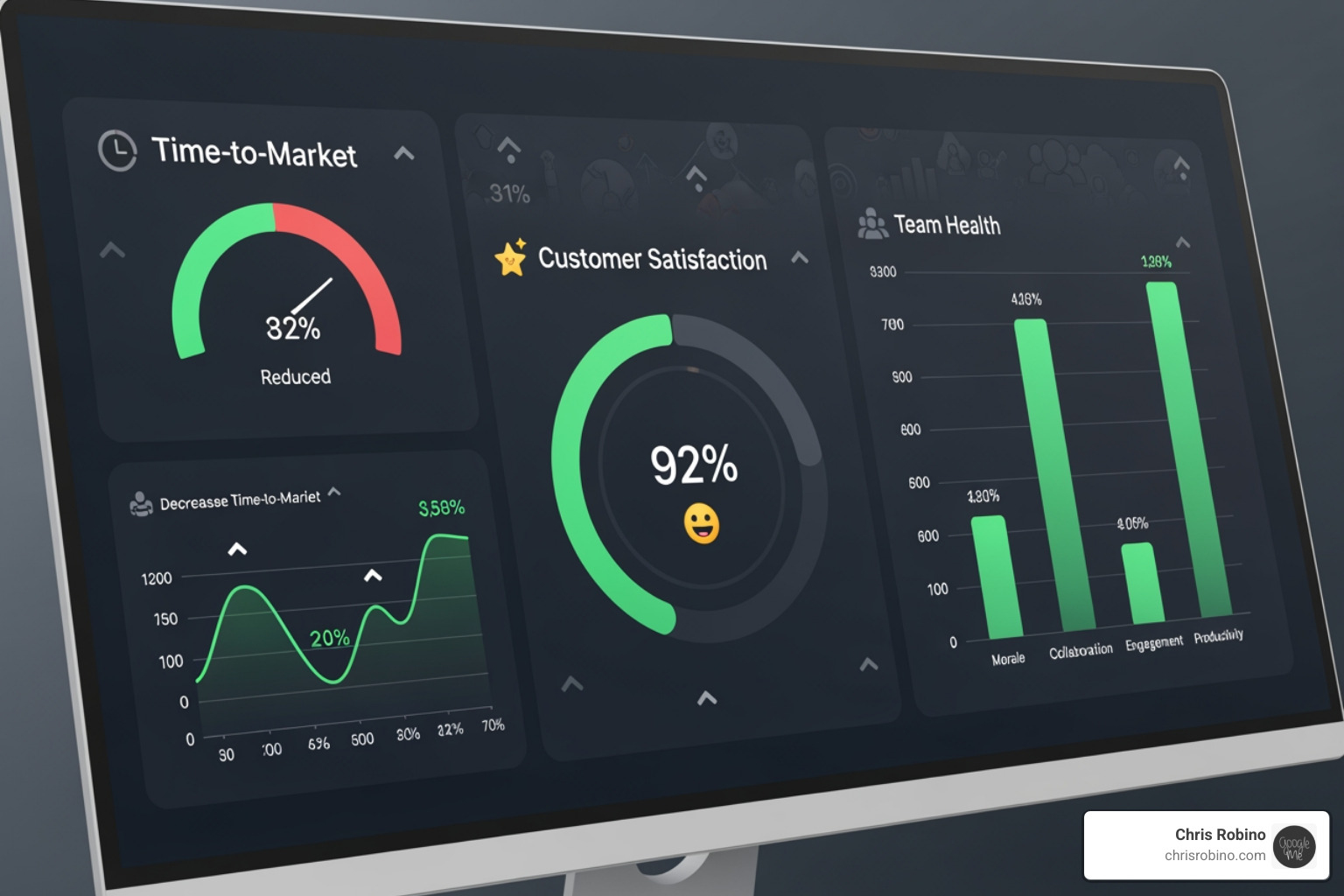
Business agility is about more than hitting numbers. It’s about building an organization designed for innovation, where an outcome-driven culture allows your teams to deliver high-impact solutions. We use tools like AI-Powered Analytics to dig deeper into performance data, spotting patterns and opportunities that might otherwise stay hidden. The bottom line is turning uncertainty into your competitive advantage.
How to Select the Right Business Agility Consulting Partner
Finding the right business agility consulting partner is about finding someone who understands your business and can guide you through change. This decision will shape your entire journey.
Key Qualities of an Effective Business Agility Consultant
The best consultants have been in the trenches and know what actually works. Look for a partner who demonstrates:
- Experience Beyond Theory: They should act as a strategic partner, developing custom solutions for your environment rather than force-fitting a pre-packaged framework.
- A Holistic Approach: They must recognize that business agility is a company-wide evolution that touches strategy, structure, and culture.
- Leadership Coaching Capabilities: Great consultants don’t just advise; they actively coach your leaders and teams, building internal capabilities that outlast the engagement.
- A Focus on Measurable Outcomes: They should define clear success metrics from day one and continuously track progress to demonstrate tangible benefits.
When evaluating partners, ask how they tailor their approach, measure success, and handle resistance to change. Our experience as both a Business Consulting Firm and a Tech Consultant gives us a comprehensive perspective on these challenges.

The Role of Leadership in a Successful Business Agility Consulting Engagement
Business agility initiatives don’t fail because of bad frameworks; they fail because of leadership gaps. The success of any change hinges on leaders who are willing to operate differently.
Leaders must be active champions who communicate the “why” behind the change and inspire their teams through uncertainty. This requires a shift from command-and-control to servant leadership, where the focus is on supporting and empowering teams. Creating psychological safety is perhaps the most important leadership responsibility. When employees feel safe to experiment and learn from mistakes, innovation flourishes.
Empowering teams means genuinely decentralizing decision-making and trusting people closest to the work to make the right calls. The best consultants recognize that developing agile leadership is central to their role, providing the coaching and support to help leaders steer this change. We also offer guidance on Thought Leadership Content Best Practices to help leaders communicate their vision.
Tailoring Your Change and Realizing the Benefits
Context is everything. A change approach that works for a tech startup will likely fail in a century-old manufacturing company. Your industry, culture, and strategic goals all shape what agility means for you. Real change requires a flexible, iterative approach that starts where you are.
When you tailor the change to your specific context, the benefits are remarkable. Organizations we’ve worked with have achieved an 80% cost reduction in projects by embracing agile ways of working. A global pharmaceutical company reached the market 4x faster. Some clients have seen their sales pipeline increase by 50% as they became more responsive to customer needs.
The impact extends beyond the bottom line. Employee satisfaction improves dramatically when people feel empowered. One leading bank saw a 60% improvement in its team health scores as its teams adopted agile practices.
My expertise in emerging tech and media helps me understand the unique pressures in fast-moving sectors. We can craft a bespoke agility roadmap that addresses your specific challenges. The question isn’t whether your organization needs to become more agile—it’s how you’ll get there.
Accelerate Digital Transformation with us today.