

Why Future Growth Strategies Are Essential for Long-Term Success
Future growth strategies are the structured plans businesses use to expand beyond their current size without running out of resources—focusing on sustainable profit and customer base growth using targeted methods like market penetration, product development, and strategic innovation.
Quick Answer: Core Elements of Future Growth Strategies
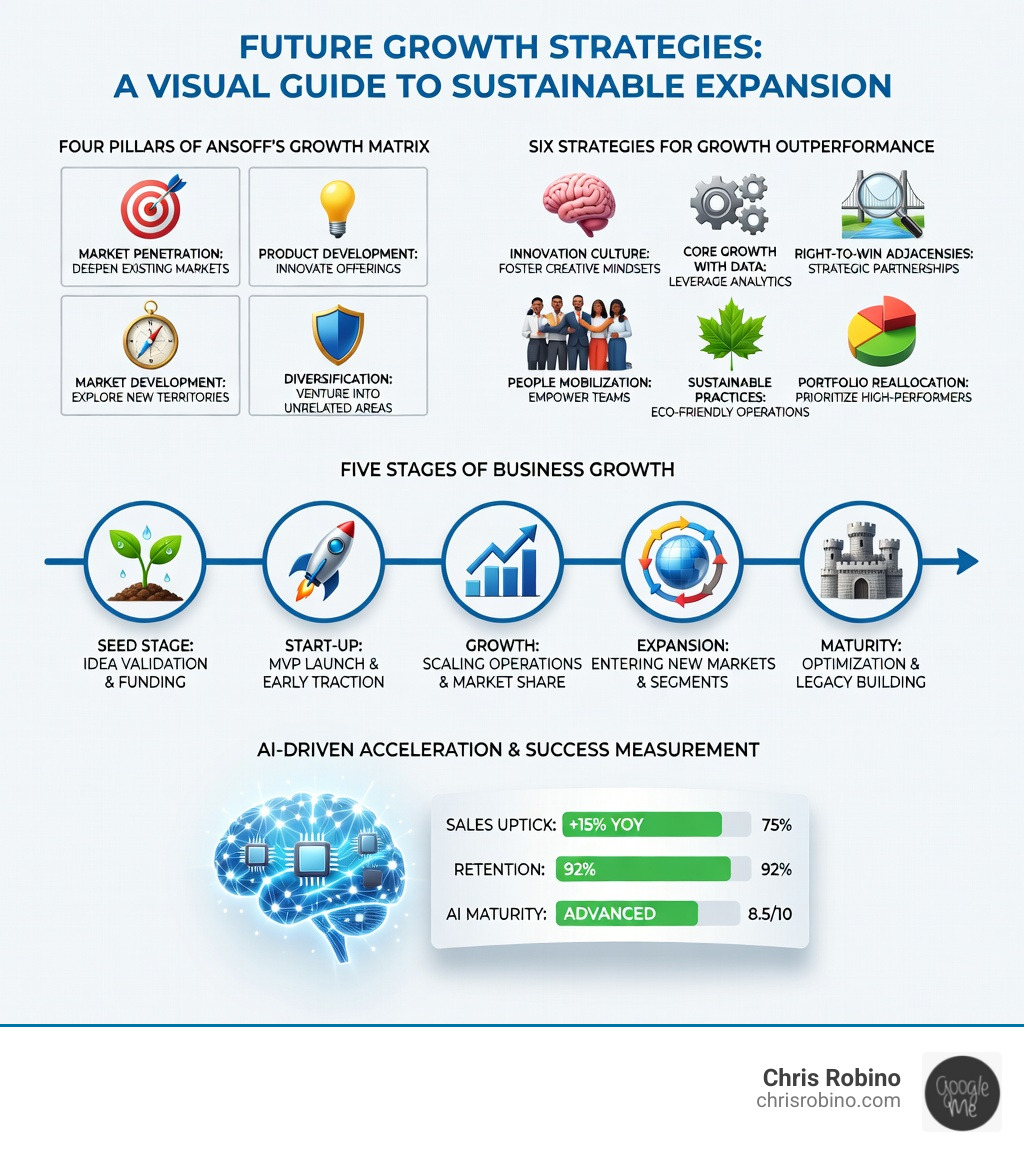
- Four Growth Pillars (Ansoff Matrix) – Market penetration, product development, market development, and diversification
- Five Business Stages – Seed, start-up, growth, expansion, and maturity phases
- AI-Driven Acceleration – Companies with high AI maturity grow 3 percentage points (4.7x) faster year-over-year
- Six Outperformance Strategies – Innovation culture, core growth with data, right-to-win adjacencies, sustainable practices, portfolio reallocation, and people mobilization
- Success Measurement – Real-time KPIs including sales growth, customer retention, and AI analytics
The reality? Only 25% of companies achieve sustainable growth over time. Those that do generate 7 percentage points more in annual total shareholder returns than their peers.
What separates growth outperformers from the rest isn’t luck—it’s courage. In an era marked by pandemic disruptions, inflation pressures, geopolitical uncertainty, and rapid AI advancement, the companies that thrive are those willing to make bold, informed bets on the future.
The stakes have never been higher. Middle-market and enterprise businesses face mounting pressure to act quickly, refine operations, and adapt to customer needs faster than larger, slower competitors. Meanwhile, 80% of sustainable growth comes from maximizing the value of your core business—not just chasing shiny new opportunities.
This is where strategic clarity becomes your competitive advantage.
As Chris Robino, a Digital Strategy Leader and AI & Search Expert with over two decades of experience, I’ve helped organizations from tech startups to established enterprises harness Future growth strategies that integrate AI automation, data-driven decision-making, and intelligent search solutions to maximize ROI. Throughout this guide, I’ll share research-backed frameworks and actionable insights to help you build a growth strategy that works for tomorrow’s markets.
Future growth strategies vocabulary:
Core Frameworks for Future Growth Strategies

To build a resilient business, we must first look at the foundational frameworks that have guided successful organizations for decades. In strategic management, a growth strategy isn’t just a wish list—it’s a roadmap for expanding market share and revenue without depleting your vital resources.
The gold standard for this is the Ansoff Growth Strategy Framework. This matrix breaks down growth into four distinct pillars based on whether you are dealing with new or existing products and markets.
| Strategy Pillar | Focus | Risk Level | Best For |
|---|---|---|---|
| Market Penetration | Selling more existing products to existing customers. | Low | Building loyalty and increasing usage. |
| Product Development | Creating new products for your current market. | Medium | Capitalizing on existing brand trust. |
| Market Development | Taking existing products into entirely new markets. | Medium | Geographic or demographic expansion. |
| Diversification | New products for new markets. | High | Long-term breakout moves and risk spreading. |
Choosing the right pillar requires a deep dive into your current data. Most companies find that 80% of their growth comes from maximizing the value of their core business (market penetration and product development). However, the truly “courageous” growers—those who outperform their peers—are twice as likely to succeed if they grow in multiple directions simultaneously over a decade.
To dive deeper into how innovation fuels these pillars, explore our Business Innovation Strategy Complete Guide.
Navigating the Five Stages of Small Business Growth
Every business follows a predictable lifecycle. Understanding where you sit today is crucial for choosing the right Future growth strategies.
- Seed and Development: This is the “lab” phase. We focus on market research to validate demand before a single dollar is spent on mass production.
- Start-up: The doors are open. The primary challenge is cash flow. Success here depends on adaptability—the ability to pivot based on early customer feedback.
- Growth: The business is generating steady income. Now, we focus on breaking even through efficiencies, strategic hires, and technology investments.
- Expansion: This is the profitable phase. We look at entering new markets or developing new products, ensuring these moves align with our current resource pool.
- Maturity: After years of success, the business has stable margins. Leaders at this stage must decide: do we sell the business, or do we reinvent the wheel to spark a new growth cycle?
Organic vs. Inorganic Future Growth Strategies
Growth doesn’t always have to come from within. We distinguish between organic growth (internal innovation, better marketing, and customer service) and inorganic growth (mergers, acquisitions, and partnerships).
Research shows that sustainable growth outperformers generate significantly higher returns. These companies don’t just “buy” growth; they use acquisitions to gain “institutional superpowers”—functional capabilities in digital, analytics, or marketing that they couldn’t build fast enough on their own.
- Organic Growth: Best for maintaining culture and steady, sustainable scaling.
- Inorganic Growth: Best for instant market share or acquiring critical technology.
- Sustainable Growth: Focuses on long-term health, often integrating ESG (Environmental, Social, and Governance) factors which can boost total shareholder returns by 7 percentage points.
Leveraging AI and Automation for Future Growth Strategies
If there is one “X-factor” in modern growth, it’s AI. Since 2022, companies with the greatest AI maturity have grown 4.7x faster than those with the least maturity.
AI is no longer just about “doing things faster”; it’s about doing things smarter. We use AI for:
- Predictive Insights: Anticipating market shifts before they happen.
- Resource Optimization: Dynamically allocating capital and talent to the projects with the highest potential ROI.
- Smart Automation: Using AI agents to handle 24/7 post-sale support or lead scoring, allowing your human team to focus on high-value strategy.
For a structured approach to integrating these tools, see our AI strategy consulting ultimate guide.
Implementing High-Performance Growth for 2025 and 2026
As we move toward 2026, the strategy shifts from short-term survival to long-term resilience. Middle-market companies have a unique advantage: agility. Unlike massive conglomerates, smaller firms can refine hiring and adapt to customer needs in real-time.
A forward-looking growth strategy requires two things: better cost management and cash flow optimization. This doesn’t mean just cutting expenses; it means eliminating waste (like unused software) while protecting essential investments in marketing and enhancing client experiences through digital platforms.
Six Strategies for Courageous Outperformance
Industry research into 4,000 companies identified six “courageous” strategies that drive continuous outperformance:
- Innovation Culture: Talking about innovation twice as much as peers and rewarding risk-taking.
- Grow the Core: Using data and AI to maximize your primary revenue stream.
- Right-to-Win Adjacencies: Moving into related businesses where you have a clear advantage. Companies using two or more “right-to-win” rationales delivered 12 percentage points higher excess shareholder returns.
- Sustainability Accelerant: Integrating ESG into the core business to drive profit.
- Shrink to Grow: Being willing to divest (sell off) underperforming parts of the business to reinvest in high-growth areas.
- Mobilize People: Activating the full organization. Changes with high employee ownership are 8 times more likely to succeed.
Emerging Trends in Digital PR and Content Marketing
Growth in 2025 will be driven by how we communicate. Content remains a pivotal channel, with 87% of marketers using email to distribute content. Email marketing isn’t dead—it’s evolving. By 2025, over 376.4 billion emails will be sent daily, offering an ROI as high as 42:1.
Key trends to watch:
- AI-Driven PR: Using tools like ChatGPT and Midjourney to create personalized media pitches and original research reports.
- Video Content: 61% of marketers plan to increase video spending. High-authority backlinks are now being earned through interactive video and live-streamed events.
- Personalized Outreach: Journalists are fatigued. Offering original research (which 63% of journalists want) is the best way to stand out.
Measuring Success with Real-Time Analytics and KPIs
You cannot manage what you do not measure. We recommend moving away from static quarterly reports and toward real-time AI analytics.
Key Performance Indicators (KPIs) to track:
- Sales Growth: Are your Future growth strategies actually moving the needle?
- Customer Retention: It is 5-25x more expensive to acquire a new customer than to keep an existing one.
- Dynamic Resource Allocation: Are you moving talent and capital to your “winning” projects fast enough?
For businesses looking to scale these efforts, our Business Growth Consultant Ultimate Guide provides a deeper look at the metrics that matter.
SEO Strategies for Large Companies: Driving Sustainable Growth
Introduction to Enterprise SEO
For large companies, SEO isn’t just about keywords; it’s about brand authority and search visibility at scale. Enterprise SEO involves managing thousands (or millions) of pages while maintaining a cohesive strategy across multiple departments.
Core Pillars of Enterprise SEO Success
Success at this level requires a focus on technical scalability. We focus on:
- Technical SEO: Ensuring site architecture can be crawled efficiently.
- Content Scalability: Using AI and structured data to create high-quality content across vast product lines.
- Link Acquisition: Moving beyond guest posts to digital PR and original research that earns “natural” high-authority links.
Leveraging Data and AI for SEO Performance
Large companies have a massive advantage: Data. By using predictive analytics, we can identify emerging search trends before they become competitive. AI-driven keyword research allows us to personalize content for different user segments, ensuring the right message reaches the right person at every stage of the funnel.
Building Authority and Trust at Scale
In the era of AI-generated spam, trust is the ultimate currency. Large companies must leverage their internal experts to produce thought leadership. Original research and white papers not only drive backlinks but also establish the brand as the “source of truth” in the industry.
Measuring and Optimizing SEO ROI
We don’t just look at rankings. For enterprise growth, we track conversion rates and cross-channel attribution. How does a search on Google impact a purchase made via an email campaign? Understanding this “omnichannel” journey is essential for optimizing your marketing spend.
Integrating SEO with Omnichannel Growth Strategies
SEO should never live in a silo. We integrate search strategies with:
- Paid Media: Using SEO data to lower CPC in Google Ads.
- Social Amplification: Promoting high-performing SEO content on LinkedIn and TikTok to spark engagement.
- Content Marketing: Ensuring every blog post and video is optimized for both users and search engines.
Future-Proofing SEO for 2025 and Beyond
The search landscape is changing. With the rise of AI Search (like Search Generative Experience) and voice search, “zero-click” results are becoming more common. To stay ahead, we focus on adaptability. We optimize for “answer engines” and ensure our technical foundation is ready for whatever algorithm update comes next.
Ready to scale? Connect with Chris Robino for custom enterprise SEO and Future growth strategies custom to your organization’s unique needs.