

Why Most Companies Are Losing the Innovation Race Right Now
Partnering with an innovation strategy consulting firm is one of the fastest ways to stop gambling with your R&D budget and start building growth you can actually predict.
Here’s a quick breakdown of what these firms do and why they matter:
| What They Do | Why It Matters |
|---|---|
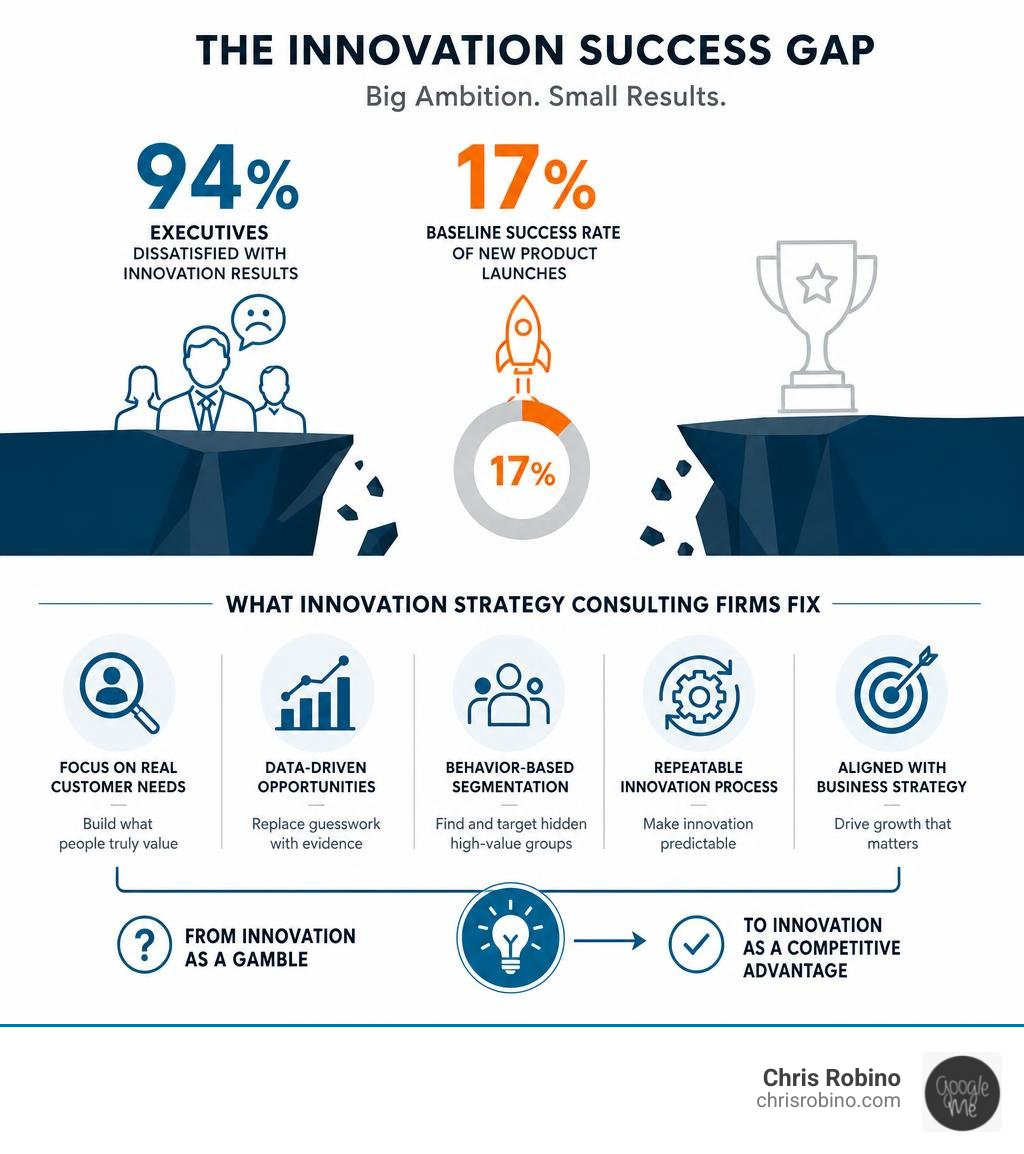
| Define markets around real customer needs | Stops teams from building products nobody wants |
| Identify unmet customer outcomes with data | Replaces guesswork with measurable opportunity |
| Segment markets by behavior, not demographics | Reveals hidden customer groups worth targeting |
| Build repeatable innovation processes | Reduces dependence on luck or creative genius |
| Align innovation with business strategy | Keeps R&D spend tied to actual growth goals |
The numbers here are hard to ignore. Only about 30% of companies believe they are good at innovation. Meanwhile, 84% of executives say innovation is a critical business priority — yet 94% are dissatisfied with their results. That gap is not a motivation problem. It is a process problem.
Most companies treat innovation like an art form. They brainstorm ideas, run workshops, build prototypes, and hope something sticks. But when only 17% of new product launches succeed at baseline, hope is not a strategy.
The companies pulling ahead are the ones treating innovation like a science — starting with quantified customer needs, not random ideas.
I’m Chris Robino, a digital strategy leader and AI and search expert who has spent over two decades helping organizations — from startups to large enterprises — sharpen how they compete and grow. My work at the intersection of technology, strategy, and digital transformation gives me a clear view of how an innovation strategy consulting firm can be the difference between incremental progress and market leadership.
Quick innovation strategy consulting firm definitions:
- Business innovation strategy
- Strategic growth consulting
- how firms use cooperative strategies to innovate
How an Innovation Strategy Consulting Firm Transforms Risk into Predictable Growth

When we look at why corporate growth initiatives stall, the root cause is almost always unmitigated risk. Traditional management consulting focuses on optimizing what already exists—cutting costs, refining supply chains, or restructuring departments. But when you need to create entirely new value, traditional frameworks fall short.
An innovation strategy consulting firm specializes in transforming this risk into predictable, repeatable growth. Instead of relying on gut feelings, these firms use structured, data-driven methodologies to find clear paths to product-market fit before you spend millions on development. This shift requires moving away from treating innovation as a creative lottery and embracing it as a disciplined business system.
We can see this difference clearly when we compare the two primary schools of thought:
| Innovation as an “Art” | Innovation as a “Science” |
|---|---|
| Starts with an idea or technology | Starts with a deeply understood customer job |
| Relies on brainstorming and “creative genius” | Relies on quantitative research and statistical validation |
| Uses rapid prototyping to see what sticks | Targets specific, quantified under-served outcomes |
| High failure rate (~83%) due to wrong starting points | High success rate (~86%) through predictable targeting |
| Focuses heavily on product features | Focuses on helping the customer get a job done |
By implementing rigorous business innovation strategies, companies can systematically identify where the market is underserved and design solutions that are mathematically positioned to succeed.
The Science of Success: Why Traditional Innovation Fails
The harsh reality of the corporate world is that most innovation initiatives fail. With baseline success rates hovering between 17% and 30%, billions of dollars in R&D are wasted every year on products and services that consumers simply ignore.
The primary driver of this waste is a flawed starting point. Most teams begin their innovation strategy development by generating ideas. They hold workshops, fill whiteboards with sticky notes, and select the most popular concepts to prototype.
But rapid iteration cannot save an idea that targets the wrong customer need. If you do not know exactly which customer outcomes are underserved, you are running fast in the wrong direction. A leading advisory partner steps in to halt this cycle, shifting the focus from “what can we build?” to “what does the customer actually need to achieve?”
Core Methodologies of a Leading Innovation Strategy Consulting Firm
To make innovation predictable, the world’s most successful consultancies rely on Jobs-to-be-Done (JTBD) Theory and Outcome-Driven Innovation (ODI). This approach is built on a simple premise: customers do not buy products; they “hire” them to get a job done.
When implementing this methodology, the process unfolds through a series of structured steps:
- Define the Customer’s Job-to-be-Done: Identify the core task the customer is trying to accomplish, independent of any current technology.
- Uncover Desired Outcomes: Capture 100+ specific, metric-based statements describing what success looks like for the customer.
- Quantify Unmet Needs: Use quantitative surveys to have customers rate the importance and satisfaction of each outcome, using the Opportunity Algorithm to highlight the biggest gaps.
- Execute Outcome-Based Segmentation: Group customers based on their shared unmet needs, rather than basic demographics or buying habits.
This scientific approach is detailed extensively in our technology innovation consulting complete guide, showing how data replaces intuition to guide engineering and product design teams.
Choosing the Right Innovation Strategy Consulting Firm: Independent vs. Affiliated
When selecting an external partner, executives face a key choice: should they work with an independent boutique agency or a practice affiliated with a massive global firm?
Independent firms often provide unbiased recommendations because they do not have a financial incentive to sell you downstream technology implementation or enterprise software licenses. They focus purely on strategy, needs discovery, and opportunity mapping.
On the other hand, larger affiliated practices offer massive scale and end-to-end execution support. They can help you design a strategy and then immediately deploy developers, designers, and change management specialists to build it.
To navigate these choices successfully, many companies turn to innovative technical business consulting to evaluate potential partners without bias.
Key Components of a High-Impact Consulting Engagement

A successful engagement with an innovation strategy consulting firm is not a series of open-ended creative sessions. It is a highly structured, phase-gate project designed to deliver concrete, actionable business assets.
A typical high-impact engagement includes:
- Market Definition: Aligning stakeholders on who the target customer is and the exact job they are trying to get done.
- Needs Discovery: Conducting deep qualitative interviews to capture the complete set of customer desired outcomes.
- Quantitative Validation: Surveying a statistically representative sample of the market to score and rank those outcomes.
- Opportunity Mapping: Identifying highly underserved areas to target, as well as over-served areas where costs can be safely cut.
- Strategy Formulation: Defining the winning product, marketing, or business model strategy to capture the identified opportunities.
For a deeper look at how to structure these phases, explore our business innovation strategy complete guide.
Building Internal Capabilities vs. Relying on External Advisors
While external consultants are invaluable for kickstarting stalled programs or tackling highly complex new markets, no business should remain permanently dependent on them. The ultimate goal of any strategic engagement should be knowledge transfer.
Leading firms do not just hand over a slide deck; they build your internal capabilities. They train your product managers, marketers, and researchers to apply JTBD and ODI thinking independently. By establishing internal innovation centers of excellence, implementing standardized training, and using specialized platforms, you can turn disciplined innovation into a core corporate capability.
To learn more about setting up these structures, check out our insights on innovation advisory services.
Partnering for Long-Term Market Leadership
In an era of rapid technological disruption, standing still is the equivalent of moving backward. Navigating this landscape requires more than just a desire to grow; it requires a disciplined, scientific process to uncover where your customers are struggling and how your business can uniquely solve those problems.
At ChrisRobino.com, we centralize the strategic insights and hands-on expertise of Chris Robino to help organizations navigate complex digital transformations, leverage emerging technologies, and build predictable growth engines. Whether you are looking to hire a business consulting firm, collaborate with a dedicated business transformation consultant, or refer to our senior business transformation consultant guide 2026, we provide a single portal for streamlined communication and direct access to top-tier strategic expertise.
To help you choose the right partner, we have compiled a checklist of key selection criteria for executives:
- Proven Methodology: Do they rely on a repeatable, scientific framework (like Jobs-to-be-Done or Outcome-Driven Innovation) or just creative brainstorming?
- Demonstrated Track Record: Can they show verified case studies of products launched that achieved market leadership?
- Alignment on Capabilities: Do they focus on building your internal team’s skills, or are they trying to create a long-term dependency?
- Unbiased Perspective: Are they independent, or do they have a hidden incentive to push specific technology platforms or implementation services?
- Strategic Fit: Do they understand your industry’s unique regulatory, technical, and competitive landscape?
If you are ready to stop guessing and start building a predictable, high-performing innovation pipeline, explore our dedicated guide to partnering with a technology innovation consulting firm and take the first step toward long-term market leadership today.