

Scaling Success: SEO Strategies for Large Companies
For large companies, search engine optimization is not just another marketing channel; it’s a critical driver of growth, brand visibility, and market share. However, the SEO strategies for large companies—often called enterprise SEO—are fundamentally different from those used by smaller businesses. The sheer scale of a corporate website, with its thousands or even millions of pages, introduces a level of complexity that demands a more sophisticated, systematic, and integrated approach.
Enterprise SEO is a discipline focused on managing this complexity. It addresses the unique challenges that arise from large-scale operations, multiple product lines, international markets, and complex organizational structures. A minor technical error can impact millions of pages, while a successful strategic initiative can yield exponential returns in organic traffic and revenue. The stakes are simply higher.
Key Challenges in Enterprise SEO:
- Technical Complexity: Managing crawl budget, site speed, indexation, and schema across a massive and often aging technology stack.
- Content at Scale: Preventing keyword cannibalization, maintaining quality control, and creating a cohesive content strategy across different departments and business units.
- Organizational Silos: Aligning SEO priorities with IT, marketing, product, and legal teams who may have conflicting goals or timelines.
- Authority and Brand: Building and protecting brand authority while scaling link acquisition and managing a global brand reputation.
Overcoming these problems requires a shift from ad-hoc tactics to a holistic, programmatic strategy. It is about building a durable framework for organic growth that is woven into the fabric of the business. This is where a deep understanding of advanced SEO strategies for large companies becomes a powerful competitive advantage.
For further background on how search engines evaluate and rank pages at scale, it can be helpful to review resources like the overview of search engine optimization to align internal teams on core concepts.
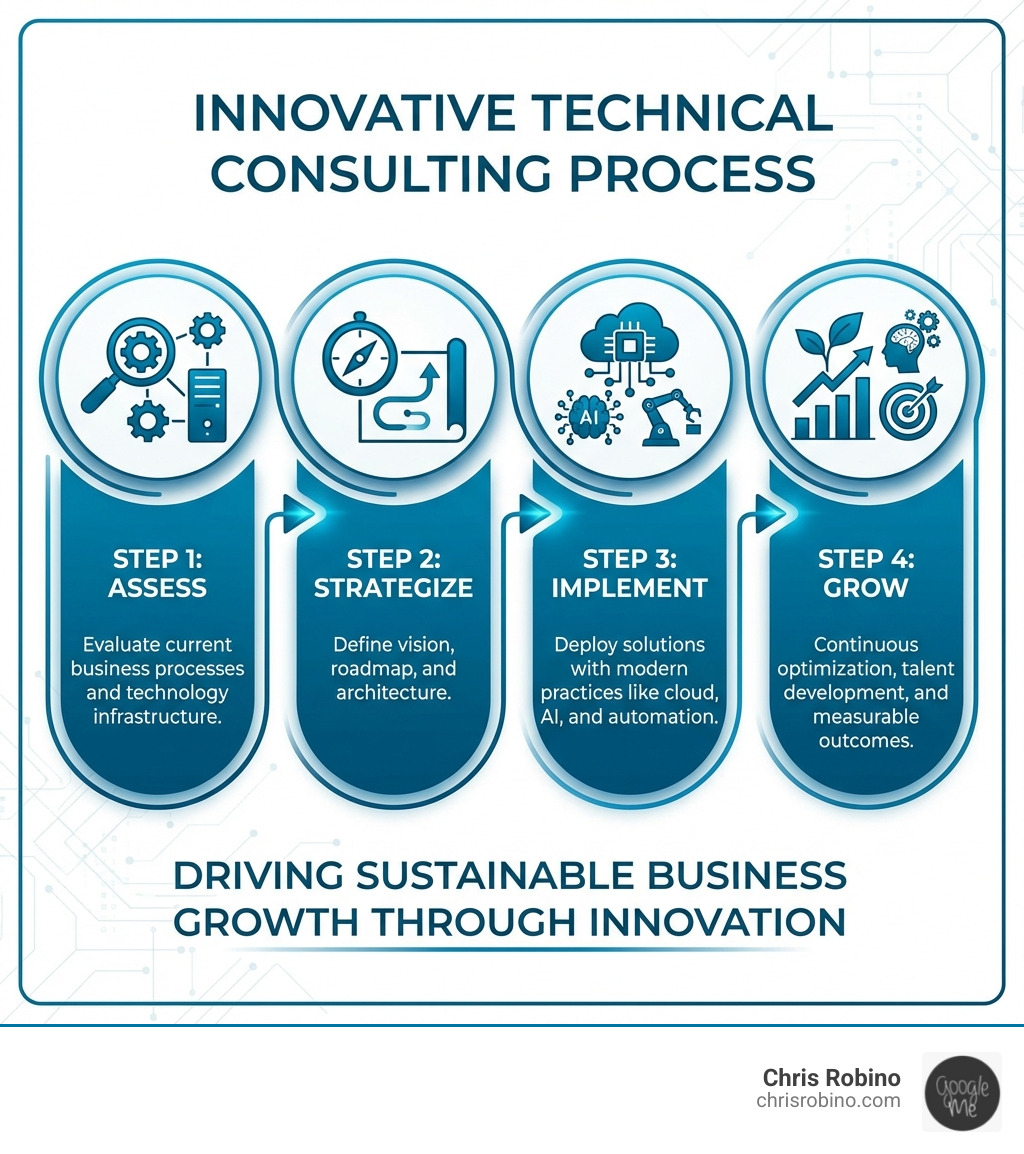
This guide provides a concise blueprint for developing and executing an SEO program that performs at an enterprise level. We will explore the core pillars of a successful strategy, from mastering technical SEO at scale to building a content engine that establishes topical authority and drives measurable business outcomes.
Handy SEO strategies for large companies terms:
- Programmatic SEO
- Technical SEO Audit
- Content Governance Strategy
A Blueprint for Dominance: The Pillars of Enterprise SEO
Effective SEO strategies for large companies are built on a foundation of scalable systems and repeatable processes. It is about moving beyond one-off campaigns and creating an operational rhythm that consistently improves organic performance across the entire digital portfolio.
Mastering Technical SEO at Scale
For an enterprise website, technical SEO is the bedrock upon which all other efforts are built. Without a technically sound foundation, even the best content will fail to reach its potential. The goal is to ensure search engines can crawl, render, and index millions of pages efficiently.
Key focus areas include:
- Crawl Budget Optimization: Large sites must be strategic about how they guide search engine crawlers. This involves using log file analysis to understand crawler behavior, optimizing robots.txt, managing URL parameters, and ensuring a clean XML sitemap structure to prioritize high-value pages.
- Site Architecture and Internal Linking: A logical site structure is crucial for distributing PageRank and helping users and search engines steer the site. This often involves creating content silos or topic clusters and implementing automated internal linking rules to connect relevant pages at scale.
- Automated Schema Markup: To win valuable rich snippets in search results, structured data (Schema) must be deployed consistently. For large companies, this means integrating schema into CMS templates so that it is automatically generated for product pages, articles, locations, and other page types.
- Core Web Vitals and Performance: Site speed is a critical ranking factor and user experience element. Enterprise-level performance optimization involves advanced techniques like leveraging a global CDN, implementing sophisticated image compression pipelines, and optimizing JavaScript rendering on complex platforms.
Developing a Strategic Content Architecture
Content for a large enterprise cannot be an afterthought. It requires a deliberate architecture designed to capture demand at every stage of the customer journey while avoiding common pitfalls like keyword cannibalization.
- Programmatic SEO: This is one of the most powerful SEO strategies for large companies. It involves using templates and databases to programmatically generate thousands of optimized landing pages. This is ideal for businesses with large inventories, multiple service locations, or extensive data sets (for example, real estate listings, travel destinations, or product comparisons).
- Content Governance: With multiple teams creating content, a strong governance model is essential. This includes establishing a central keyword map, a shared content calendar, quality guidelines, and clear processes for updating or pruning old content to prevent site bloat and internal competition.
- Building Topical Authority: Instead of targeting individual keywords, enterprise SEO focuses on owning entire topics. This is achieved by building comprehensive content hubs—a central pillar page covering a broad topic, supported by a cluster of articles that dig into specific sub-topics. This signals deep expertise to search engines and users alike.
Scaling Authority and Digital PR
Authority, primarily measured through high-quality backlinks, remains a cornerstone of SEO. For large brands, this moves beyond manual outreach and into the field of strategic communications and digital PR.

- Link-Worthy Asset Creation: The most effective way to earn authoritative links at scale is by creating assets that journalists, bloggers, and industry leaders want to cite. This includes proprietary data studies, free tools, in-depth industry reports, and compelling data visualizations.
- Digital PR Integration: SEO teams should work closely with PR and communications departments to ensure that press releases, media pitches, and company announcements are optimized to generate not just brand mentions, but valuable backlinks to relevant pages on the corporate site.
- Brand SERP Management: A key task is to control the narrative on the first page of search results for brand-name queries. This involves optimizing the knowledge panel, ensuring key social media profiles rank, and monitoring for any negative results that require a reputation management response.
By systematizing these pillars—technical excellence, content architecture, and authority building—large companies can create a powerful and sustainable engine for organic growth that aligns closely with broader digital change and innovative technical business consulting initiatives.
Integrating for Impact: Process, Measurement, and the Future of Enterprise SEO
Even the most sophisticated SEO strategies for large companies will falter without the right organizational structure, measurement framework, and forward-looking perspective. The final, crucial step is to embed SEO into the core operations of the business, changing it from an isolated marketing function into a shared capability that drives tangible value.
Building an SEO-Centric Culture
Lasting success in enterprise SEO depends on cross-functional collaboration and executive buy-in. SEO can no longer operate in a silo.
- Cross-Functional Integration: SEO must be a key stakeholder in decisions made by other departments. This means collaborating with IT on website development, with product teams on user experience, with content teams on editorial planning, and with legal teams on compliance. Breaking down these silos ensures that SEO considerations are baked into projects from the start, not bolted on at the end.
- Establishing a Center of Excellence (CoE): Many successful enterprises create a central SEO team that acts as a CoE. This group is responsible for setting standards, providing training and resources to other departments, managing core SEO technology, and governing the overall strategy to ensure consistency and alignment across the organization.
An SEO CoE often partners closely with innovation and technology leaders.
Measuring What Matters: From Rankings to Revenue
Enterprise SEO demands a move beyond vanity metrics like keyword rankings. The focus must be on tying SEO efforts directly to key business performance indicators.
- Advanced Business-Case Reporting: Success should be measured in terms of non-branded organic traffic growth, share of voice against key competitors, and, most importantly, organic-driven leads, sales, and revenue. This requires sophisticated tracking and attribution models.
- Custom Dashboards for Stakeholders: Data should be custom to the audience. The C-suite needs to see high-level ROI and market share trends, while a product manager may need to see organic performance for their specific section of the site. Using data visualization tools to create custom, automated dashboards is key to providing actionable insights at every level.
Future-Proofing Your SEO Strategy
The search landscape is in a constant state of flux. Large companies must remain agile and anticipate changes to maintain their competitive edge.
- Adapting to AI in Search: The rise of AI-driven search experiences requires a strategic shift. Content must be structured to provide direct answers, and building a strong, trusted brand becomes more important than ever as a key differentiator.
- Focus on Agility: The organizations that will win in the future are those that can test, learn, and adapt quickly. This means fostering a culture of experimentation and building processes that allow for rapid implementation of SEO changes.
Implementing robust SEO strategies for large companies is an investment in a sustainable competitive advantage. It builds a powerful asset that generates returns long into the future by creating a direct line to customers and establishing the brand as a definitive authority in its space.
To connect these SEO efforts with a broader change agenda, large organizations can align their roadmap with innovative technical business consulting.
Ready to build a dominant organic presence and open up new growth opportunities with SEO that scales as fast as your business? Get started with Enterprise SEO Consulting and integrated innovation support today.