

Enterprise SEO Strategies That Perform Well for Large Companies
Large companies do not win organic search by publishing isolated blog posts or chasing short-term keyword spikes. Enterprise SEO works best when search strategy is treated as an operating system: a repeatable process that connects technical performance, content governance, analytics, product teams, legal review, and executive priorities.
For large organizations, the challenge is rarely a lack of content. It is usually fragmentation. Multiple business units, regional teams, legacy domains, outdated templates, duplicated pages, and disconnected analytics can quietly limit organic performance. The strongest SEO strategies for large companies focus on scale, consistency, and measurable business impact.
At a high level, enterprise SEO sits at the intersection of content strategy, technical architecture, digital operations, and revenue growth. It requires the same disciplined execution expected from broader transformation work. More info about business technology consulting provides context for how technical and business alignment supports large-scale digital initiatives.
| Enterprise SEO Focus | Why It Matters | High-Impact Actions |
|---|---|---|
| Technical SEO | Search engines must crawl, render, and index important pages efficiently | Improve site speed, resolve crawl waste, fix redirects, optimize internal linking, and maintain clean structured data |
| Content Governance | Large companies often publish across many teams and regions | Create editorial standards, keyword maps, approval workflows, refresh schedules, and duplicate-content controls |
| Authority Building | Established brands can outperform when expertise is organized clearly | Build topic clusters, expert-led resources, digital PR assets, and useful research pages |
| Measurement & ROI | Enterprise teams need proof tied to business outcomes | Track qualified traffic, conversions, pipeline influence, assisted revenue, and page-level performance |
Build SEO Around Business Units, Not Just Keywords
For large companies, SEO strategy should begin with business priorities. Instead of asking, “What keywords can we rank for?” leadership should ask, “Which products, services, markets, and customer questions deserve stronger organic visibility?”
This shift prevents SEO from becoming a disconnected content exercise. A strong enterprise SEO program maps keywords to revenue priorities, customer journeys, and operational ownership. For example, a global services company may need separate keyword strategies for enterprise buyers, regional markets, industry verticals, partner ecosystems, and support documentation.
The best-performing programs usually include:
- Executive Search Themes: Broad topics tied to core services, market positioning, and thought leadership.
- Product and Service Hubs: Structured pages that explain offerings clearly and link to supporting use cases, case studies, FAQs, and implementation resources.
- Industry-Specific Content: Pages tailored to the language, pain points, and compliance concerns of each sector.
- Lifecycle Content: Educational resources for awareness, comparison, purchase justification, onboarding, and retention.
This structure helps large companies avoid content sprawl. Every page should have a defined audience, search purpose, owner, conversion path, and refresh cadence.
Prioritize Technical SEO at Enterprise Scale
Technical SEO becomes more complex as websites grow. A small site may have dozens of pages; a large company may manage hundreds of thousands across different regions, product lines, documentation centers, investor sections, and acquired domains.
The most reliable enterprise SEO gains often come from fixing technical constraints that prevent valuable pages from performing. These include slow templates, broken internal links, excessive redirects, duplicate parameter URLs, inconsistent canonical tags, thin indexable pages, and poor mobile performance.
Technology and SEO teams should collaborate on:
- Crawl Budget Management: Ensure important pages are easy to discover while low-value pages are blocked, consolidated, or noindexed where appropriate.
- Site Architecture: Use clear hierarchy, logical navigation, breadcrumb trails, and contextual internal links so authority flows to priority pages.
- Page Experience: Improve loading speed, responsiveness, accessibility, and layout stability across core templates.
- Structured Data: Apply accurate schema to products, articles, FAQs, events, reviews, and organization details where relevant.
- Migration Controls: Use strict SEO checklists for redesigns, CMS changes, domain consolidations, and international site launches.
Because these improvements often require engineering resources, SEO should be included in technical planning rather than added after launch. Organizations evaluating modernization or platform improvements can learn more info about IT consultancy services to understand how technical advisory support can reduce implementation risk.
Use Content Governance to Prevent Organic Decline
Enterprise SEO content must be governed like a strategic asset. Without governance, large companies often create overlapping pages that compete against one another, use inconsistent terminology, or become outdated after product changes.
A practical governance model includes:
- Keyword Ownership: Assign primary keywords and topics to specific pages to reduce internal competition.
- Editorial Standards: Define tone, formatting, expertise requirements, metadata rules, linking practices, and source quality.
- Content Refresh Cycles: Review high-value pages quarterly or semiannually to update data, improve clarity, and remove obsolete claims.
- Approval Workflows: Coordinate brand, legal, compliance, product, and SEO review without slowing execution unnecessarily.
- Content Pruning: Consolidate weak, duplicative, or outdated pages into stronger resources.
For regulated sectors, SEO governance must also account for compliance, privacy, accessibility, and security standards. Broader frameworks such as ISO 27001 illustrate why mature digital programs need documented controls, ownership, and ongoing review.
Strengthen Authority with Expertise, Not Volume
Large companies often have an advantage: internal experts. Product leaders, engineers, analysts, executives, customer success teams, and field specialists all understand customer problems deeply. Enterprise SEO should turn that expertise into useful, searchable assets.
Instead of publishing generic articles, large companies should produce expert-led resources such as original research, implementation guides, industry benchmarks, technical explainers, comparison frameworks, executive briefs, and customer education hubs.
This approach supports both search visibility and brand trust. It also improves conversion quality because visitors find content that answers real business questions rather than shallow keyword summaries.
How Large Companies Should Execute and Measure Enterprise SEO

Execution is where enterprise SEO usually succeeds or fails. Large organizations need more than recommendations; they need a repeatable operating model that turns SEO insights into shipped improvements. The most effective programs combine centralized standards with distributed ownership across marketing, engineering, analytics, product, regional teams, and sales enablement.
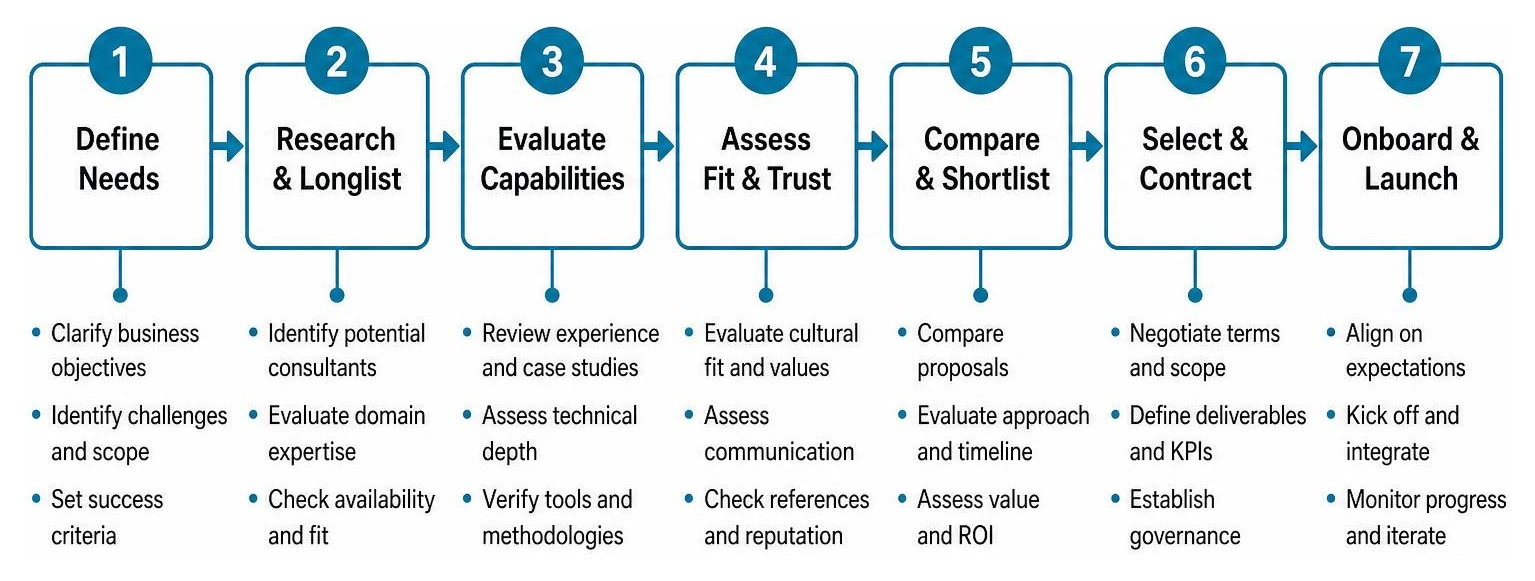
To support enterprise-wide change, SEO leaders should connect search initiatives to digital innovation, customer experience, and operational efficiency. Read more info about digital innovation consultancy to understand how structured innovation programs help organizations execute at scale.
Create a Central SEO Center of Excellence
A center of excellence gives large companies a clear way to scale SEO without creating bottlenecks. The central team should define standards, maintain tools and reporting, identify opportunities, train stakeholders, and review major releases. Business units and regional teams should then apply those standards to their own markets and content calendars.
A strong enterprise SEO operating model usually includes:
- Central Strategy: Owns keyword research frameworks, technical standards, dashboards, governance, and executive reporting.
- Business Unit Owners: Prioritize pages, campaigns, and content based on revenue goals and customer demand.
- Engineering Partners: Implement template improvements, schema, speed fixes, redirects, and crawl controls.
- Analytics Teams: Validate attribution, conversion quality, and reporting consistency.
- Legal and Compliance Reviewers: Ensure regulated claims, privacy requirements, and accessibility obligations are addressed.
This structure keeps SEO embedded in the business instead of isolated inside marketing.
Align SEO with AI Search and Modern Discovery Behavior
Search behavior is changing as users rely on summaries, recommendations, assistants, and conversational discovery experiences. Large companies should respond by making content clearer, more structured, and more authoritative.
Practical strategies include:
- Answer customer questions directly near the top of key pages.
- Use clear headings, definitions, summaries, and comparison tables.
- Maintain accurate author, organization, product, and service information.
- Publish original insights, not recycled generalities.
- Keep structured data accurate and aligned with visible page content.
- Build pages around complete topics rather than isolated keyword variations.
AI-related discovery still depends heavily on trustworthy, well-organized source material. Companies exploring automation, intelligent systems, or workflow modernization can review more info about technical consulting careers for additional context on the technical skills shaping modern digital execution.
Use Enterprise SEO KPIs That Reflect Business Value
Traffic alone is not enough. Large companies should measure SEO with metrics that connect visibility to meaningful outcomes. A page that attracts many visitors but produces no qualified engagement may be less valuable than a specialized page that drives enterprise leads, demo requests, partner inquiries, or support deflection.
Useful enterprise SEO KPIs include:
- Qualified Organic Sessions: Visits from target geographies, industries, personas, or account segments.
- Non-Branded Visibility: Rankings and impressions for strategic topics beyond the company name.
- Conversion Contribution: Form fills, calls, demo requests, ecommerce revenue, subscriptions, or assisted pipeline.
- Content Efficiency: Performance improvements from refreshing existing pages versus creating new ones.
- Technical Health: Crawl errors, index coverage, site speed, redirect chains, broken links, and schema validity.
- Share of Search by Topic: Visibility across priority product, service, and industry categories.
Demand for technical and analytical talent remains strong across digital roles, as reflected in broader computer and information technology outlook data from the U.S. Bureau of Labor Statistics. Enterprise SEO teams should therefore plan for sustained investment in specialized skills, automation, and cross-functional collaboration.
Choose the Right Support Model
Large companies may execute SEO internally, through specialist advisors, or with a hybrid model. The right choice depends on complexity, speed, technical debt, and internal capacity.
- Internal Teams: Best for ongoing governance, brand knowledge, stakeholder relationships, and long-term accountability.
- Specialist Advisors: Useful for audits, migrations, international SEO, technical troubleshooting, analytics design, and executive strategy.
- Hybrid Execution: Often the strongest model, combining internal ownership with outside expertise for complex initiatives.
For organizations undergoing broader transformation, more info about senior business transformation consulting can help clarify how advisory support should align with operating-model change.
Avoid Common Enterprise SEO Mistakes
Large companies often underperform in organic search because of operational issues, not lack of brand authority. The most common mistakes include launching redesigned websites without redirect planning, allowing business units to publish duplicate pages, ignoring international hreflang requirements, measuring only rankings, delaying technical fixes, and treating SEO as a final approval step rather than an input to strategy.
To avoid these problems, enterprise teams should define SEO requirements before projects begin, assign ownership for every priority page, document migration plans, and review performance after major releases. They should also maintain a clear backlog that ranks SEO work by business impact and implementation effort.
Keep the Strategy Focused
The best SEO strategies for large companies are disciplined. They prioritize high-value topics, technically sound websites, expert content, clean governance, and measurement tied to revenue or operational efficiency. They do not rely on content volume alone.
When enterprise SEO is integrated with technology, analytics, and business planning, it becomes a durable growth channel rather than a campaign. Ready to strengthen your digital strategy? Explore the complete emerging technology consultant guide for frameworks and strategic insights that can support broader transformation planning.