

The AI Adoption Paradox: Why Most Companies Struggle Despite Heavy Investment
AI adoption strategies are structured plans for integrating artificial intelligence to deliver business value. Despite heavy investment, most companies struggle to move beyond small-scale experiments to meaningful, enterprise-wide implementation.
Quick Answer: The Five Core AI Adoption Strategies
- Strategic Alignment – Connect AI initiatives directly to business objectives with leadership buy-in.
- Data-First Foundation – Establish robust data governance, quality, and infrastructure.
- Human-Centered Implementation – Prioritize talent development and responsible AI practices.
- Pilot-to-Scale Framework – Start small with clear goals, learn, and then scale what works.
- Continuous Measurement – Track KPIs tied to efficiency and productivity gains.
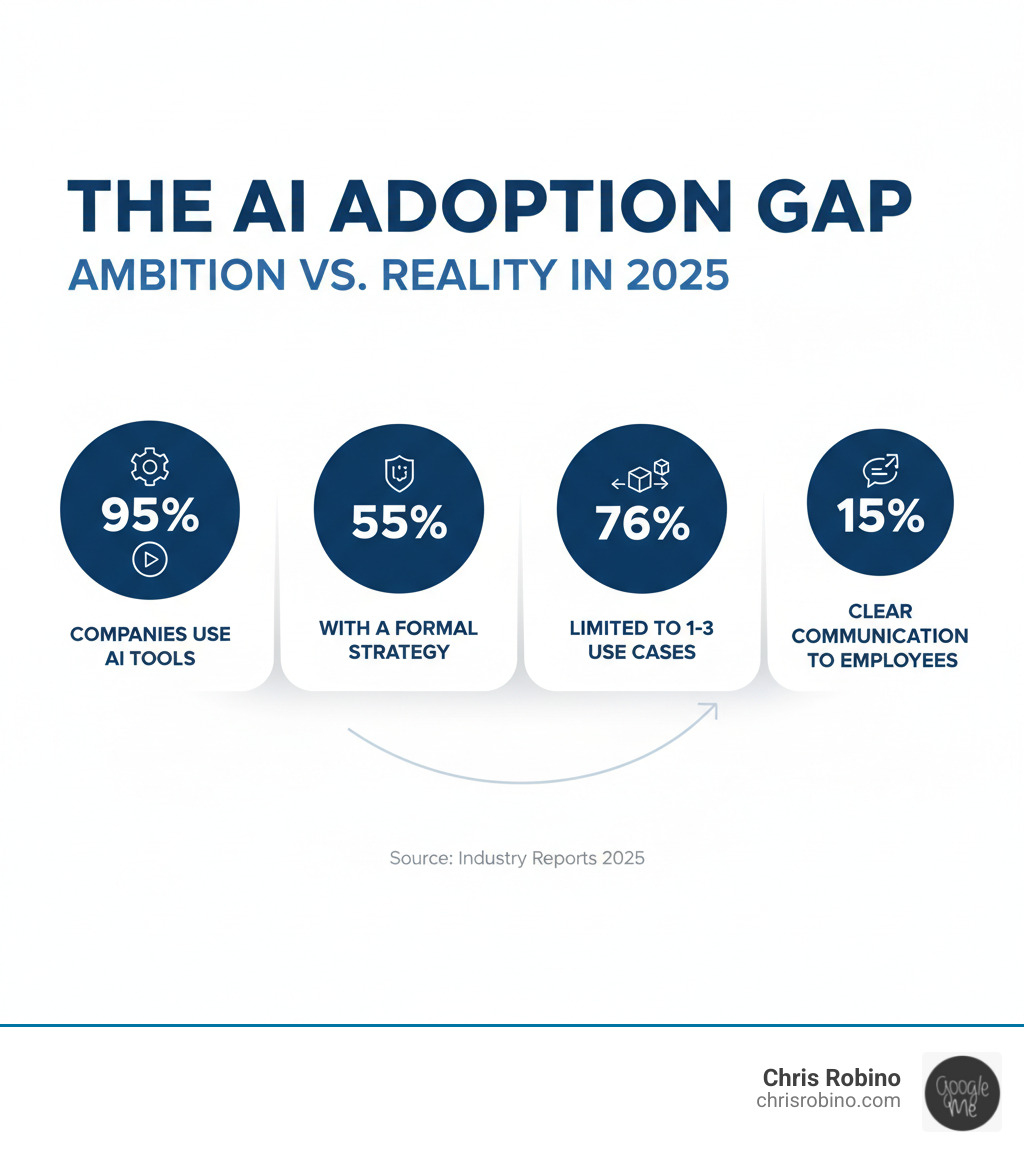
The gap between AI ambition and execution is staggering. While 95% of tech companies use AI, only 55% have a formal strategy. This disconnect is felt by employees, as just 15% of U.S. workers agree their organization has a clear AI plan. The result is a landscape of isolated pilots, with 76% of companies using AI in only one to three use cases. This happens because organizations treat AI as a technology problem, not a strategic and cultural one.
The cost of inaction is high, with experts warning that companies failing to invest may not be competitive in 18 months. However, rushing in without a plan wastes resources and erodes trust. This guide provides a blueprint for building an AI strategy that delivers measurable results.
I’m Chris Robino, a Digital Strategy Leader and AI & Search Expert. I help organizations steer complex technology changes and develop AI adoption strategies that align with business goals, deliver ROI, and build long-term capabilities.
A Blueprint for Effective AI Adoption Strategies
Think of successful AI adoption like launching a multi-stage rocket. Each phase builds on the previous one, and skipping steps leads to failure. The difference between companies that make AI work and those that don’t comes down to having a clear, strategic framework that addresses both the technology and the people involved.
AI adoption strategies work best when they follow a phased approach that treats AI as a business change, not just a technology project. This means thinking about organizational change, culture, and measurable outcomes from day one.

Step 1: Charting Your Course with Strategic Alignment
Successful AI adoption starts with business problems, not technology. Instead of finding a problem for a cool AI tool, identify real operational friction and then seek the right AI solution. Leadership buy-in is essential for securing resources and driving organizational support.
Focus on business outcomes first. Define clear, quantifiable goals. For example, instead of a vague goal to “use AI for customer service,” aim to “reduce customer wait times by 40% and improve first-contact resolution by 25%.” To find these opportunities, ask departments about their bottlenecks and repetitive tasks. Filter ideas through your specific business context and define the goal, objective, and success metrics for each potential use case.
One of the first key decisions is the buy versus build framework. To decide, consider these factors:
- Total Cost of Ownership (TCO): Account for ongoing maintenance, integration, and operational costs, not just the initial price.
- Time-to-Market: Can you afford a long custom build when a ready-made solution offers faster value?
- Competitive Differentiation: If the AI capability is core to your unique value proposition, building may be necessary. For generic functions, buying is often more practical.
- Internal Capabilities: Be realistic about your team’s ability to build and maintain a custom AI solution.
For deeper insights on making these strategic decisions, explore our guide on AI Implementation Strategies.
Ask yourself these questions when evaluating potential AI projects: Where are our current operational bottlenecks? What customer pain points could AI alleviate? Which repetitive, data-heavy tasks could be automated to free up our team for higher-value work? Can AI provide predictive insights that improve our decision-making? Does this use case align with our core business objectives?
Step 2: Building the Engine with Data and Technology
AI is only as smart as the data it learns from. A data-first strategy is non-negotiable, as algorithms trained on poor, biased, or incomplete data will produce flawed results. Your data foundation must address several key areas:
- Data Governance: Define clear ownership, stewardship roles, and data classification rules to ensure accountability and manage risk.
- Data Quality & Lifecycle: Implement ongoing processes for data cleansing and validation. Establish how data is collected, stored, processed, and retired.
- Responsible Data Practices: Track data lineage, actively check for bias in training sets, and evaluate fairness to mitigate business and reputational risks.
- Data Liquidity: Break down data silos to ensure information can flow seamlessly across the organization, enabling more powerful AI applications.
Once your data is in order, select the right technology stack. Most organizations use a mix of service models:
- Software as a Service (SaaS): Ready-to-use AI features embedded in existing software. Ideal for quick wins with minimal technical overhead.
- Platform as a Service (PaaS): Development platforms for building custom AI applications. Offers flexibility without full infrastructure management.
- Infrastructure as a Service (IaaS): Cloud-based computing resources for maximum control. Best for organizations with deep in-house expertise training large, custom models.
| Approach | Use Case | Control Level | Required Skills |
|---|---|---|---|
| SaaS | Initial productivity gains, embedded AI features | Low (pre-built) | User-level proficiency |
| PaaS | Custom AI application development, RAG applications | Medium (configurable) | AI developers, data scientists |
| IaaS | High-performance model training, maximum customization | High (full infrastructure) | Machine learning engineers, DevOps specialists |
For more insights on building the right infrastructure foundation, check out our resources on Cloud-Based Computing.
Step 3: Cultivating a Culture of Innovation and Responsibility
Technology doesn’t drive change—people do. If your team doesn’t trust, understand, or want to use AI, your investment is wasted.

Human-centered AI prioritizes augmenting human capabilities, not just automating tasks. Design solutions that solve real user pain points and make your teams more effective. Adopt a talent-centric approach by upskilling your existing workforce to build AI literacy and reduce anxiety. Foster a culture of knowledge sharing and attract diverse, cross-functional talent that understands both the technology and the business. Instead of traditional change management, accept change leadership that inspires people. Nurture grassroots innovation and celebrate small wins to build momentum organically.
Responsible AI development is a business imperative, not an afterthought. Integrate ethical frameworks from the start:
- Fairness and Bias: Actively test and mitigate bias, especially in sensitive areas like hiring and performance evaluation.
- Transparency and Explainability: Build systems where users can understand the “why” behind an AI’s decision or recommendation. This explainable AI (XAI) builds trust.
- Privacy and Security: Ensure your AI solutions comply with data privacy regulations and protect sensitive information.
- Accountability: Assign clear ownership for AI governance and maintain human oversight. Align your principles with established industry and government standards for AI risk management.
For a deeper exploration of building ethical AI systems, read our guide on Ethical AI Development.
Step 4: Executing and Scaling Your AI Adoption Strategies
The journey from a successful pilot to enterprise-wide impact is where most AI adoption strategies fail. Disciplined execution is the key to bridging this gap.
Start small, but think big. Begin with pilot projects that address specific, high-impact problems with measurable outcomes. Involve end-users from the start to ensure the solution is practical and useful. Design every pilot for learning, documenting both successes and failures to inform future efforts. Use an agile AI development approach, breaking large projects into smaller sprints for continuous testing and rapid adaptation.
Scaling successful pilots requires a deliberate plan. Secure leadership support to champion wins and allocate resources for broader adoption. Create repeatable processes by documenting workflows and best practices from your pilots. This prevents each new deployment from becoming a one-off project. Consider establishing a Center of Excellence (CoE) to centralize expertise, standardize governance, and coordinate efforts across the organization.
Finally, you can’t manage what you don’t measure. Measuring impact and ROI is critical for justifying continued investment. Define clear Key Performance Indicators (KPIs) from the start, focusing on:
- Operational Efficiencies: Time saved, error reduction, resource optimization.
- Employee Productivity: Improvements in task completion or output quality.
- Business Value: Direct links to revenue growth, cost reduction, or customer satisfaction.
Use AI-Powered Analytics to continuously monitor these metrics and create a feedback loop for refining your strategy based on real-world performance.
Conclusion: Turning Your AI Strategy into a Competitive Advantage
The gap between AI experimentation and business impact is bridgeable. Successful AI adoption strategies address the full picture: the technology, people, processes, and strategic vision. The goal isn’t to implement AI for its own sake, but to build a strategic capability that delivers measurable, sustainable value.
Organizations winning with AI treat it as a business change, not just a technology project. They align on priorities, build solid data foundations, empower their employees, and scale initiatives thoughtfully. This disciplined approach is what turns AI from a buzzword into a true competitive advantage.
The stakes are high, but so is the opportunity. As an expert who has spent over two decades helping organizations steer complex technology changes, I’m Chris Robino, and I focus on developing Business Innovation Strategies that translate technical possibilities into business realities.
Navigating AI adoption requires both strategic vision and practical execution. To translate these strategies into a plan customized for your organization’s needs, explore this Emerging Tech Consultant Complete Guide. The right guidance can make the difference between wasted investment and transformative impact.