

Why Business Change Is Mission-Critical Today
A business change consultant is a strategic advisor who helps executives turn ambitious goals into measurable outcomes. They bridge the gap between vision and execution by redesigning strategy, operating models, technology, and organizational capabilities to ensure change efforts deliver sustainable value.
Key activities include:
- Linking change to revenue, cost, and risk metrics with clear KPIs.
- Restructuring roles, processes, and decision rights.
- Advising on technology selection, integrations, and analytics.
- Establishing program rhythm and managing change readiness.
- Leading post-merger integration and synergy capture.
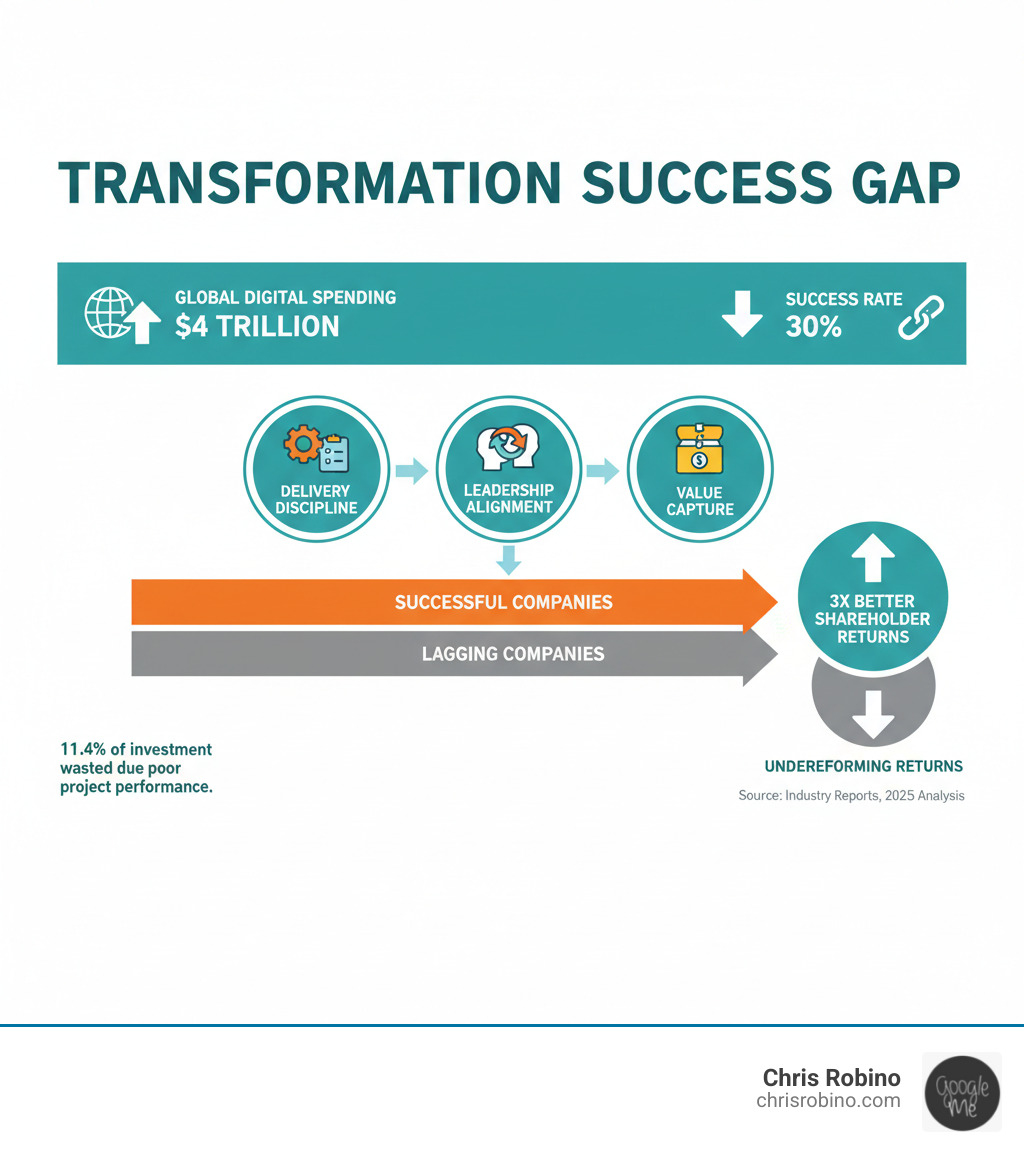
The stakes have never been higher. While global spending on digital programs is projected to approach $4 trillion by 2027, studies show that only 30% of changes fully succeed in delivering long-term results. Furthermore, 11.4% of total investment is wasted due to poor project performance. This gap between spending and success creates an urgent opportunity for organizations that approach change strategically.
Companies that execute change well don’t just survive—they thrive. Research shows they are three times more likely to outperform their sector peers in total shareholder return. The largest changes have been shown to deliver significantly higher TSR compared to relevant stock indices.
The current economic climate intensifies these challenges with disruptions from AI, shifting customer expectations, and competitive pressure. Doing nothing means risking irrelevance, but change without disciplined execution can make things worse.
As Chris Robino, I’ve spent over two decades as a Digital Strategy Leader and business change consultant, helping organizations steer digital change and implement AI-driven strategies. My experience has shown that combining strategic vision with hands-on execution is what separates successful changes from expensive failures.
The Modern Business Change Consultant: A Deep Dive
In today’s fast-moving business world, the business change consultant has become an essential partner for survival and growth. They help organizations turn ambitious ideas into tangible results that work.
What is their primary role?
A business change consultant partners with executives to bridge the gap between vision and reality. Their work spans strategy, operating models, technology, and people. Unlike specialists who focus on one area, they ensure all pieces work together. A key differentiator is their focus on value capture—staying engaged to ensure the expected benefits appear in your financials and competitive position. They also bring an objective, outside-in perspective, helping to identify blind spots, challenge outdated assumptions, and align teams around shared goals, leveraging deep expertise in Business and Technology Consulting.

Key Responsibilities and Activities of a business change consultant
The work of a business change consultant is varied, but core responsibilities include:
- Value Mapping & Target Setting: Defining success with clear KPIs and a review cadence to track financial, customer, and operational improvements.
- Operating Model Redesign: Redefining roles, decision rights, and workflows to create an organization structured to deliver on its new vision.
- Process Optimization: Identifying inefficiencies and reengineering processes to improve speed, quality, and profitability.
- Technology & Data Advisory: Guiding the selection and integration of technology platforms to enable strategy and data-driven decisions.
- Change Management & Adoption: Developing strategies to prepare the workforce, coach sponsors, and manage resistance, often connected to a broader Innovation Strategy Development.
- Stakeholder Communication: Crafting clear messages for different audiences to manage expectations and build confidence.
- Post-Merger Integration: Guiding the complex process of combining operations, cultures, and systems to maximize value.
How a business change consultant differs from other specialists
The key difference is scope and integration. While IT and Strategy Consultants dive deep into specific domains, a business change consultant takes a holistic, end-to-end view that connects all the pieces of a change.
An IT Consultant focuses on implementing technical solutions, as detailed in IT Consulting Services. A Strategy Consultant focuses on high-level recommendations—the “what” and “why.” A business change consultant spans the entire spectrum, integrating strategy, operations, technology, and people. They are responsible for the “how,” leading the value case, designing the target state, and ensuring the change is implemented and sustained.
| Feature | Business Change Consultant | IT Consultant | Strategy Consultant |
|---|---|---|---|
| Scope | Holistic, organization-wide; integrates strategy, operations, technology, people, and culture for systemic change. | Specialized in technology; focuses on hardware, software, network, and system implementation. | High-level strategic direction; market analysis, competitive positioning, M&A strategy. |
| Primary Focus | Driving sustainable, fundamental change across the entire business model and operating model. | Technical solutions, system integration, software development, cybersecurity, and infrastructure management. | Formulating strategic recommendations and frameworks for senior leadership. |
| Deliverables | Comprehensive change roadmaps, redesigned operating models, change management plans, value realization frameworks. | Implemented systems, technical specifications, IT infrastructure upgrades, software solutions. | Strategic plans, market entry strategies, competitive analyses, growth recommendations. |
| Typical Engagement | Long-term partnership, guiding through findy, design, implementation, and sustainment of change. Often involves coaching. | Project-based, focused on specific technical implementations or problem-solving. | Project-based, focused on delivering high-level recommendations; less involved in day-to-day execution. |
| Key Differentiator | Leads the value case, target design, and adoption plan across functions, ensuring integrated change. | Focuses on building and configuring technology within a set scope, often as part of a larger change. | Provides the “what” and “why” of strategy, but typically not the “how” of operational change and implementation. |
The Evolving Role in the Age of AI
AI adds new dimensions to the consultant’s role, requiring a blend of time-tested change principles and navigation of new challenges around trust and scale. Key focus areas now include:
- Digital Fluency: A deep understanding of AI to develop effective AI Implementation Strategies that align with business goals.
- Data-Driven Decisions: Using AI-Powered Analytics to move beyond gut instinct to decisions backed by robust data.
- Automation and Efficiency: Identifying processes to automate, freeing up human capital for higher-value work.
- Ethical AI and Risk Management: Guiding clients through questions of fairness, transparency, and accountability.
- Upskilling the Workforce: Developing strategies to prepare employees for new roles in an AI-enabled future.
- Fostering Experimentation: Creating safe environments for teams to test new technologies, learn from failures, and scale successes.
The strategic imperative is to adapt to AI. A business change consultant’s evolving role is to ensure companies not only adopt AI but thrive with it, turning it into a genuine competitive advantage.

Partnering for Success: How to Maximize Your ROI
Engaging a business change consultant is a significant investment. Maximizing that ROI means understanding when to bring in expertise, how to collaborate effectively, and what outcomes to expect.
Key Indicators You Need a Business Change Consultant
Recognizing the signs that you need help can be the difference between a minor adjustment and a full-blown crisis. Key indicators include:
- Stagnant Growth or Declining Profitability: Your company’s trajectory has flatlined or profits are shrinking despite market opportunities.
- Value Leakage in Customer Journeys: Customers are hitting roadblocks, leading to churn or lost revenue.
- Outdated Legacy Platforms: Old systems are holding back agility, slowing innovation, and creating a “delivery drag.”
- Poor Project Performance: A pattern of failed initiatives or wasted investment, which globally accounts for 11.4% of spending.
- Multiple Competing Programs: Initiatives lack clear objectives or measurable benefits, causing internal confusion.
- Low Employee Morale: A disengaged workforce is resisting new initiatives or is overwhelmed by constant, poorly managed change.
- Post-Merger Integration Challenges: Synergy targets are being missed, or cultural and operational integration is failing.
- Lack of a Trusted Performance View: Leaders cannot get reliable data to make informed decisions.
If these sound familiar, seeking Digital Strategy Advice can provide the clarity and momentum your organization needs.
Overcoming Change Challenges with Expert Guidance
Business change is rarely a straight line, and many initiatives fail to deliver long-term impact. Common problems include resistance to change, lack of leadership alignment, poor execution discipline, insufficient internal resources, and cultural barriers.
A business change consultant helps overcome these challenges by bringing structured methodologies and an objective perspective. We facilitate leadership alignment, use proven change management strategies to build buy-in, and establish rigorous execution frameworks to ensure accountability. By acting as an extension of your team, we provide the bandwidth and specialized skills to steer complexity and boost your odds of success.
The Engagement Process and Best Practices
Engaging a consultant is a partnership that follows a structured path to ensure clarity and measurable outcomes.
- Initial Assessment & “Findy”: We dive deep into your current state to understand challenges and align on objectives.
- Strategy & Roadmap Creation: We co-create a detailed change strategy, including target operating models, technology architecture, and a step-by-step implementation roadmap with clear KPIs.
- Pilot Programs: We often start with low-risk, high-impact pilots to deliver early wins, build momentum, and refine the approach before a full-scale rollout.
- Implementation & Execution: We work hand-in-hand with your teams to execute the roadmap, redesign processes, and manage the human side of change.
- Performance Tracking & Value Realization: We continuously monitor KPIs to ensure the change is delivering the expected value and make adjustments as needed.
- Capability Building & Sustainment: We focus on upskilling your teams and embedding new processes to ensure changes are sustainable long after our engagement.
To maximize ROI, ensure clear communication, visible executive sponsorship, and active involvement from your internal teams. By focusing on measurable outcomes and staying agile, you can Accelerate Digital Transformation and achieve a lasting impact.
The Tangible Benefits of Engaging a Business Change Consultant
Partnering with a business change consultant offers benefits that can fundamentally reshape your organization for long-term success.
- Accelerated Value Creation: Quickly open up new revenue sources, drive cost efficiencies, and secure a stronger market position.
- Improved Competitive Advantage: Adapt quickly to market shifts, innovate faster, and outperform rivals.
- Improved Operational Efficiency: See significant jumps in productivity and reductions in operational costs through streamlined processes and modernized technology.
- Sustainable Growth: Build internal capabilities and embed new ways of working that contribute to robust, long-term growth.
- Risk Mitigation: Leverage deep expertise to identify pitfalls, develop contingency plans, and steer complex regulatory landscapes.
- Leadership and Workforce Empowerment: Equip leaders and employees with the skills and mindset needed for future success.
- Objective Perspective: Gain an unbiased viewpoint and access to proven methodologies from across various industries.
- Strategic Alignment: Ensure all change efforts are tightly aligned with your overall business strategy, preventing fragmented initiatives.
A consultant helps transform the daunting prospect of change into a powerful engine for innovation, resilience, and success.