

Understanding the High-Stakes World of Business Change Consulting
A senior business change consultant is a strategic advisor who helps organizations integrate strategy, process, and technology to increase effectiveness, reduce costs, and improve profitability. They drive sustainable organizational change by aligning high-level strategy with operational execution.
The stakes are high. While many business changes deliver short-term wins, an estimated 75% fail to deliver long-term, fundamental change. Yet, companies that succeed are three times more likely to outperform their sector’s average total shareholder return. Failed changes can lead to shrinking profit margins, lost market share, and diminished competitive advantage.
Senior business change consultants stand at the intersection of strategy and execution. They don’t just recommend changes—they lead teams through complex organizational shifts, manage resistance, and ensure new capabilities stick. The role demands both technical expertise in methodologies like Agile and Lean Six Sigma and soft skills like persuasion and conflict resolution.
I’m Chris Robino, and with two decades of experience leading digital change and AI implementation, I’ve seen what separates successful change leaders from the rest. It’s rarely about technical skills alone.
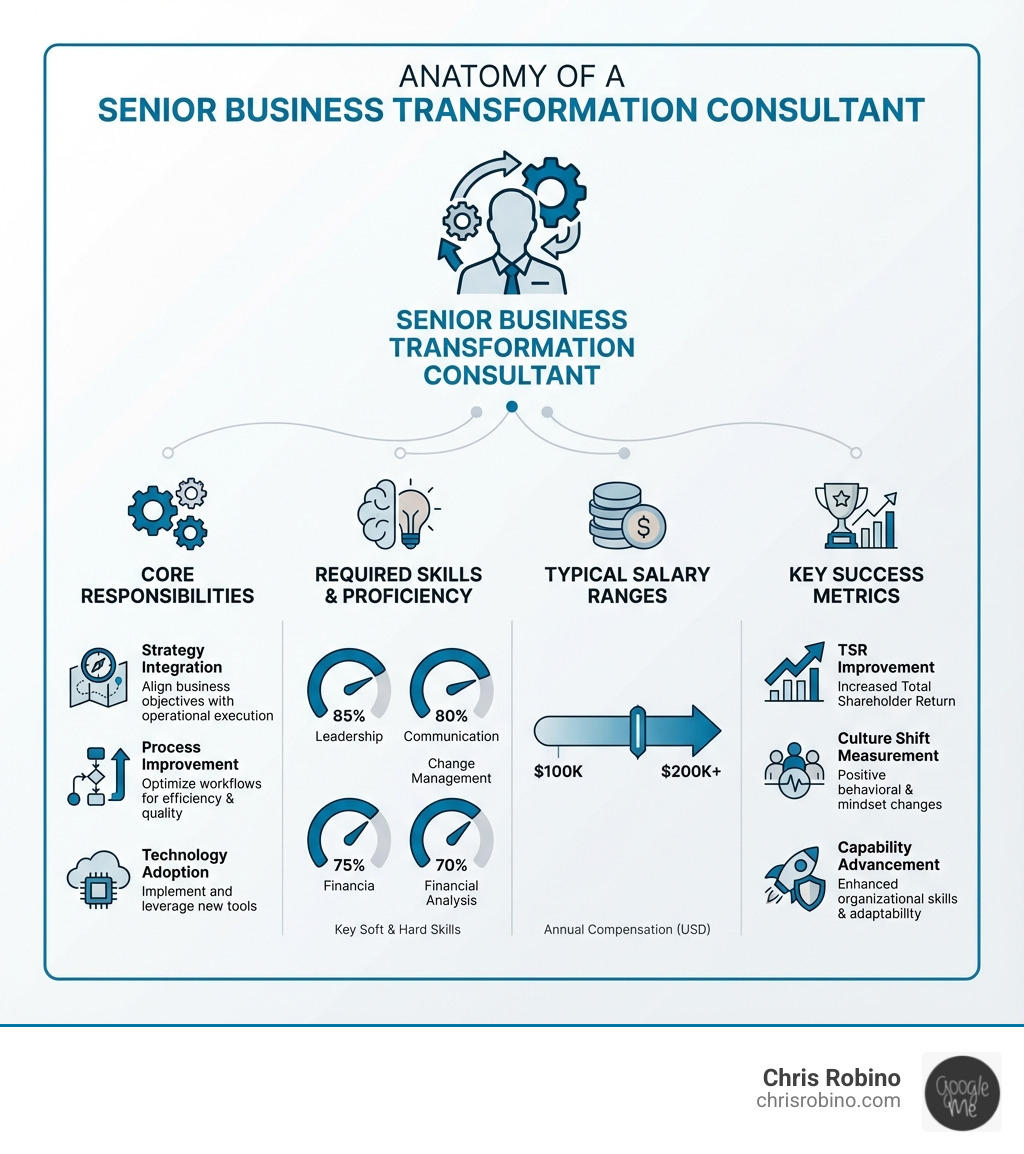
This guide breaks down what you need to know about becoming—or hiring—a senior business change consultant, from responsibilities and skills to measuring success.
Defining the Role: Strategist, Leader, and Change Agent
The senior business change consultant’s primary responsibility is to analyze business performance, identify growth opportunities, and orchestrate changes that drive revenue and achieve strategic goals. They are architects of change, designing new operational models, implementing new technologies, and fostering a culture of innovation.
How does this role differ from a Business Analyst? A senior consultant operates at a higher, strategic level, leading the overall change initiative. A Business Analyst focuses more on gathering detailed requirements and process mapping for specific projects.
| Feature | Senior Business Change Consultant | Business Analyst |
|---|---|---|
| Focus | Holistic organizational change, strategic alignment | Detailed requirements gathering, process mapping |
| Scope | Enterprise-wide, strategic initiatives | Project-specific, tactical implementation |
| Key Skills | Leadership, change management, strategic thinking | Requirements elicitation, data analysis, documentation |
| Contribution | Drives fundamental shifts in business models and culture | Ensures technical solutions meet business needs |
This role requires a deep understanding of both business and technology, a topic we explore further in our insights on Business and Technology Consulting.
Essential Skills and Qualifications for a Senior Business Change Consultant
Success in this role requires a blend of hard and soft skills.
Key Hard Skills:
- Financial Analysis: Developing business cases with ROI, risks, and upside.
- Project and Program Management: Leading complex work streams and delivering project outcomes.
- Lean Six Sigma: A methodology for process improvement and efficiency.
- Data Analysis: Interpreting market trends and operational data to formulate recommendations.
- Technology Acumen: Familiarity with enterprise systems, data migration, IT strategy, and modern development methodologies (Agile, Waterfall).
Top 5 Essential Soft Skills:
- Leadership: Motivating teams, building coalitions of stakeholders, and driving change.
- Communication: Clearly articulating the change vision and objectives to diverse audiences.
- Stakeholder Management: Engaging all parties affected by the change to gather input and manage resistance.
- Problem-Solving: Thinking critically to address business issues and identify impactful solutions.
- Adaptability: Adjusting to changing situations and dealing with uncertainty.
Continuous learning is vital, and we encourage exploring resources like our Professional Development Portal.
Methodologies, Frameworks, and the Tech Toolkit

Consultants use proven methodologies to structure change, including:
- Agile software development and Scrum): Iterative approaches for projects with evolving requirements.
- Waterfall model: A linear, phased approach for projects with a well-defined scope.
- Lean Six Sigma: A focus on improving process performance by removing waste and reducing variation.
- Change management models: Proven frameworks to address the human side of change.
Technology is a key enabler. We leverage AI-Powered Analytics for data-driven decision-making, helping clients visualize and solve complex issues. This tech-led approach involves integrating digital technologies across the business, from customer experience to operations.
Navigating organizational culture is perhaps the most challenging aspect. A successful change requires a sustained culture shift. We focus on leader enablement, people engagement, and comprehensive organizational change management (OCM) to build trust and ensure new behaviors stick. Our insights on AI Implementation Strategies explore how to integrate technology while managing the human element.
The Anatomy of the Senior Business Change Consultant Role
Overcoming Challenges and Navigating Organizational Politics

The path of a senior business change consultant is rarely smooth. Navigating challenges and organizational politics is a core part of the job.
Common Challenges:
- Resistance to Change: Employees may fear job loss, increased workload, or prefer the status quo. This is a primary reason why 75% of changes fail long-term.
- Bureaucracy and Silos: Rigid structures can slow down decision-making and hinder collaboration.
- Lack of Buy-in: Without strong leadership sponsorship, even the best strategy can falter.
- Conflicting Priorities: Competing objectives among departments can divert energy from the change initiative.
Strategies for Success:
- Build Coalitions: Engage influential stakeholders to champion the change.
- Communicate Effectively: Craft clear, consistent messages about the “why” and “what” of the change.
- Gain Trust: Be transparent, demonstrate expertise, and deliver on promises.
- Use Data-Driven Persuasion: Present compelling business cases that articulate the benefits of change and the risks of inaction.
The benefits of this role are immense: driving innovation, making a tangible impact, and continuous skill development in a dynamic environment. However, the drawbacks include high-stakes pressure and demanding hours. It’s a role for those who thrive under pressure and are passionate about making a difference.
The Career Path and Salary of a Senior Business Change Consultant
The career path for a senior business change consultant is typically structured, offering clear progression.
Typical Career Ladder:
- Analyst/Junior Consultant: Focuses on data gathering and supporting senior team members.
- Consultant: Leads smaller workstreams and conducts analysis.
- Senior Consultant: Leads projects, manages client relationships, and mentors junior colleagues.
- Principal/Manager: Manages multiple projects and develops new business.
- Director/Senior Manager: Oversees a portfolio of clients and contributes to firm strategy.
- Partner/Vice President: The highest level of leadership, responsible for driving the firm’s strategic direction.
Experienced consultants can also transition into executive roles like Chief Change Officer (CTO) or Chief of Staff. Opportunities are widespread across industries like technology, healthcare, financial services, and manufacturing.
Salary is a significant draw. While figures vary, compensation is highly competitive, with mid-senior level roles often exceeding $100,000+. Some data shows that senior consultants can earn base salaries well over $150,000, reflecting the high value placed on their strategic expertise. As businesses continue to evolve, understanding Future Business Technology Trends is crucial for career growth.
Measuring Success and Delivering Sustainable Value
The ultimate goal is to ensure changes lead to long-term success and sustainable value. This means moving beyond short-term wins to deliver lasting impact.
Key Outcomes of Successful Change:
- Sustainable Value Creation: Generating lasting financial benefits, such as increased revenue, reduced costs, and improved total shareholder return (TSR).
- Step Changes in Capabilities: Developing new organizational skills, like advanced analytics or agile ways of working.
- Sustained Culture Shift: Ingraining new mindsets, behaviors, and values into the company’s DNA.
How Success is Measured:
- Key Performance Indicators (KPIs): Tracking clear metrics related to operational efficiency, customer satisfaction, and employee engagement.
- Financial Metrics: Monitoring improvements in profit margins, return on investment (ROI), and cash flow against the initial business case.
- Change Adoption Measurement: Using surveys and feedback to gauge how well new processes are being adopted by employees.
- Strategic Outcomes: Evaluating whether the change has enabled the client to gain a competitive edge and adapt to future challenges.
Our contribution is rooted in integrating strategy, process, and technology. This holistic approach is key to developing robust Business Innovation Strategies that stand the test of time.
Conclusion: Is This Career Path Right for You?
The role of a senior business change consultant is for those who thrive in high-stakes environments and are driven to create profound, lasting change. These professionals act as strategists and leaders, integrating strategy, process, and technology to open up an organization’s full potential.
The career path offers significant growth and compensation but is demanding. It requires a unique blend of analytical rigor, from financial analysis to data-driven methodologies, and empathetic leadership to steer the human side of change. Success means overcoming resistance to deliver sustainable value, new capabilities, and a lasting culture shift.
If you are passionate about solving complex business problems and leading teams through challenging transitions, this career might be your calling.
As Chris Robino, I’ve dedicated my career to helping businesses steer the complexities of digital change. I understand the critical role that expert guides play in ensuring successful outcomes. Whether you aspire to become a consultant or need to partner with one, true change is a journey. We are here to help you Accelerate Digital Transformation.