

Why Digital Growth Solutions Matter Now More Than Ever
Digital growth solutions are integrated strategies and technologies that help businesses scale revenue, optimize operations, and improve customer experiences through data-driven digital tools. They combine analytics, automation, AI, and modern delivery methods to create sustainable competitive advantages.
Key components include:
- Data & AI Integration – Predictive analytics and automation that boost ROI by up to 40%.
- Full-Funnel Systems – Connected channels tied to north star metrics (AARRR framework).
- Digital Roadmaps – Strategic blueprints for change from vision to execution.
- Personalization at Scale – Targeted marketing that triples conversion rates.
- Agile Delivery – DevSecOps and product-centric approaches for faster time-to-market.
Research shows only 16% of companies have a clearly defined digital strategy-a critical factor in change success. Without precision in the initial strategy phase, even well-funded initiatives fail to realize their potential. The stakes are higher than ever as rising consumer expectations and digital disruption fundamentally change the growth game.
Digital measures don’t just cut costs; they rewire organizations through a fundamental reboot of how work gets done. Processes become automated, data delivers insights, and teams operate with new capabilities. The result is lasting performance improvement that persists long after the initial change phase ends.
Consider the impact: Companies digitizing B2B sales generate gains of 10% to 20% in revenue while improving marketing efficiency by 15% to 30%. Digital personalization can deliver conversion rate boosts of 20% to 40%. These are sustainable advantages built into how the business operates.
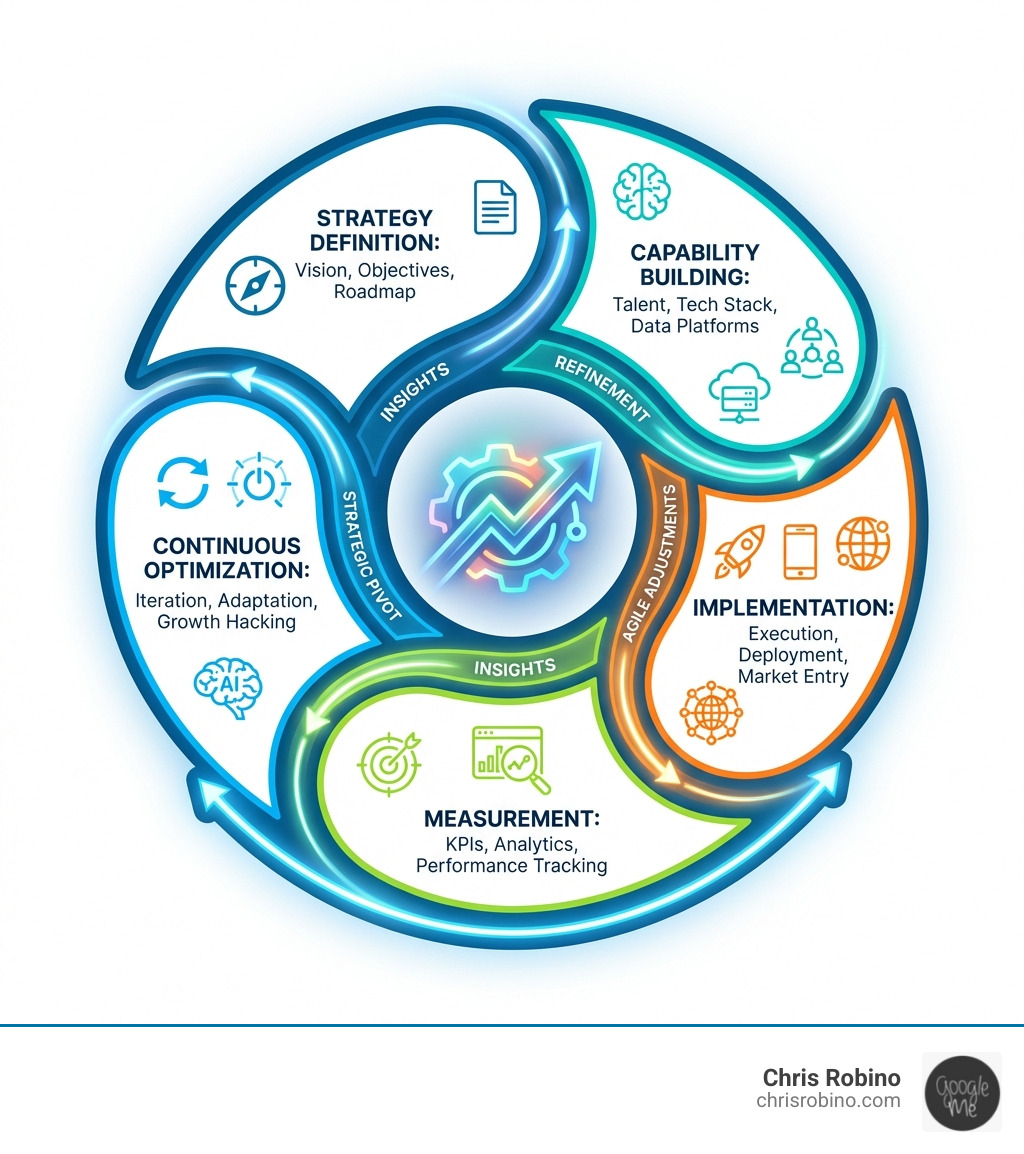
Core Components of Modern Digital Growth Solutions
Modern digital growth solutions represent an integrated operating system designed to drive efficiency and ensure sustainable business expansion. At the heart of this system is a “full-funnel growth system” that connects every channel and touchpoint to a single “north star metric.”

We leverage the AARRR framework-Acquisition, Activation, Retention, Revenue, and Referral-to structure our approach. To excel in today’s landscape, businesses must adopt the Growth PASS: Precision, Agility, Speed, and Scale. This allows us to pursue multiple paths to growth simultaneously, supported by robust capabilities.
Leveraging Data and AI for Digital Growth Solutions
In the new growth game, data and AI are the strategic advantage. Predictive analytics allows us to forecast customer needs and optimize resource allocation. AI-driven tools can generate a 5% drop in spending for negotiations and free up 30% of managers’ time. Robotic Process Automation (RPA) can lead to cost cuts reaching up to 40%.
“Personalization at scale” is a primary driver, delivering a boost of 20% to 40% in conversion rates. To achieve this, we focus on four key actions:
- Collecting and activating first-party data.
- Developing dynamic content capabilities.
- Building a robust AI decision engine.
- Implementing agile testing and learning.
SEO Strategies That Perform Well for Large Companies
For large companies, SEO is one of the highest-leverage digital growth solutions because it scales acquisition without scaling media spend. Enterprise SEO differs from small-site tactics: it requires repeatable systems for technical excellence, content governance, and cross-functional execution across thousands (or millions) of URLs.
Start with technical SEO fundamentals at scale. Large organizations often accumulate technical debt across legacy platforms, templates, and third-party scripts. Prioritize fixes using an impact/effort model and focus on the constraints that most commonly limit organic growth:
- Crawl efficiency and indexation control: Ensure important pages are discoverable and indexable while preventing low-value URLs (faceted navigation, internal search, session parameters) from consuming crawl budget. Standardize canonical tags, pagination handling where needed, and robots directives.
- Site architecture and internal linking: Use clear hierarchies and hub-and-spoke models that mirror how users search. Strengthen internal link pathways to priority pages with consistent navigation, contextual links, and scalable modules (e.g., “related” blocks) driven by rules.
- Core Web Vitals and performance: Enterprise sites typically ship heavy pages. Reduce render-blocking resources, compress images, implement caching/CDNs, and continuously monitor LCP/INP/CLS across key templates. Faster pages improve both rankings and conversion.
- Structured data at scale: Apply schema via templates (products, articles, FAQs, organization, breadcrumbs) and validate routinely. Structured data improves eligibility for rich results and reduces ambiguity for search engines.
- Duplicate content prevention: Consolidate near-duplicates caused by URL parameters, sort orders, printable pages, or localized variants. Use canonicals, parameter handling rules, and content template governance.
Build a scalable content program that avoids fragmentation. Large companies often have many teams publishing independently, which creates keyword cannibalization and inconsistent quality. A strong enterprise content operating model includes:
- Keyword mapping and intent alignment: Map primary and secondary queries to a single best page per intent. Maintain a shared map so teams don’t compete against each other.
- Editorial standards and refresh cycles: Define what “done” means (depth, evidence, UX, internal links, structured data) and schedule updates for aging pages that still have demand.
- Programmatic and templated content—carefully governed: Templates can expand coverage for locations, categories, integrations, or help content, but require quality thresholds, unique value, and strong internal linking to prevent thin pages.
Operationalize SEO across teams. Enterprise SEO succeeds when it’s embedded into the organization’s normal delivery mechanisms:
- SEO-by-design in product and engineering workflows: Add SEO requirements to definition-of-done for templates, migrations, and releases (indexability checks, metadata rules, performance budgets).
- Clear ownership and approvals: Define who owns taxonomy, navigation, template changes, and content standards so changes don’t stall.
- Testing and learning: Run controlled tests on titles, internal links, and template elements to quantify impact before rolling out globally.
Measure outcomes with executive-ready reporting. Tie SEO metrics to business value:
- Leading indicators: crawl health, indexation rates, Core Web Vitals by template, internal link coverage, and ranking distribution for priority topics.
- Business KPIs: organic sessions to key journeys, qualified leads or revenue, assisted conversions, and retention signals.
The goal is a durable system: technically sound pages, governed content creation, and a workflow that keeps improvements shipping continuously.
Measuring ROI and Overcoming Change Challenges
Implementing digital growth solutions requires tracking KPIs that align with business goals, such as operational efficiency, organic traffic growth, and sales performance. Many initiatives fail to meet their potential without a clearly defined digital strategy.
To overcome resistance to change, emphasize a clear strategy and consistent communication. Digital tools can help track execution with transparency and accountability. Prioritize projects based on potential value and short-term ROI to build momentum.
Building a Roadmap for Sustainable Business Expansion
Sustainable digital growth demands a carefully crafted roadmap. A structured digital strategy model ensures that digital efforts are deeply embedded within the overall business strategy.
Critical components of the roadmap include:
- Digital Vision: Articulating how digital will change the industry and competitive advantage.
- Competitive Assessment: Evaluating current digital positioning, strengths, and weaknesses.
- Prioritized Digital Bets: Identifying opportunities consistent with business strategy.
- Gap Analysis: Identifying the capabilities and systems needed to win.
- Change Roadmap: Detailed plans with timelines, targets, and accountabilities.
A critical shift is moving towards product-centricity, where technologies and roadmaps revolve around the customer. This involves implementing modern delivery methods like Agile and DevSecOps to reduce time to market and improve security.
Essential Steps for a Digital Growth Solutions Roadmap
- Blueprinting the Strategy: Defining objectives and identifying functional capabilities. This involves creating future digital scenarios and investment plans.
- Activating MVPs: Using a “pilot-first” model to test hypotheses and gather early feedback through Minimum Viable Products. This iterative process reduces risk.
- Scaling Initiatives: Expanding successful digital initiatives across the organization, ensuring seamless integration and organizational alignment.
Industry-Specific Applications of Digital Change
Digital growth solutions are adaptable frameworks that drive transformative change across diverse industries:
- Manufacturing: Digitization can reduce costs by 20% and defect rates by 90% through smart analytics and predictive algorithms.
- B2B Sales: Digitizing sales can generate 10% to 20% revenue gains and triple conversion rates by personalizing the customer journey.
- Supply Chain: Big data can boost demand fulfillment by 6% and reduce warehousing costs by 20%.
- Service Operations: Digital tools can reduce customer service volume for simple queries by 80% while increasing satisfaction.
The Strategic Value of Expert Partnerships
Navigating digital growth is complex. Partnering with industry experts provides a streamlined path for communication and direct access to specialized expertise and content. By leveraging these resources, businesses can build scalable systems, achieve global reach, and use cutting-edge tech like AI and data analytics. To lift your business, seek professional guidance to navigate your digital change journey through a specialized portal.