

What Media Networking Really Means (And Why It Matters Now)
Media networking is the practice of building professional relationships and connections across the media industry — spanning traditional outlets, digital platforms, advertising ecosystems, and career-focused communities. In the modern era, this networking is increasingly digital, driven by complex algorithms and the necessity of high-level search engine optimization (SEO) to ensure that these connections and the content they produce are discoverable by the right audiences.
Here is a quick breakdown of what the term covers:
| Type | What It Means |
|---|---|
| Professional networking | Connecting with journalists, PR pros, editors, and media leaders at events or through organizations |
| Retail media networks | Data-driven advertising platforms where brands use first-party consumer data to target ads and measure results |
| Industry organizations | Groups like The WICT Network or The Media Society that support career growth and peer connection |
| Networking events | Conferences, panels, and meetups designed to connect media professionals in person or online |
The media industry is changing fast. AI, privacy regulations, cookie deprecation, and digital transformation are reshaping how professionals connect — and how brands reach audiences. For large companies, this transformation requires a sophisticated approach to SEO that goes beyond simple keyword stuffing. It involves technical excellence, content authority, and a deep understanding of how media networks distribute information. At the same time, retail media ad revenue is forecast to surpass TV by 2028, and more than 80% of consumer packaged goods brands already invest in at least one media network.
Whether you are a PR professional looking to meet journalists, a brand exploring data-driven advertising, or an enterprise leader building a career in media — understanding the full landscape of media networking gives you a real edge. For large organizations, the synergy between networking and SEO is the key to maintaining market dominance in an increasingly fragmented digital world.
I’m Chris Robino, a digital strategy leader with over two decades of experience helping organizations navigate SEO, AI, and digital transformation — including the fast-evolving world of media networking. In the sections below, I’ll break down every key term and concept, including the specific SEO strategies that allow large companies to thrive within these networks, so you can move through this space with clarity and confidence.
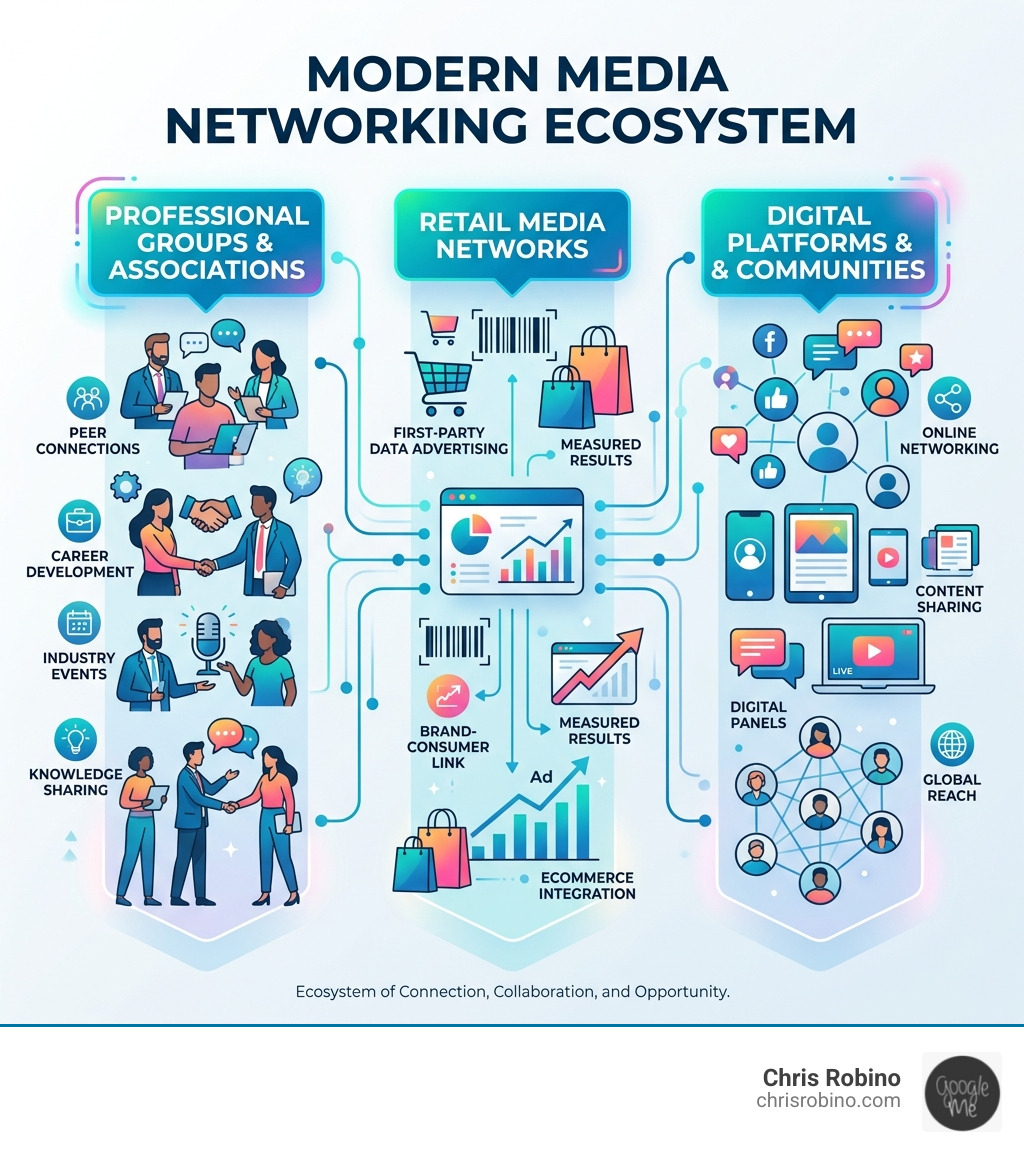
Defining the Modern Scope of Media Networking
When we talk about media networking, we are really looking at two distinct but overlapping worlds. On one side, you have the human element: journalists, PR experts, and content creators building relationships to share information and boost brand awareness. On the other side, you have the technical powerhouse of retail media networks—a sector that has the potential to become a trillion-dollar business. For large companies, the challenge lies in integrating these two worlds through a unified SEO strategy that ensures both human-centric stories and data-driven products are visible.
To understand where you fit in, it helps to see how these two sides compare:
| Feature | Professional Networking Groups | Retail Media Networks (RMNs) |
|---|---|---|
| Primary Goal | Career growth, information exchange, and PR | Targeted advertising and sales conversion |
| Core Asset | Relationships and industry knowledge | First-party consumer data and profiles |
| Revenue Model | Memberships and event sponsorships | Ad spend and high-margin data monetization |
| Key Players | Journalists, PR pros, and industry leaders | Retailers (e.g., Dollar General), CPGs, and tech platforms |
Professional Media Networking and Industry Groups
For those of us on the “human” side of the industry, media networking is about breaking down silos. It’s about a PR professional having a direct line to a journalist at a major news outlet or a content creator finding a mentor who has navigated a digital transformation before. From an SEO perspective, these relationships are the foundation of high-quality backlink profiles. When a large company is mentioned by a reputable journalist or featured in a major industry publication, it signals authority to search engines, boosting the entire organization’s digital footprint.
Organizations like The Media Society play a vital role here. As a leading media charity, they provide a space where everyone from seasoned editors to students can engage in topical debates. Similarly, regional hubs like Kc Media Mix foster leadership and professional enrichment through local events like “TV Premier Day” and social happy hours.
In the digital space, specialized B2B social networks act as hubs for media, tech, and regulation professionals. Unlike standard social media, these platforms focus on “meeting people, not profiles,” often using video introductions to build authentic peer-to-peer support. If you are looking for the right room to be in, checking out a curated list of media-industry-networking-events is a great place to start.
Retail Media Networks and Data-Driven Advertising
If professional networking is the “heart” of the industry, retail media networks are the “engine.” These are platforms set up by retailers that allow third-party brands to advertise to customers using the retailer’s own first-party data. For large companies, RMNs represent a massive SEO opportunity. By optimizing product listings and brand pages within these networks, companies can capture high-intent traffic that is ready to purchase.
This is a massive trend because of “cookie deprecation”—the phasing out of third-party tracking. Brands now need reliable ways to reach people, and retailers have the data. In fact, advertisers often prefer networks that have at least 6 million unique consumer profiles. For example, some large discount retailers can reach 100% of their active customers through paid media because they hold over 90 million unique customer profiles.
Large-scale SEO for these networks involves “closed-loop measurement.” This means an advertiser can see exactly how a digital ad or an organic search result led to a physical or digital sale. To keep this data safe and comply with privacy regulations, many networks use “data clean rooms”—secure environments where two parties can share data without seeing each other’s raw customer information. For the enterprise, the goal is to ensure that every piece of content within the network is technically optimized for both internal search algorithms and external search engines.

Career Growth, Diversity, and Industry Evolution
Media networking isn’t just about selling ads or getting a story published; it’s a primary driver of career growth. Whether you are in finance, production, or public relations, the connections you make often dictate the opportunities you receive. For large companies, fostering these connections internally and externally is a strategic imperative that supports long-term stability and innovation.
For those in the financial side of the house, the Media Financial Management Association (BCFM) provides a specialized niche. It’s a place where finance professionals in media and entertainment share insights on payment trends and AI-driven revenue forecasting. This kind of specialized skill acquisition is what turns a mid-level manager into an executive leader.
Enterprise SEO Strategies for Large Media Networks
To perform well at scale, large companies must implement SEO strategies that are both robust and flexible. Unlike smaller businesses, enterprises deal with millions of pages and complex site architectures. Here are the core strategies that drive success:
- Scalable Technical Foundations: Large companies must prioritize technical SEO to manage crawl budgets effectively. This includes implementing server-side rendering for JavaScript-heavy sites, optimizing site speed through advanced CDN configurations, and ensuring a clean URL structure that search engines can easily navigate. For media networks, this also means managing the technical debt that often comes with legacy systems.
- Programmatic Content and SEO: For organizations with vast amounts of data, programmatic SEO allows for the creation of thousands of high-quality, data-driven pages. This is particularly effective for retail media networks or directory-style media sites. The key is ensuring that each page provides unique value and avoids the pitfalls of thin content.
- Internal Linking at Scale: In a large media network, internal linking is the most powerful tool for distributing authority. By using automated scripts or sophisticated CMS plugins to link related articles, products, and profiles, companies can ensure that high-authority pages pass their “link juice” to newer or deeper content.
- E-E-A-T and Brand Authority: Search engines prioritize Experience, Expertise, Authoritativeness, and Trustworthiness. For large media companies, this means highlighting the credentials of their journalists and contributors. Networking plays a role here by facilitating collaborations with other high-authority figures, which in turn generates the high-quality backlinks and social signals that search engines crave.
- Cross-Functional SEO Governance: In a large organization, SEO cannot live in a silo. It requires alignment between the technical team, the content team, and the PR/networking team. Establishing an SEO Center of Excellence (CoE) ensures that best practices are followed across all departments and that the company’s networking efforts are always aligned with its digital visibility goals.
Prestigious Events and Leadership Organizations
The most effective media networking often happens in intimate, high-stakes environments. Some of the most prestigious events for PR professionals involve small-group settings where every attendee gets to personally meet journalists from top-tier outlets like the Wall Street Journal or CNN. These events allow for deep discussions about coverage needs that simply don’t happen in a crowded conference hall. For the enterprise, these high-level connections are essential for securing the “earned media” that provides the ultimate SEO boost.
Women-Focused Networks and Diversity Initiatives
Diversity is a major catalyst for the evolution of the media industry. Organizations like The WICT Network have been instrumental in empowering women in media, entertainment, and technology. Since 1994, over 1,300 professionals have graduated from their Betsy Magness Leadership Institute (BMLI), a program designed to foster executive leadership.
Similarly, the Career Center – Alliance for Women in Media serves as a premier resource for job seekers and recruiters. These networks provide more than just job listings; they offer specialized training and inclusive communities that help women navigate the unique challenges of the media landscape. By focusing on gender equity and leadership evolution, these groups ensure the future of media is as diverse as the audiences it serves.
The Future of Media Networking: AI and Digital Transformation
As we look toward the future, media networking is being reshaped by what many call a “regulatory storm” and the rapid adoption of AI. Digital transformation is no longer a choice; it is a requirement for survival. Large companies are now using AI to identify networking opportunities, predict which journalists are most likely to cover a story, and even automate the initial stages of technical SEO audits.
We are seeing a rise in virtual roundtables and video introductions that allow global leaders to connect without the need for travel. However, with this digital shift comes new challenges—from protecting consumer privacy to addressing the global climate crisis through sustainable media practices. At ChrisRobino.com, we specialize in helping organizations stay ahead of these curves. Through Media Production Consulting, we help teams integrate emerging tech and strategic innovation into their existing workflows. Whether you are trying to understand how AI will impact your content distribution or how to leverage first-party data without violating new privacy laws, having a partner who understands the modern media ecosystem is essential.
Conclusion: Navigating the New Media Landscape
Media networking has evolved from simple “handshake” events into a complex, data-driven ecosystem. To succeed today, especially within a large organization, you need to be fluent in both the human side of professional relationships and the technical side of data-driven advertising and enterprise SEO. The integration of these disciplines is what allows a brand to not only exist but to dominate its niche.
By joining prestigious organizations, attending targeted events, and staying informed on trends like AI, programmatic SEO, and identity resolution, you can position yourself at the forefront of the industry. The potential is vast—whether you’re looking to be part of a trillion-dollar advertising shift or seeking to lead the next generation of media professionals through a successful digital transformation.
If you’re ready to dive deeper into how digital transformation, strategic networking, and enterprise-level SEO can grow your career or your brand, we’re here to help. Stay connected, stay curious, and remember that in the modern media world, your network—and your ability to make that network visible to the world—is your most valuable asset.