

Why Choosing the Right Professional SEO Firm Can Make or Break Your Online Growth
A professional SEO firm is one of the most important investments a business can make in its digital presence — but the industry is crowded with agencies that overpromise and underdeliver.
Here’s a quick answer to what separates a legitimate professional SEO firm from the rest:
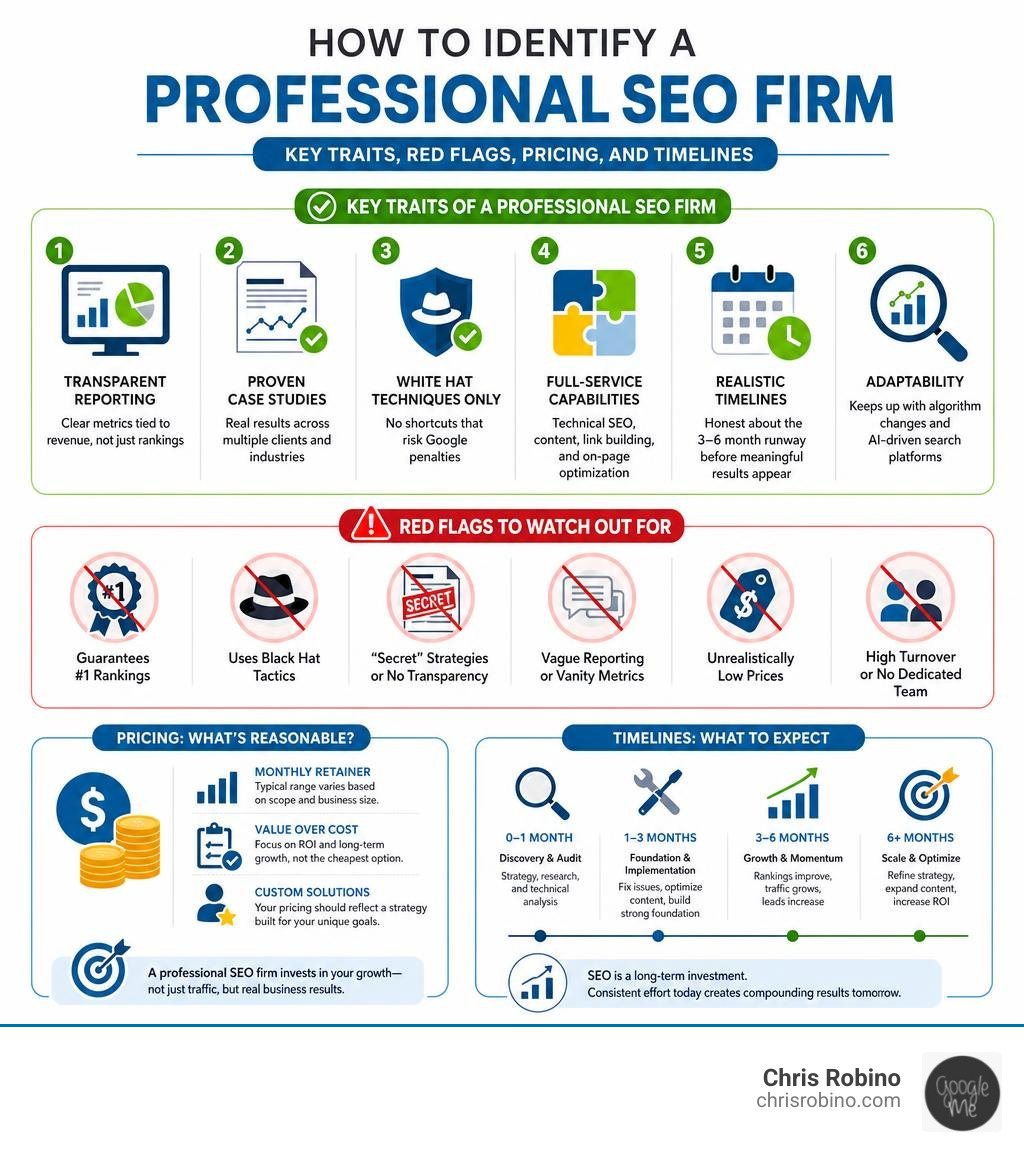
What makes an SEO firm truly professional:
- Transparent reporting — clear metrics tied to revenue, not just rankings
- Proven case studies — real results across multiple clients and industries
- White hat techniques only — no shortcuts that risk Google penalties
- Full-service capabilities — technical SEO, content, link building, and on-page optimization
- Realistic timelines — honest about the 3–6 month runway before meaningful results appear
- Adaptability — keeps up with algorithm changes and AI-driven search platforms like ChatGPT and Google AI Overviews
Consider this: 53.3% of all website traffic comes from organic search, and only 0.63% of clicks go to results on Google’s second page. Where you rank is where your business lives or dies online.
Yet many businesses hand over their SEO budget to firms that deliver jargon-heavy reports with no connection to actual growth.
That’s exactly what this guide is here to help you avoid.
I’m Chris Robino — a digital strategy leader with over two decades of experience helping organizations from early-stage startups to established enterprises navigate search, AI automation, and intelligent digital growth. I’ve evaluated and worked alongside many types of professional SEO firm partnerships, and I know what separates a strategic partner from a vendor just cashing a monthly retainer.
Key Indicators of a Professional SEO Firm
When evaluating an agency, look beyond polished presentations and ask how the team will improve search visibility, qualified traffic, and revenue. A truly professional seo firm operates with transparency, uses white hat SEO practices, and can show verified case studies and client reviews tied to business outcomes.
For larger companies, the best firms also understand complexity: multiple stakeholders, large site architectures, compliance reviews, migrations, international pages, and long approval cycles. Freelancers can be strong specialists, and in-house teams often know the brand deeply, but a professional agency brings a cross-functional team of technical specialists, content strategists, analytics experts, and link-building professionals who can execute at scale.
To get more from your digital presence, explore our curated SEO Tips to Improve Organic Rankings to understand the foundational strategies reputable firms use.

Core Services Offered by a Professional SEO Firm
A serious search campaign is built on connected pillars. If an agency only writes blog posts or only builds links, performance gaps will appear. A top-tier firm provides:
- Technical SEO: Improving crawlability, indexation, Core Web Vitals, mobile usability, internal linking, JavaScript rendering, and site speed.
- On-Page Optimization: Structuring URLs, title tags, meta descriptions, headings, and page copy around real search intent.
- Off-Page SEO & Link Building: Earning relevant, authoritative links through digital PR, partnerships, and high-quality content assets.
- Local SEO: Optimizing business profiles, citations, local landing pages, and map visibility for multi-location organizations.
- Content Strategy: Building topical clusters, buyer-stage content, and editorial systems that support both rankings and conversions.
For large companies, these services must be coordinated across product, engineering, legal, brand, and analytics teams. We recommend partnering with firms that can pair conversion rate optimization (CRO) with foundational SEO so every qualified visitor has a clearer path to action. Understanding these core elements is vital to mastering your overall Search Engine Rankings. For baseline best practices from a primary source, review Google Search Central’s SEO Starter Guide.
How a Professional SEO Firm Measures and Reports Success
A common industry trap is focusing on vanity metrics like ranking for obscure keywords or reporting traffic without context. True professionals connect their work to business outcomes.
| Vanity Metrics (What to Ignore) | Actionable Business Metrics (What to Track) |
|---|---|
| Ranking for non-branded, low-intent keywords | Growth in target, high-intent transactional keywords |
| General traffic spikes with high bounce rates | Sales qualified leads (SQLs) and digital conversions |
| Impression count increases | Organic contribution to pipeline and revenue attribution |
| Total backlink count, including low-quality spam | Backlinks from authoritative, contextually relevant domains |
Reports should integrate Google Analytics 4 (GA4), Google Search Console (GSC), CRM data when available, and clear attribution models. For enterprise programs, ask for segmented reporting by business unit, region, template type, product category, and funnel stage. That is how leadership can see which parts of the site are creating measurable value. For more guidance on tracking performance, check out our Google Search Ranking Tips.
Red Flags to Watch Out For When Evaluating Agencies
The search marketing industry has bad actors. Protect your brand’s digital equity by watching for these warning signs:
- Guaranteed Rankings: No agency controls search algorithms. Guarantees often signal risky tactics.
- Lack of Transparency: If link-building methods or optimization work are treated like a black box, walk away.
- Unbelievably Cheap Packages: Quality SEO requires strategy, technical expertise, research, content, and manual outreach.
- No Long-Term Strategy: Generic checklists rarely work for competitive markets or complex websites.
- No Enterprise Process: Larger companies need documentation, prioritization frameworks, QA workflows, and implementation support.
Realistic Timelines and Pricing Models for Modern SEO
SEO is a compounding, long-term asset. On average, it takes 3 to 6 months of consistent optimization to see meaningful movement in rankings and traffic, with stronger ROI often materializing around the 12-month mark.

In 2026, professional SEO pricing generally falls into three structures:
- Monthly Retainers: Common for ongoing campaigns, typically ranging from $2,500 to $7,500+ per month depending on competition and site complexity.
- Project-Based Pricing: Useful for technical audits, migrations, information architecture, or initial setup, often ranging from $5,000 to $30,000.
- Hourly Consulting: Appropriate for strategic oversight or in-house team training, often between $90 and $175+ per hour.
Enterprise and e-commerce programs may require larger budgets because the work involves more templates, stakeholders, analytics requirements, and technical dependencies. To understand the long-term nature of these investments, read our comprehensive Search Engine Rankings Ultimate Guide 2025.
Adapting to AI-Driven Search and Algorithm Changes
Search has evolved beyond traditional blue links. AI Overviews, conversational search, and answer engines are changing how users discover brands. Modern campaigns require Generative Engine Optimization (GEO) and Answer Engine Optimization (AEO), not keyword stuffing.
A professional firm should help structure content so it is clear, factual, well-sourced, and easy for search systems to interpret. That includes concise answers, schema markup, expert authorship, entity consistency, internal links, and source-worthy content. For large companies, this also means governing content quality across thousands of pages so the brand earns visibility in both traditional search and AI-assisted discovery.
Tailoring Strategies for Enterprise and E-Commerce Brands
A generic campaign will fail on a complex, large-scale website. Enterprise and e-commerce brands require specialized methods:
- Enterprise SEO: Managing large page inventories, crawl budgets, governance workflows, migrations, internationalization, and technical prioritization.
- E-Commerce SEO: Optimizing category pages, product schemas, faceted navigation, internal search pages, reviews, and merchandising-driven content.
- Programmatic SEO: Scaling useful pages from structured data while avoiding thin, duplicative, or low-value content.
- Pillar-Cluster Models: Organizing authority around strategic topics so search engines and users can understand the depth of expertise.
- Schema and Internal Linking: Helping crawlers understand products, services, locations, FAQs, authors, and relationships between pages.
If you manage a large-scale platform, read The Ultimate Guide to Search Engine Ranking Tips for advanced technical frameworks. The right professional SEO partner will not just chase rankings. They will build systems that help a large organization scale organic growth safely, measurably, and sustainably.
Conclusion: Partnering for Long-Term Organic Growth
Finding the right professional seo firm requires moving past vanity metrics and demanding transparency, strategic alignment, and modern technical capabilities. By focusing on agencies that build sustainable, white-hat campaigns and optimize for both traditional search engines and AI platforms, you position your brand for predictable, compounding growth.
At ChrisRobino.com, we specialize in centralizing complex digital strategies, emerging tech integrations, and media insights into a single portal. We are here to help you cut through the noise, streamline your communication, and access the exact expertise you need to build a future-proof digital presence.
Ready to take your search rankings to the next level? Explore our essential SEO Tips to Improve Organic Rankings to start optimizing your digital footprint today.