

Why Content SEO Optimization Is the Foundation of Organic Growth for Enterprises
Content SEO optimization is the process of improving your web content so it ranks higher in search engines, satisfies user intent, and drives measurable business results. For large companies, this process is not just about writing; it is about managing a complex digital ecosystem where thousands of pages must align with brand standards and search engine requirements.
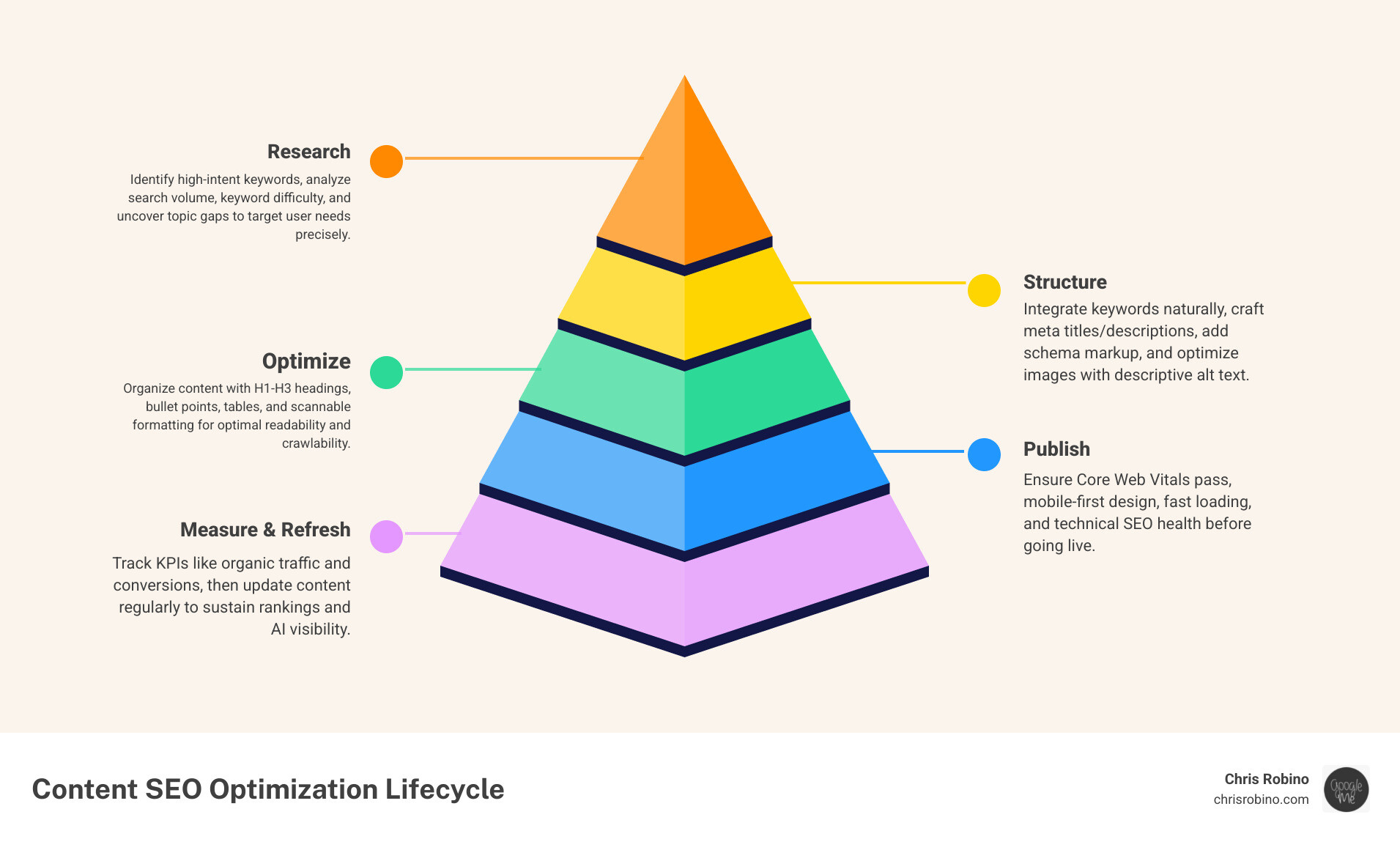
Here is how it works at a glance for large-scale organizations:
- Research – Identify high-value keywords, search intent, and competitive gaps across massive datasets.
- Structure – Organize content with clear headings, logical hierarchy, and scannable formatting to ensure both users and crawlers can navigate the site.
- Optimize – Place keywords naturally, write compelling meta tags, and add descriptive alt text while maintaining brand voice.
- Publish – Ensure technical health across the domain, focusing on Core Web Vitals, mobile-friendliness, and schema markup.
- Measure – Track organic traffic, rankings, and conversions using enterprise-level analytics tools.
- Refresh – Update legacy content regularly to maintain rankings and ensure visibility in AI-driven search results.
Millions of new content pieces are published every single day. For large companies, the challenge is not just creating content, but ensuring that content doesn’t get buried under its own weight. The old playbook — stuffing keywords and building low-quality links — no longer works. Google’s algorithms have evolved to reward topical depth, user experience, and genuine expertise.
Modern content SEO serves two masters at once: the human reader who wants fast, clear, useful answers, and the search engine crawler that needs structure and semantic clarity. For an enterprise, getting this balance right is what separates pages that generate consistent organic traffic from pages that collect dust on page five. I’m Chris Robino, a digital strategy leader and AI search expert with over two decades of experience helping organizations — from startups to global enterprises — master content seo optimization to drive real, measurable growth. In the sections ahead, I’ll walk you through the exact frameworks and tactics that work in 2026.
The Core Pillars of Content SEO Optimization at Scale
To succeed in May 2026, large companies must look at content as a holistic ecosystem. It is no longer enough to “write a blog post.” We need to build authoritative assets that demonstrate E-E-A-T (Experience, Expertise, Authoritativeness, and Trustworthiness). While E-E-A-T is not a direct ranking factor, it is a useful framework for evaluating whether content is genuinely helpful to users.
A major shift in modern content seo optimization is the move toward semantic SEO. This means search engines can interpret relationships between concepts, not just exact keyword matches. For a large organization, this requires a sophisticated approach to content clusters. If we write about “enterprise software,” search engines also expect related concepts like “scalability,” “integration architecture,” and “security compliance.” Google’s own guidance on creating helpful, people-first content reinforces this emphasis on usefulness and relevance: Google Search Central.
Understanding search intent is the bedrock of this process. We categorize intent into three primary buckets to ensure we are giving the user exactly what they asked for:
| Intent Type | User Goal | Content Format Example |
|---|---|---|
| Informational | To learn something or find an answer | White papers, how-to guides, “What is” posts |
| Navigational | To find a specific website or page | Login portals, brand homepages, specific tool names |
| Transactional | To buy a product or complete an action | Product pages, pricing tables, “Request a Demo” buttons |

Strategic Keyword Research for Large Companies
Keyword research for large companies has evolved from finding high-volume terms to identifying traffic potential and business potential across thousands of URLs. For large organizations, competing for broad head terms is often a losing battle with diminishing returns. Instead, we focus on long-tail keywords, specific multi-word phrases that capture high-intent traffic.
Statistics show that only a tiny fraction of keywords receive more than 100,000 searches per month. The real opportunity for an enterprise is in the niche. By targeting phrases like “B2B SaaS content marketing strategy for healthcare,” we reach a user who is further along in the buying process. When we evaluate keywords at scale, we look at:
- Keyword Difficulty: A scale from 0 to 100 measuring how hard it is to crack the top 10.
- Search Intent: Does the keyword match the page we are building?
- Topic Clusters: We don’t just target one keyword; we build a hub page and several spoke pages to signal topical authority.
For a deeper dive into how these rankings are calculated, see our Search Engine Rankings Ultimate Guide 2025.
Balancing Human Readability with Content SEO Optimization
In a large organization, maintaining editorial standards across hundreds of writers is a challenge. We often say that we write for humans but format for robots. If a page is a wall of text, users will bounce, and weak engagement can limit performance. To keep readers engaged, we aim for a 7th-to-9th-grade reading level. This is not about reducing substance. It is about maximizing comprehension and accessibility for a broad audience.
One of our favorite techniques is the BLUF method (Bottom Line Up Front). We provide the answer to the user’s main question in the first 40-60 words of a section. This helps us win featured snippets and provides immediate value to the reader. Other scannability best practices include using short paragraphs, bulleted lists, and formatting H2 and H3 headers as questions that users actually type into search bars. This level of editorial governance helps ensure that every piece of content published under the brand name meets a high standard of quality and SEO readiness.
Technical Foundations and AI Visibility
Technical health is the entry fee for ranking. If our site is slow or broken, even the best content seo optimization will struggle. In 2026, we prioritize Core Web Vitals, metrics that measure loading performance (LCP), interactivity (INP), and visual stability (CLS). For large companies, this often means managing technical debt and ensuring that legacy systems do not hinder modern SEO performance.
We also must prepare for Generative Engine Optimization (GEO). AI chatbots still represent a small share of total web traffic, but they are increasingly influential in brand discovery. To improve visibility, we use schema markup to help AI systems and search engines interpret our content, mobile-first indexing to ensure navigation is touch-friendly, and descriptive alt text to support both accessibility and image understanding. A robust technical audit is essential for any large-scale site so search engines can crawl and index content efficiently without getting stuck in crawl traps.
Scaling Authority and Measuring Success in the Enterprise
Once the content is live, the work shifts to building authority. While the more backlinks a page has, the more organic traffic it tends to attract, quality beats quantity every time. For large companies, a single link from a relevant, highly authoritative source can provide more ranking benefit than dozens of low-quality links. We also focus heavily on content refreshing. Data suggests that sites that refresh their content see up to a 106% increase in organic traffic. In a fast-moving world, a guide written in 2024 is likely outdated by 2026. We recommend auditing your top 20 traffic-driving pages quarterly to ensure all statistics, links, and insights remain fresh.
For actionable ways to boost your site’s authority, explore our SEO Tips to Improve Organic Rankings.

Advanced Internal Linking and Topic Clusters
Internal linking is one of the most underrated tools in content seo optimization, especially for large sites with deep architectures. It allows us to distribute “link equity” (ranking power) from our high-performing pages to our newer content. We use a hub-and-spoke model where a central “pillar” page links out to detailed “cluster” articles. Key internal linking rules we follow include using descriptive anchor text, keeping the links logical and valuable to the reader, and flattening the architecture to ensure every important page is no more than three clicks away from the homepage.
You can learn more about building these structures in The Ultimate Guide to Search Engine Ranking Tips.
Data-Driven Performance Tracking and KPIs
We don’t guess; we measure. To determine if our content seo optimization is working, we track several Key Performance Indicators (KPIs) across the entire organization. Organic traffic remains the primary metric, but we also look at dwell time as a signal of content quality. We monitor zero-click results to see how often our content appears in featured snippets or AI Overviews. Finally, we track conversion rates to ensure that our readers are taking the desired actions, whether that is signing up for a newsletter or requesting a consultation. Google still sends significantly more traffic than the leading AI-driven search platforms combined, so while we track AI citations, organic search remains our primary North Star.
For a checklist on what to monitor, see our Google Search Ranking Tips.
Future-Proofing Your Strategy with Chris Robino
As we look toward the second half of 2026, the landscape of content seo optimization will continue to shift toward “Prompt-Aligned SEO.” This means we are no longer just optimizing for keywords, but for the natural language prompts users ask AI tools. At ChrisRobino.com, we specialize in helping large-scale organizations navigate this transition. Whether it’s pruning low-performing legacy content to improve overall site quality or implementing advanced FAQ schema to capture voice search queries, our goal is to ensure your brand remains the “source of truth” for your industry.
By focusing on the “SEO-human balance”—creating content that is technically perfect for robots but deeply engaging for people—we build a sustainable organic growth engine that survives algorithm updates and AI disruptions alike. Large companies must avoid common mistakes like keyword stuffing, ignoring mobile-first indexing, and neglecting content freshness. If you are looking to streamline your digital ecosystem and access professional expertise in emerging tech and media, we invite you to explore our content strategy consulting. Let’s build something that ranks, resonates, and reflects the true authority of your brand.