

Why Tech Industry Insights Matter Now More Than Ever
Tech industry insights reveal a sector at a critical crossroads. Here’s what you need to know right now:
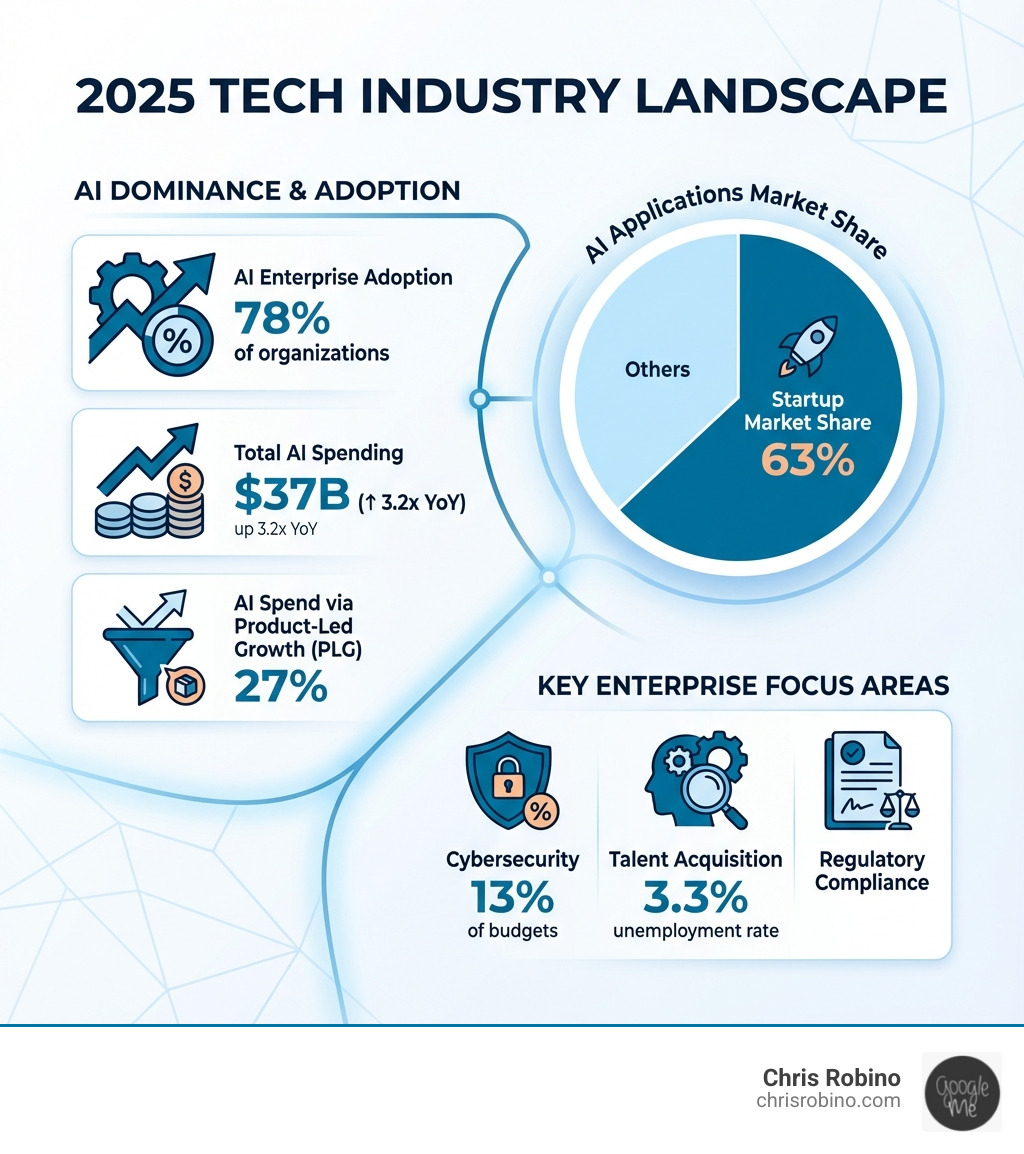
- AI is the dominant force: Capturing over 50% of venture funding and driving $37B in enterprise spending in 2025
- Talent dynamics are shifting: Tech unemployment sits at 3.3% while companies struggle to fill critical roles
- Cybersecurity spending is surging: Now exceeding 13% of infrastructure budgets
- Global competition is intensifying: Nations and corporations race for technological leadership
- Companies are buying, not building: 76% of AI use cases are now purchased rather than developed internally
The numbers tell a clear story. Enterprise AI has surged from $1.7B to $37B since 2023. AI agent startups attracted $3.8B in funding, nearly tripling in the past year. Decacorns raised a record $94.5B through Q3 2025.
But here’s what the data doesn’t always show: success depends on strategic execution, not just adoption. Organizations that balance short-term AI gains with long-term scalable value, align workforce capabilities with evolving demands, and treat technology investments as business outcomes—not just capabilities—are the ones pulling ahead.
The pace of change is unprecedented. As one AT&T CISO noted, “The speed and impact of AI are the primary differentiators compared to past technological shifts.” This means the window for competitive advantage is shrinking fast.
The reality is stark: While 78% of organizations use AI in at least one function, only 1% report their AI deployments are fully mature. The gap between experimentation and scaled value remains wide.
I’m Chris Robino, and I’ve spent over two decades helping organizations steer digital change and leverage emerging technologies like AI to drive measurable growth. Throughout my career working with tech startups and established enterprises, I’ve seen how Tech industry insights translate into competitive advantage when applied strategically—and how quickly companies fall behind when they treat technology as a checkbox rather than a business driver.
For leaders in large organizations, this mirrors the journey of modern SEO at scale: surface-level tactics no longer move the needle. High-performing enterprises focus on search strategies tightly aligned to business outcomes—mapping content to revenue-driving journeys, leveraging structured data, and building technical foundations that enable fast experimentation and measurement. Industry research underscores that integrated, data-driven digital strategies consistently outperform fragmented efforts.
Core Tech Industry Insights for 2025 and Beyond
The tech industry is a whirlwind of innovation, complexity, and opportunity. To stay competitive, we must not only understand the current state but also anticipate future shifts. Our deep dive into the latest Tech industry insights reveals several critical areas demanding strategic attention.

From the foundational role of AI to the intricate dance of venture capital and the evolving cybersecurity landscape, these insights are crucial for navigating the road ahead. We’ll explore the financial shifts, the intensifying global competition, the dynamic challenges in talent acquisition and product management, the complexities of scaling, and the growing imperative for responsible innovation.
AI’s Dominance: Enterprise Adoption and Financial Impact
Artificial Intelligence isn’t just a trend; it’s the bedrock of modern technological advancement. It’s a foundational amplifier, accelerating progress across all other tech trends and open uping new possibilities. Companies are strategically adapting to AI adoption, focusing on driving value without overextension.
The financial landscape reflects this dominance. AI is on track to capture over 50% of total annual venture funding for the first time in 2025. This surge is fueled by massive investments, with AI agent startups alone attracting $3.8 billion in funding, nearly tripling in the past year. These AI agents are rapidly moving from experimentation to deployment, especially in industries with high-volume processes and structured workflows. This shift is creating ‘virtual coworkers’ that can autonomously plan and execute multistep workflows, from customer service to software coding.
Valuations in software and AI are notably liftd, with software companies trading at more than double their 10-year average, and AI valuations trading 41% above historical norms. This presents both lucrative exit opportunities and higher acquisition costs. The venture landscape is also seeing a “flight to quality,” with fewer, larger deals and a record $94.5 billion raised by decacorns (companies valued at $10B+) through Q3 2025. This trend of mega-rounds is allowing companies to stay private longer, as they can raise substantial capital without the immediate pressures of public markets.
The demand for AI is also driving innovation in hardware. Application-specific semiconductors are experiencing innovation spikes due to exponentially higher demands for computing capacity, memory, and networking for AI training and inference. Even M&A activity is increasingly AI-driven, with companies seeking to acquire specialized capabilities and talent.
For more detailed strategies on integrating AI into your operations, explore our resources on AI Implementation Strategies.
| Metric | Traditional Enterprise Software | AI-Native Enterprise Tools |
|---|---|---|
| Buyer Conversion Rate | 25% | 47% |
| Product-Led Growth | 7% of spend | 27% of spend |
| Startup Market Share | Low (Incumbents dominate) | 63% (in AI applications) |
| Development Speed | Slower, feature-rich updates | Faster, agile iterations |
| Primary Value Driver | Process efficiency, data management | Productivity gains, automation |
The Human Element: Evolving Talent, Tools, and Security
While AI takes center stage, the human element remains paramount. Building agile and resilient tech teams requires emerging strategies for talent acquisition and development. The tech talent gap remains a critical challenge, but we’re seeing shifts. Tech layoffs have declined steadily, returning to pre-pandemic levels in Q2 2025. However, unemployment in computer and math occupations is creeping higher, now at 3.3%, after years of stability. This suggests a tightening labor market for specific skills, particularly those related to AI.

Companies are responding by focusing on skills strategies to align workforce capabilities with evolving demands. This involves upskilling existing employees and strategically acquiring new talent, nurturing new human-machine collaboration models that shift the narrative from human replacement to augmentation. It’s about designing with people, not just for them, and fostering continuous learning and adaptation. Our Business Agility Consulting Guide 2025 offers deeper insights into building such dynamic teams.
Product-led management is also evolving for enterprise tools, enhancing productivity and employee experience. This approach, where product usage drives growth and adoption, is particularly effective in AI. Individual users are driving AI adoption at four times the rate of traditional software, contributing to 27% of AI application spend via product-led growth (PLG). This bottom-up demand often converts into enterprise contracts, highlighting the importance of intuitive, value-driven tools.
Simultaneously, the cybersecurity landscape continues its rapid evolution. Spending is growing, with cloud security, data protection, and observability projected to rise to over 13% of infrastructure budgets. As AI becomes ubiquitous, it also becomes a target. The dilemma is clear: the technology meant to give businesses an advantage is becoming the target used against them. This necessitates robust AI-powered defenses and comprehensive strategies to secure AI across data, models, applications, and infrastructure. Ethical considerations and responsible innovation are also critical here, as trust becomes a gatekeeper to adoption for powerful technologies. Learn more about balancing innovation with ethical considerations in Ethical AI Development.
Global Dynamics: Scaling, Competition, and Key Tech Industry Insights
The global competitive landscape for critical technologies is shifting dramatically. Regional and national competition has intensified, driving a push for sovereign infrastructure and localized production, particularly in semiconductors. This geopolitical dynamic impacts supply chains, talent acquisition, and market access.
Scaling emerging technologies and infrastructure presents significant challenges. The surging demand for compute-intensive AI workloads is creating a $500 billion power infrastructure gap for data centers, impacting global infrastructure and driving interest in new energy solutions like fusion. This massive demand also highlights issues in physical network vulnerabilities, supply chain delays, and labor shortages. Companies must steer these complexities, balancing centralized scale with localized control in technology deployment.
Navigating the complexities of global market expansion and regulatory environments within the tech industry is another major hurdle. From data security and privacy concerns (like SOC reporting becoming a gold standard in the US and GDPR compliance in the EU) to complex tax compliance landscapes (monitoring permanent establishment risk and nexus footprints), international operations demand proactive strategies. Big Tech, emerging startups, and middle-market players are all vying for dominance, making the battle for global market share fierce.
Responsible innovation and ethical implementation of new technologies, particularly AI, are no longer optional but strategic imperatives. AI governance is a critical trend, requiring comprehensive frameworks to review AI use and establish best practices. Trust, transparency, fairness, and accountability are essential for powerful technologies to gain widespread adoption. Our AI Regulatory Compliance resources can help you steer this intricate environment.
From Insight to Impact: Your Strategic Next Steps
Understanding these Tech industry insights is just the first step. The real challenge, and the true opportunity, lies in translating these insights into actionable strategies that drive growth and resilience. We are at a juncture where proactive planning and a holistic approach can transform potential challenges into measurable opportunities.
The tech landscape of 2025 and beyond demands a long-term vision, strategic alignment across all business units, and a relentless focus on connecting every investment to tangible business outcomes. It’s about future-proofing your business in a world of accelerating change.
Implementing Actionable Tech Industry Insights for Growth
To thrive in this dynamic environment, we recommend focusing on three key actions:
- Adopt AI strategically for measurable value: Don’t just implement AI; integrate it with purpose. Focus on use cases that drive immediate productivity gains or cost savings, such as AI agents for customer support or coding copilots. Balance experimentation with scalable solutions, always ensuring a human-in-the-loop approach for accuracy and ethical oversight.
- Build an agile talent and security framework: Invest in skills-based talent strategies that foster continuous learning and adaptability. Prioritize upskilling your workforce to leverage AI effectively, moving towards human-machine augmentation rather than replacement. Simultaneously, lift your cybersecurity posture, treating it as a non-negotiable cost of doing business. Focus on cloud security, data protection, and observability, recognizing that AI itself needs to be secured.
- Develop a proactive global and regulatory strategy: As global competition intensifies and regulations evolve, a reactive approach is a recipe for disaster. Map out your global market expansion with a keen eye on regulatory compliance, data privacy laws, and tax implications. Engage with emerging AI governance frameworks and treat responsible innovation as a strategic lever for market adoption and trust.
By connecting your technology investments directly to business outcomes, you can steer the inherent complexities of the modern tech industry. We can help you turn these critical Tech industry insights into competitive advantages. For guidance on innovation strategies and leveraging emerging technologies, explore our technology innovation consulting firm services and dig into effective Business Innovation Strategies.