

Why Revenue Box Strategies Are Critical for Modern Business Success
Revenue box strategies are frameworks that combine multiple income streams—like subscriptions, transactions, and partnerships—to build resilient, scalable business models. Instead of relying on a single approach, these strategies layer different monetization methods to reduce risk and amplify growth across the full customer lifecycle.
Quick Answer: Core Revenue Box Strategies
- Subscription Models – Recurring revenue through monthly/annual fees (SaaS, memberships, retainers)
- Transactional Revenue – Payment processing, marketplace fees, usage-based pricing
- Attention-Based Income – Advertising, sponsorships, data licensing
- Embedded Finance – Affiliate programs, financial services, commission structures
- Premium Add-ons – Upsells, cross-sells, and tiered service offerings
This multi-layered approach is why the subscription box industry is projected to reach $38.2 billion by 2024. Successful businesses design a “Revenue Architecture,” a system that maps value flows and monetization across the customer journey. They combine product excellence with sophisticated monetization to create “revenue flywheels,” where each income stream reinforces the others.
For large companies, enterprise SEO is the demand engine that feeds this architecture. By aligning search intent with every revenue stream—core subscription tiers, add-ons, partnerships, and transactions—organizations compound inbound demand and lower blended acquisition costs. Grounding acquisition in a scalable, technically sound SEO program ensures each monetization layer has matching findy paths and conversion moments.
However, value creation alone isn’t enough. A brilliant product can fail without an effective system to capture and compound its value. Modern revenue box strategies treat monetization and findability as core design disciplines from day one—pairing pricing and packaging with search intent mapping, structured content, and conversion-oriented experiences.
If you’re new to these concepts, see background on the subscription business model and how search engine optimization underpins scalable, cost-efficient customer acquisition.
As Chris Robino, I’ve spent two decades helping organizations implement these strategies. I’ve consistently seen companies that master multi-layered monetization—and combine it with enterprise SEO—outperform those that don’t, improving digital visibility and achieving sustainable growth.
Foundational Revenue Box Strategies for Sustainable Growth
Building a successful subscription business requires systems for predictable income. The best revenue box strategies rest on a foundation where pricing, costs, channels, and metrics work in harmony. For large enterprises, that foundation must explicitly connect revenue mechanics to search-driven demand—via information architecture, content hubs, and conversion-focused landing pages that map to priority intents.
For businesses looking to craft a compelling narrative around their revenue model, our Content Strategy Consulting services can help translate complex financial strategies into stories that resonate with customers and investors alike.
Choosing and Pricing Your Core Revenue Model
The subscription model you choose shapes your margins, retention, and SEO acquisition pattern.
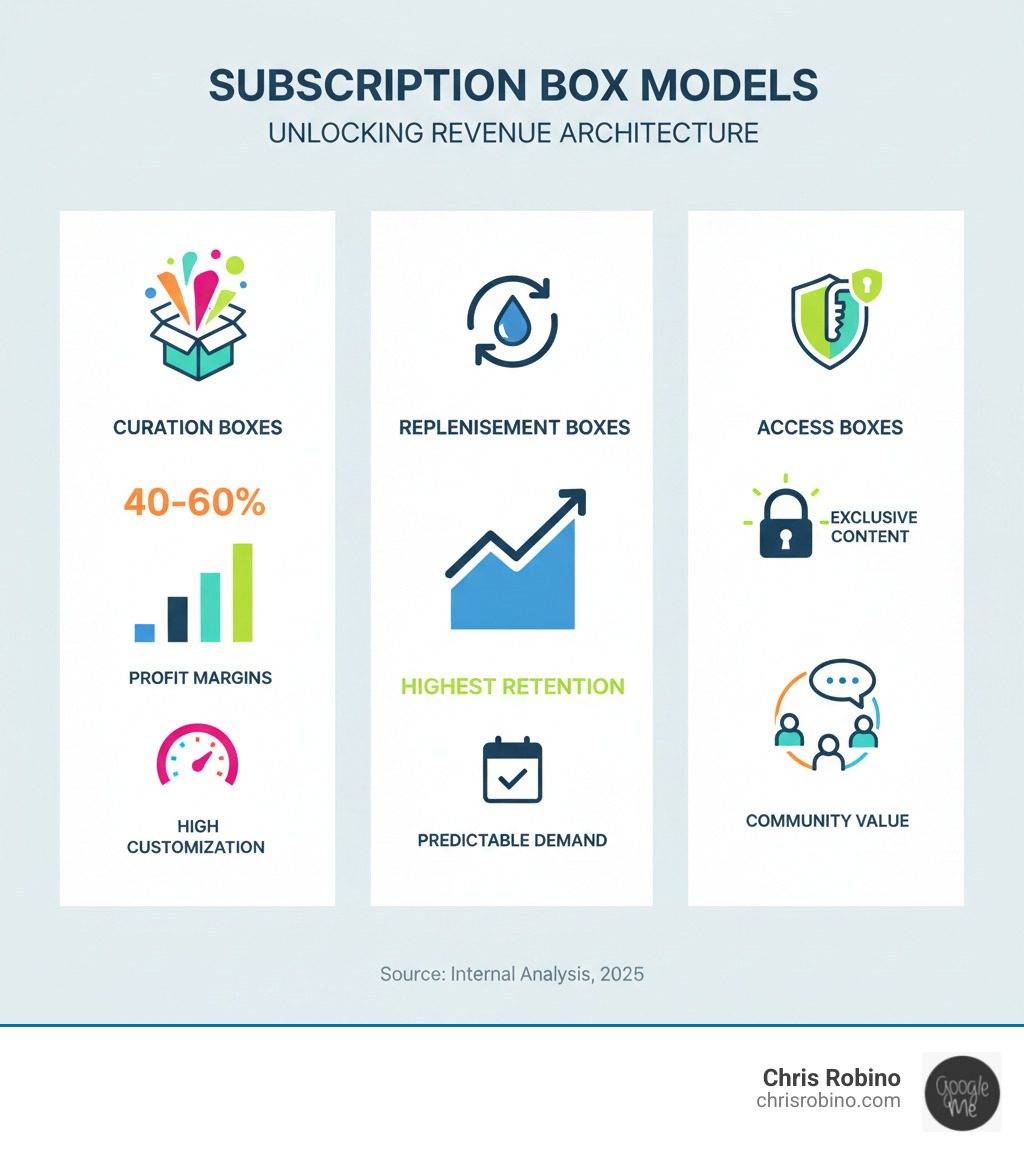
- Curation Boxes: Deliver themed, surprise selections (e.g., artisan snacks, beauty samples). They command high profit margins (40-60%) by offering findy and delight.
- Replenishment Boxes: Provide regular delivery of essentials like coffee or vitamins. They thrive on convenience, leading to lower margins (20-35%) but the highest retention rates.
- Access Boxes: Offer value through exclusivity, such as members-only content or events. Stickiness comes from community and premium access.
The ideal price for consumer boxes often falls between $25-45 per month, but the perceived value should be 2-3 times the cost to ensure satisfaction. Beyond a fixed monthly fee, consider tiered pricing (basic to premium), freemium models (free access with paid upgrades), or usage-based pricing that scales with consumption.
SEO for large companies: map each model and tier to dedicated, indexable landing pages aligned to high-intent keyword clusters (“best [category] subscription,” “[product] refills,” “[niche] membership”). Use structured data, on-page FAQs, and internal links from content hubs to improve findability and conversion.
Here’s how the three main subscription models compare:
| Model Type | Key Characteristic | Typical Profit Margin | Customer Retention | Ideal Niche |
|---|---|---|---|---|
| Curation Boxes | Curated surprise items, findy | 40-60% | Moderate | Beauty, fashion, hobbies, gourmet foods, unique experiences |
| Replenishment Boxes | Regular delivery of consumable essentials | 20-35% | Highest | Personal care, pet supplies, coffee, pantry staples, health supplements |
| Access Boxes | Exclusive membership, community, premium content | Variable (often high) | High | Niche communities, professional development, exclusive clubs, digital content |
Calculating Profitability and Key Metrics
Profitability is paramount. The basic formula is Revenue – Cost of Goods Sold (COGS) – Operating Expenses = Profit. For subscription businesses, key costs include:
- Product Costs: 30-40% of revenue.
- Shipping Costs: 15-25% of revenue.
- Packaging Costs: 5-10% of revenue.
- Marketing & Operations: 10-20% and 10-15% of revenue, respectively.
Beyond costs, track these key metrics to gauge business health:
- Customer Acquisition Cost (CAC): What you spend to gain a new subscriber.
- Customer Lifetime Value (LTV): The total revenue a customer generates. Aim for an LTV that is at least 3x your CAC.
- Churn Rate: The percentage of subscribers who cancel. Reducing churn is critical, as retaining customers is far cheaper than acquiring new ones. A 5% improvement in retention can boost profits by 25-95%.
- Average Revenue Per User (ARPU): The average revenue per subscriber.
Helpful definitions: Customer acquisition cost, Customer lifetime value, Churn rate, and ARPU.
Enterprise SEO measurement to tie organic efforts to revenue:
- Organic share-of-voice and non-brand traffic growth by product tier.
- Assisted and direct conversions from organic to subscription, add-ons, and upgrades.
- LTV:CAC by channel (with organic CAC modeled via content and platform costs).
- Cohort retention and expansion MRR originating from organic.
Data-driven decisions are non-negotiable. For businesses ready to leverage advanced analytics, AI-Powered Analytics can uncover patterns and opportunities invisible to manual analysis.
Integrating Revenue Streams into Your Business Plan
Your revenue streams must integrate with your entire business plan. Use a business model framework to connect your revenue model to your value proposition, customer segments, channels, and cost structure.
Ensure your channels align with your pricing, and build monetization into your solutions from the start. A seamless journey from awareness to renewal is crucial. The same principle applies here: every part of the business must support the revenue model.
Enterprise SEO foundations that support scale:
- Information architecture that mirrors product tiers and categories.
- Scalable, programmatic landing pages for SKUs, bundles, and locales.
- Structured data (Product, Offer, FAQ, Organization) and robust internal linking.
- Technical excellence: crawl budget control, canonicalization, sitemaps, Core Web Vitals, and accessibility.
- Governance: content standards, author E-E-A-T, and publishing workflows.
Before launch, address legal basics like forming an LLC and securing the right permits and insurance. Finally, don’t underestimate fulfillment and shipping. Operational excellence in warehousing, inventory, and shipping directly impacts profitability and customer satisfaction, preventing churn.
When these elements work in harmony, your revenue box strategies become a practical system for sustainable growth.
Advanced Revenue Growth & Diversification Tactics

With a solid foundation, move to advanced growth and diversification. The goal is a “revenue flywheel,” where each income stream strengthens the others. For large companies, enterprise SEO at scale provides the recurring demand that keeps the flywheel spinning—powering findy for core subscriptions, upgrades, partnerships, and new markets.
For organizations ready to build this kind of interconnected digital presence, our services for Digital Ecosystem Development provide the framework and support needed to make it happen.
Expanding Income with Upsells, Add-ons, and Premium Tiers
Since retaining a customer is far cheaper than acquiring one, expanding revenue from your existing base is a smart move. This is tracked as Expansion MRR.
- Upselling & Cross-selling: Offer a deluxe version of a product (upsell) or complementary items (cross-sell). The key is enhancing the customer’s existing experience.
- Add-ons & Premium Tiers: Give customers control with optional add-ons or create premium tiers with advanced features. For B2B models, this can include professional services like onboarding and custom implementation.
- Self-Serve Upgrades: Make it effortless for customers to upgrade on their own. Removing friction in the upgrade path directly increases conversion rates.
- Annual Plans: Offer discounts for annual commitments to lock in revenue, reduce churn, and improve cash flow.
Enterprise SEO tactics that amplify expansion:
- Create indexable upgrade and comparison pages (“[product] vs [product]”, “upgrade [plan]”, “premium [category] membership”) with FAQs and ROI calculators.
- Use schema (Product, Review, FAQ) and internal links from lifecycle content (onboarding guides, how-tos) to funnel qualified users to upgrades.
- Leverage programmatic SEO for add-on catalogs and pricing variations across regions or industries.
Diversifying Beyond the Core: Innovative revenue box strategies
Resilient revenue box strategies diversify beyond the core subscription. This builds protection against market shifts and opens new growth paths.
- Strategic Partnerships & Sponsorships: Collaborate with non-competing brands on co-marketing or bundled offers. Secure sponsorships for content, events, or by featuring partner products in your subscription box.
- Affiliate Revenue: Earn commissions by authentically promoting products and services that resonate with your audience.
- Licensing & Data Monetization: License proprietary software or tools you’ve developed internally. Package valuable industry data or content into premium “data products” or reports.
- Leveraging Community: For associations, create affinity programs that generate revenue while providing member value or develop new certification tracks.
SEO enablement for diversification:
- Build partner hubs and resource centers that rank for category-level queries and drive co-branded demand.
- Use structured data for Events, Courses, and Organization to improve visibility for sponsorships and certifications.
- Publish defensible research and benchmarks to earn authoritative links that lift the entire domain.
For a deeper dive into how content itself can become a powerful revenue driver, explore Content Monetization Strategies.
Future-Proofing Your Revenue Model with Data and Technology
Future-proofing means building an adaptable system with data, technology, and continuous iteration.
- Use Data for Personalization: Collect and analyze customer data to tailor offerings and messages. Personalization can increase retention by up to 25%. Use predictive analytics to anticipate needs and proactively reduce churn.
- Accept AI and Automation: Use AI-powered curation to improve product recommendations and boost customer satisfaction. Automate repetitive tasks like order processing and inventory management to reduce costs and errors.
- Test and Iterate: Continuously A/B test pricing, product mixes, and marketing. Small, data-backed improvements compound into significant revenue gains over time.
- Focus on Sustainability: With a large majority of consumers preferring eco-friendly options, incorporating sustainable packaging and ethical sourcing is now a business essential.
Enterprise SEO for durability and scale:
- Technical excellence: optimize Core Web Vitals, manage crawl budget, fix duplication with canonicalization, and maintain clean sitemaps.
- Entity and E-E-A-T signals: authoritative author pages, transparent sourcing, and organization-level identity to strengthen ranking resilience.
- Internationalization: use hreflang, localized content at scale, and regional pricing pages to expand markets without cannibalization.
- Governance: establish SEO guardrails for AI-assisted content, change management for site migrations, and log-file analysis for ongoing health.
This is where expertise in AI-Driven Business Solutions becomes invaluable. As a Business and Technology Consulting Firm, we help organizations turn these complex changes into sustained revenue growth. My two decades of experience have shown that companies embracing these principles don’t just survive market shifts—they thrive.