

Why SaaS Content Marketing Strategy Roles Matter More Than Ever
SaaS content marketing strategy roles are the specialized positions that drive content creation, distribution, and optimization for software-as-a-service companies. These roles differ from traditional marketing positions because they must steer unique challenges like long sales cycles (40-170 days depending on contract value), complex multi-touchpoint attribution (31-75 touchpoints per deal), and subscription-based business models where customer retention matters as much as acquisition.
In large-scale enterprise environments, these roles become even more critical. Large companies often struggle with “content sprawl”—thousands of pages that lack a cohesive SEO strategy or internal linking structure. For these organizations, SEO isn’t just about ranking for a few keywords; it’s about managing a massive digital ecosystem that captures intent across global markets. This requires a sophisticated understanding of how different roles interact to maintain technical health and topical authority at scale.
Core SaaS Content Marketing Roles:
- Navigator – Owns strategic direction, ICP definition, and high-level SEO keyword clustering.
- Scribe – Owns messaging consistency and the production of high-quality, authoritative content.
- Sculptor – Owns content presentation, UX, and the visual hierarchy of information.
- Engineer – Owns marketing systems, technical SEO infrastructure, and automation.
- Content Strategist – Identifies content gaps and aligns production with the product roadmap.
- Marketing Operations Manager – Scales logistics through tools, processes, and cross-departmental alignment.
- VP of Marketing Operations – Oversees the entire tech stack, budgets, and data integrity.
The SaaS industry faces specific challenges that make role clarity critical. Companies compete with non-competitors for the same keywords, making a robust SEO and content strategy essential. Only 9% of marketers strongly agree their strategies work, and just 40% believe their companies have effective marketing. In large organizations, the problem is often structural: siloed teams creating redundant content that cannibalizes its own search rankings.
Traditional specialist-heavy teams create communication overhead that grows exponentially. At 8-12 people, coordination becomes the primary workload instead of execution. Modern SaaS teams, especially those managing enterprise-level domains, need fewer, broader roles with clear ownership rather than narrow specialists who require constant alignment meetings.
I’m Chris Robino, and over two decades I’ve helped SaaS companies from startups to enterprises transform their digital visibility through strategic saas content marketing strategy roles that integrate AI automation with data-backed growth strategies. Here’s how to structure your team for maximum impact.
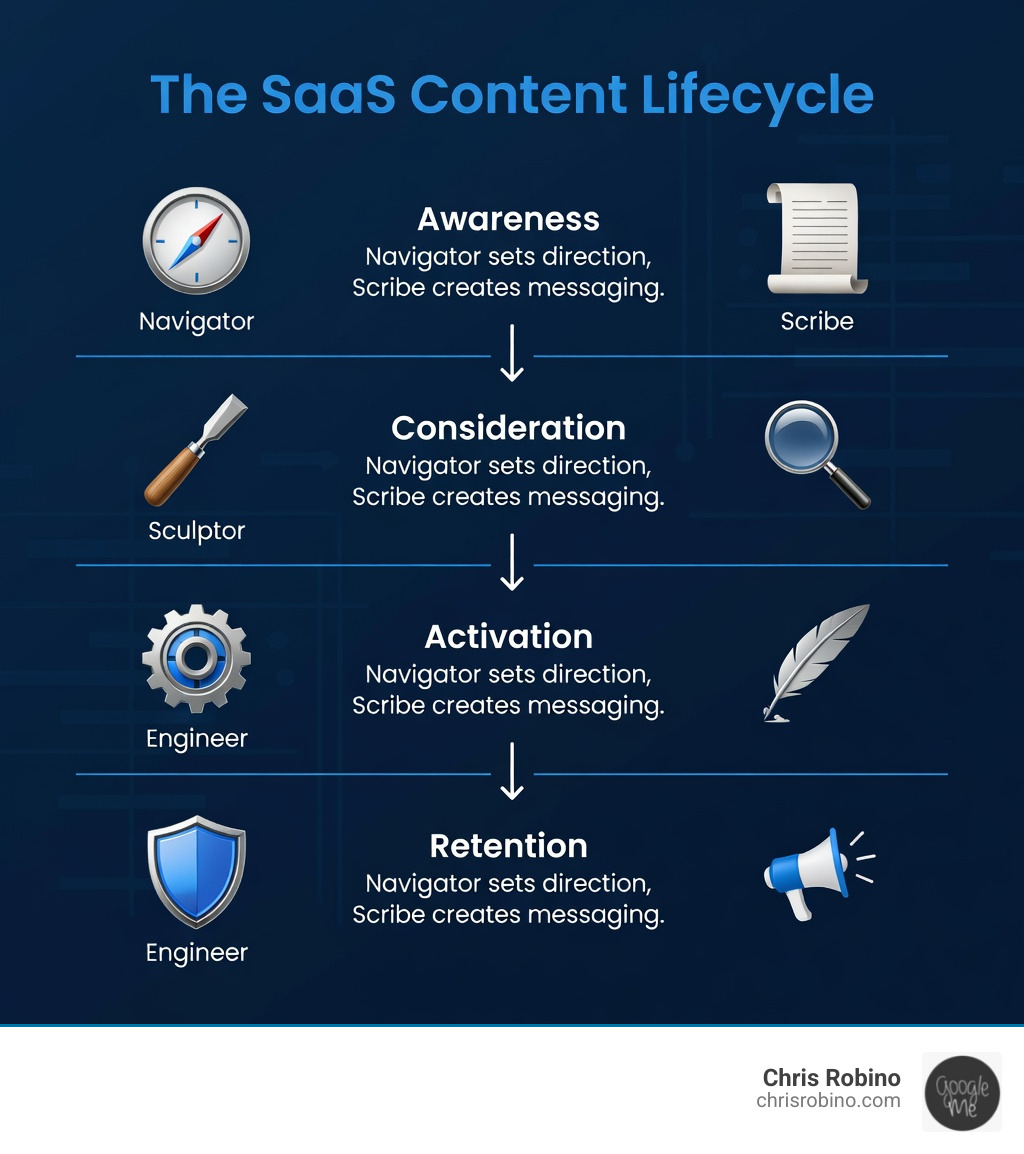
Saas content marketing strategy roles terms explained:
Core SaaS content marketing strategy roles and Team Structures
For years, SaaS companies followed a predictable hiring pattern: hire an SEO lead, then a writer, then a designer, then a social media manager. We’ve seen this lead to “communication overhead.” When you hire specialists one function at a time, you don’t necessarily create more capability; you often just create more meetings.
Research shows that as team size grows, the lines of communication grow exponentially. By the time a team hits 10+ people, the “Navigator” spends half their day just making sure everyone is on the same page. This is where the 4-role model, introduced in the Syntropy framework, simplifies everything, particularly for large companies managing complex SEO requirements.

- The Navigator: They own the “Why” and the “Who.” In an enterprise SEO context, they are responsible for market share analysis and identifying high-value keyword clusters that align with the company’s long-term product vision. They ensure the team isn’t just chasing traffic, but capturing the right intent.
- The Scribe: The Scribe owns the message across every touchpoint. For large companies, this means maintaining brand voice across thousands of pages. They architect the content standards that allow for high-volume production without sacrificing quality or SEO integrity.
- The Sculptor: They own the user experience. In SEO, this translates to Core Web Vitals, mobile responsiveness, and ensuring that the information architecture is intuitive for both users and search engine crawlers.
- The Engineer: They own the machine. For large-scale SEO, the Engineer is vital. They manage the technical SEO debt, implement schema markup at scale, and build the automation tools that allow for programmatic SEO and efficient internal linking.
Defining the Content Strategist vs. Content Operations Roles
One of the biggest red flags in saas content marketing strategy roles is the confusion between strategy and operations.
A Content Strategist focuses on the high-level roadmap. They ask: What content do we need to create to solve our customers’ pain points? How does this align with our product roadmap? They focus on messaging and brand alignment. If you’re looking for a deep dive into how to build this roadmap, our SaaS Content Marketing Guide covers the tactical steps.
In contrast, Content Operations (Content Ops) is about the “How.” They manage the governance, documentation, and project management tools. In large companies, Content Ops ensures that SEO best practices are baked into the workflow, preventing the technical decay that often plagues large websites.
For a neutral overview of how content strategy differs from day-to-day content operations, see Content strategy.
Key Marketing Operations Roles for Scaling SaaS
As a SaaS company grows, the “Engineer” role often evolves into a full Marketing Operations (MOps) team. This team is the backbone of the marketing department, ensuring that creative efforts aren’t wasted on broken systems.
- VP of Marketing Operations: They oversee the entire tech ecosystem and budget. They are the bridge between marketing, sales, and finance, ensuring that SEO investments are tied to revenue outcomes.
- Marketing Operations Manager: They focus on repeatable processes. If a lead comes in from a blog post, they ensure it’s correctly attributed and passed to the right sales rep.
- Data and Analytics Manager: With large companies spending more than double the amount on software than they were five years ago, this role is vital. They turn raw data into actionable insights, helping the team understand which content clusters drive the highest Monthly Recurring Revenue (MRR).
- Marketing Technology Specialist: They are the “tool whisperers.” They research, integrate, and maintain the tech stack, including enterprise-level SEO platforms and automation tools.
How AI is Reshaping SaaS content marketing strategy roles
The rise of AI has fundamentally changed what we expect from saas content marketing strategy roles. We are moving toward an “AI-native” mindset. Being AI-native means using automation not just to work faster, but to work smarter.
AI allows a single “Scribe” to produce the volume of content that previously required a team of five writers. However, the role has shifted from generating text to architecting prompts and editing for brand nuance. For large companies, AI is the key to scaling SEO through programmatic content and automated internal linking audits. Today’s content roles require high technical literacy to manage these AI-driven workflows effectively.
Executing and Measuring a High-Performance Content Strategy
When scaling, one of the most debated topics is whether to keep roles in-house or outsource. Our research suggests that while outsourcing can save a company up to $25,000 per year, in-house teams often outperform agencies when it comes to deep product understanding and complex technical SEO execution.
| Role | In-House | Outsourced (Agency/Freelance) |
|---|---|---|
| Strategy (Navigator) | Essential – Must own the brand vision. | Good for external audits/fresh eyes. |
| Writing (Scribe) | Best for technical/product-led content. | Great for high-volume SEO/TOFU. |
| Design (Sculptor) | Best for core product/brand identity. | Good for creative campaigns/ads. |
| Ops (Engineer) | Essential for data security/CRM. | Good for initial tech stack setup. |
SEO Strategies for Large Companies
For large SaaS organizations, standard SEO tactics aren’t enough. To dominate competitive markets, these companies must employ advanced strategies that leverage their existing authority.
1. Programmatic SEO at Scale Large companies can use the “Engineer” and “Scribe” roles to build programmatic landing pages. For example, if a SaaS product has 500 integrations, creating a unique, high-quality landing page for each “[Product] + [Integration]” keyword can capture massive amounts of high-intent traffic. This requires a robust technical infrastructure to ensure each page is unique and valuable.
2. Content Hubs and Topical Authority Instead of isolated blog posts, large companies should build comprehensive content hubs. This involves the “Navigator” identifying a broad topic (e.g., “Project Management”) and the “Scribe” creating a pillar page supported by dozens of cluster articles. This structure signals deep topical authority to search engines and improves internal link equity distribution.
3. Technical SEO and Crawl Budget Management With thousands of pages, large SaaS sites often face crawl budget issues. The “Engineer” must prioritize technical SEO, ensuring that search engines are crawling the most important pages. This includes managing redirects, fixing 404 errors, and optimizing site speed to meet Core Web Vitals standards.
4. Global SEO and Localization For enterprise SaaS, SEO is often a global effort. This requires roles that understand hreflang implementation and localized keyword research. It’s not just about translating content; it’s about adapting the strategy to local search behaviors and cultural nuances.
Aligning SaaS content marketing strategy roles with the Sales Funnel
Successful saas content marketing strategy roles must be aligned with the sales cycle. Because SaaS sales cycles can be incredibly long, roles must be distributed across the funnel:
- Bottom-of-Funnel (BOFU): This is where your highest ROI lives. Roles here focus on “VS” pages, use case pages, and pricing guides. The goal is conversion.
- Middle-of-Funnel (MOFU): Roles focus on “how-to” guides and templates that solve specific customer pain points.
- Top-of-Funnel (TOFU): This is about awareness. It’s high volume but lower intent.
We recommend a “Bottom-Up” strategy. Don’t hire a TOFU writer until you’ve hired someone to nail your BOFU conversion content. In large companies, this prevents the common mistake of generating millions of visitors who never convert into trials or demos.
Essential Skills and KPIs for Modern Content Teams
What does success look like? It’s not just “more traffic.” For SaaS, the metrics must tie back to the bottom line.
- Customer Acquisition Cost (CAC): Is our content making it cheaper to get a customer?
- Lifetime Value (LTV): Is our educational content helping users stay longer?
- Churn Rate: Are we providing enough “Success” content to keep people from leaving?
- Monthly Recurring Revenue (MRR): The ultimate SaaS North Star.
Roles like the Content Manager must be comfortable looking at these numbers. They need to understand How to Use Case Studies in SaaS Content Marketing to bridge the gap between a “cool story” and a “closed deal.”
Conclusion: Scaling Your SaaS content marketing strategy roles
Building a world-class SaaS content team isn’t about collecting titles; it’s about defining ownership. Whether you adopt the 4-role model or a more traditional MOps structure, the goal remains the same: reduce communication overhead and focus on high-intent, product-led content that performs at scale.
For large companies, the path to success lies in mastering technical SEO, programmatic content, and topical authority. As you scale, your team structure should be as agile as your software. Start with clear ownership, embrace an AI-native mindset, and always measure success by the impact on your MRR, not just your word count. By aligning your saas content marketing strategy roles with both user needs and search engine requirements, you create a sustainable engine for long-term growth.
If you’re looking for personalized guidance on how to structure your team or refine your approach to enterprise-level SEO, I’m here to help as a SaaS Content Marketing Consultant. Let’s build a content engine that actually drives growth.