
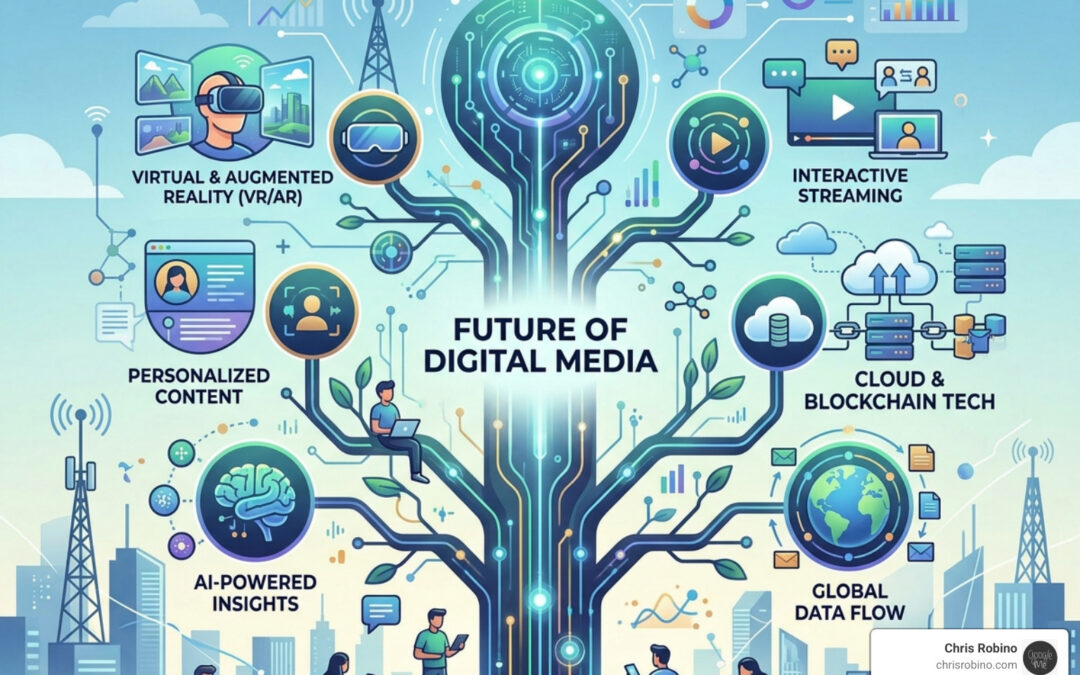
The Digital Media Future Is Already Here — Here’s What You Need to Know
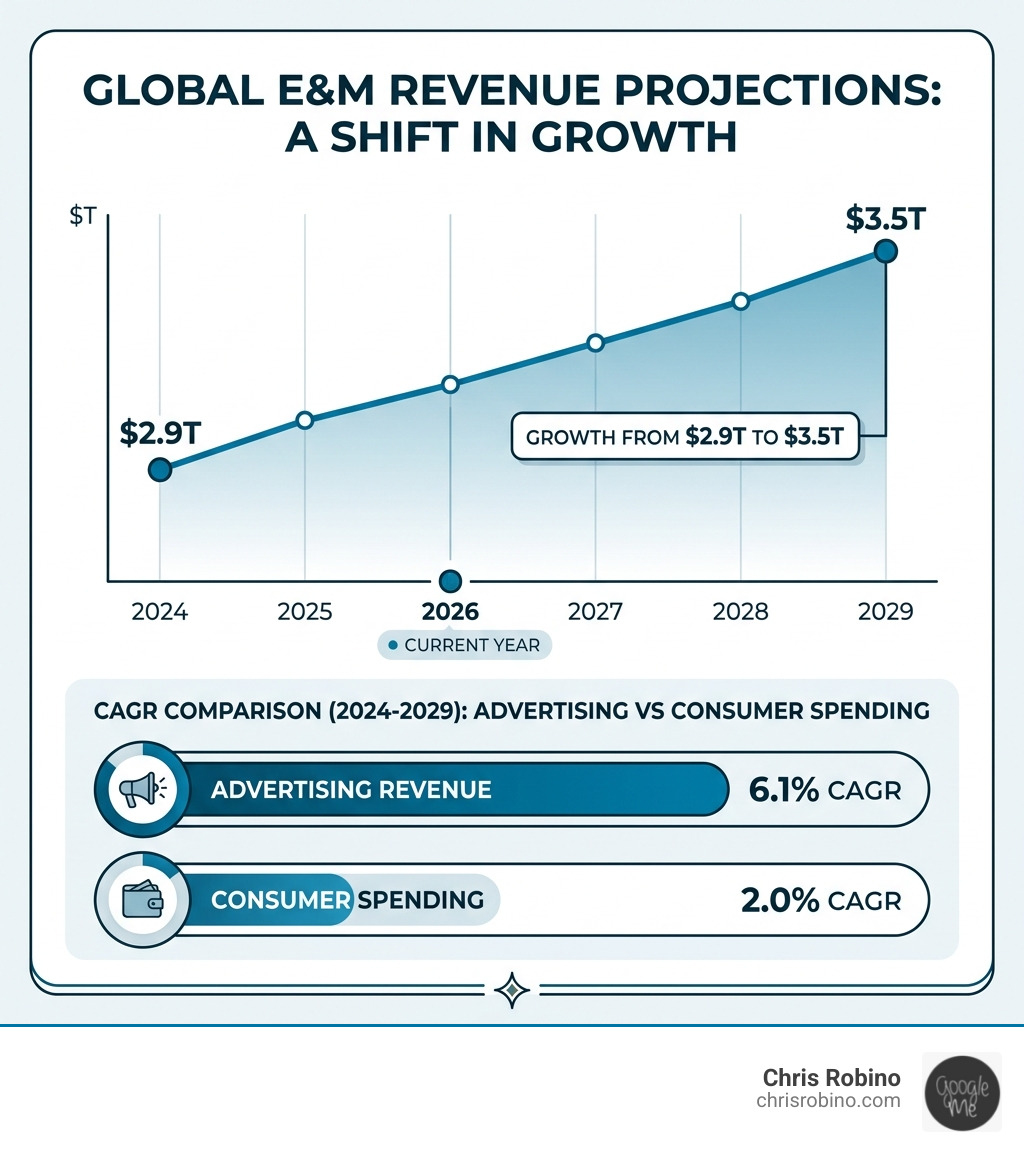
The digital media future is unfolding right now, and the numbers are hard to ignore. Global entertainment and media revenues hit $2.9 trillion in 2024 — a 5.5% jump in a single year. By 2029, that figure is projected to reach $3.5 trillion.
Here’s a fast-read breakdown of the biggest forces shaping where digital media is headed:
| Trend | What’s Happening |
|---|---|
| AI transformation | GenAI is reshaping content creation, advertising, and consumer behavior at speed |
| Advertising dominance | Ad revenue is overtaking consumer spending, growing at 6.1% CAGR vs. 2.0% |
| Fandom economy | 80% of consumers identify as fans; fans spend 16% more time daily on media |
| Social video disruption | Platforms like TikTok and YouTube are outcompeting traditional studios for attention and ad dollars |
| Streaming fatigue | 41% of SVOD subscribers churned in the last six months despite paying an average of $69/month |
| Regional growth | India’s internet advertising is growing at 15.9% CAGR — the fastest of any major market |
| Gaming surge | Video game revenues reached $223.8 billion in 2024, on track for $300 billion by 2029 |
The average person now spends 6 hours every day consuming media and entertainment. That’s not a trend — that’s a lifestyle. And the companies that understand how those hours are being spent, and who is spending them, are the ones pulling ahead.
The Enterprise SEO Imperative in a Digital-First World
As we look toward the digital media future, large-scale organizations face a unique challenge: maintaining visibility across millions of pages while search engines transition into AI-driven answer engines. For enterprise-level companies, SEO is no longer just about keywords; it is about infrastructure, data integrity, and brand authority.
Large companies must move away from fragmented, department-specific content strategies and toward a unified, programmatic approach. This involves optimizing for “search intent clusters” rather than individual terms. When you are managing a site with 100,000+ URLs, the focus shifts to crawl budget optimization and ensuring that your most valuable assets are easily discoverable by both human users and AI crawlers. The future of enterprise SEO lies in the ability to scale high-quality, authoritative content that serves as the definitive source for both traditional search results and generative AI responses.
I’m Chris Robino, a digital strategy and AI search expert with over two decades of experience helping organizations — from startups to enterprise brands — navigate exactly these kinds of shifts in the digital media future. In this guide, I’ll break down the data, the disruptions, and the practical strategies you need to stay ahead.
Digital media future further reading:
The Digital Media Future: AI, Advertising, and the $3.5 Trillion Shift
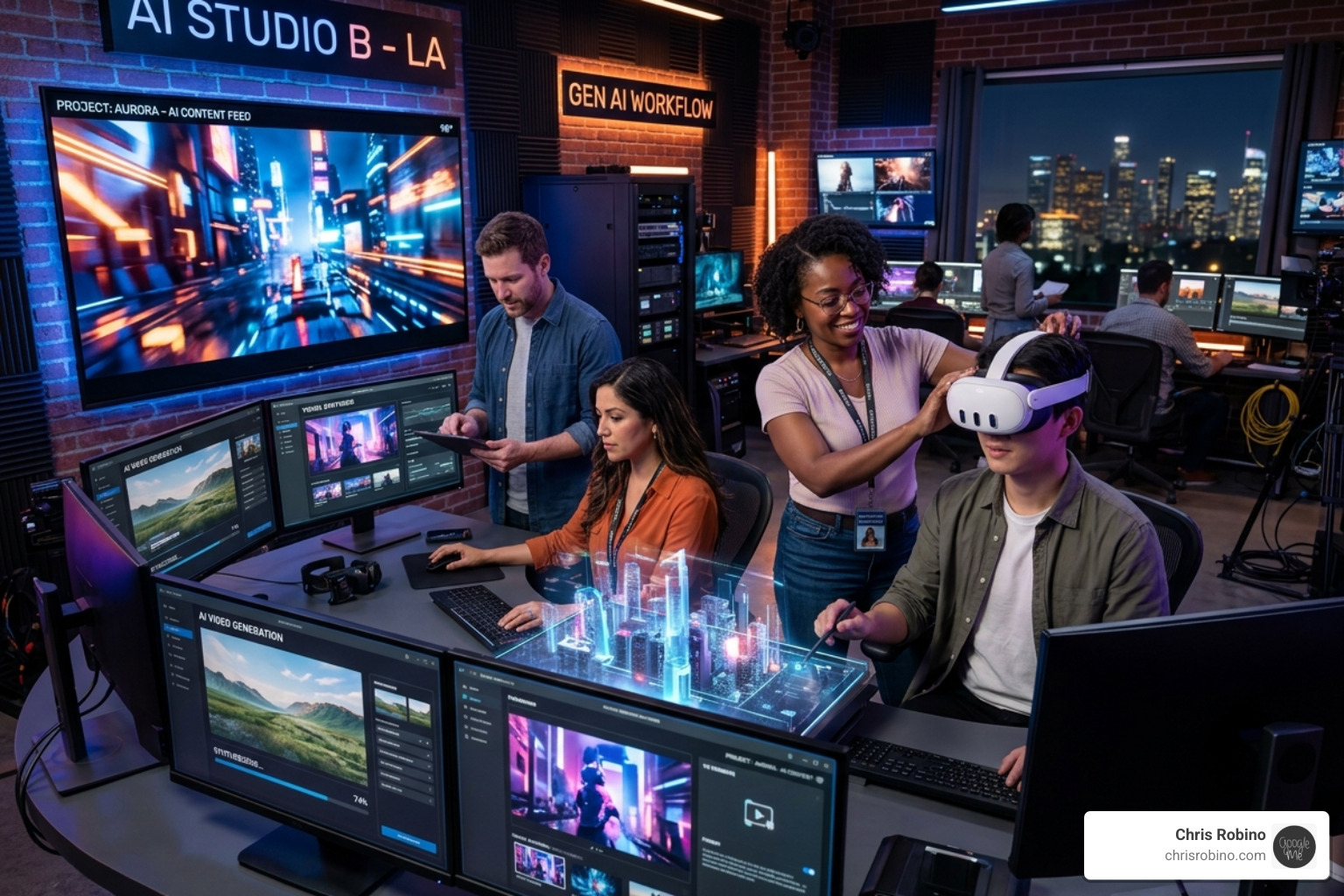
As we peer into the digital media future, we are witnessing a massive structural realignment. The industry is no longer just growing; it is evolving into a tech-first ecosystem where data and automation dictate the winners. With a projected global revenue of $3.5 trillion by 2029, the stakes have never been higher.
Generative Engine Optimization (GEO): The New Frontier for Large Brands
Generative AI (GenAI) is the primary engine behind this transformation. It isn’t just a tool for making “cool” images; it is rewriting the rules of consumer behavior. For large companies, this necessitates a shift toward Generative Engine Optimization (GEO). Unlike traditional SEO, which focuses on ranking in a list of links, GEO focuses on becoming the cited source within an AI’s generated response.
Large brands have a significant advantage here: established authority. By leveraging structured data (Schema.org) and maintaining a high level of E-E-A-T (Experience, Expertise, Authoritativeness, and Trustworthiness), enterprise companies can ensure their content is the “truth set” that LLMs (Large Language Models) rely on. This requires a technical SEO strategy that prioritizes machine-readability and semantic clarity. If your enterprise site isn’t optimized for how AI models ingest and synthesize information, you risk becoming invisible in the next generation of search.
According to recent industry trends, AI is accelerating the speed of change to a “breakneck” pace. Publishers expect a 40% decline in traditional search traffic as “answer engines” begin to provide direct information rather than links. To survive, companies must move beyond experimentation and embed AI into their core operations. This is where digital transformation services become essential, helping legacy brands rewire their infrastructure for an AI-first world.
The Monetization Pivot: Advertising Overtaking Consumer Spend
For decades, the “gold standard” of media was the subscription. But the tide is turning. By 2029, advertising revenue will surpass consumer spending by a staggering $300 billion. Why? Subscription fatigue.
With 90% of US households already paying for at least one SVOD (Subscription Video on Demand) service—and many juggling four or more—the wallet is stretched thin. 41% of consumers say SVOD content isn’t worth the rising prices. This has led to the rise of hybrid models:
- AVOD (Advertising-Based Video on Demand): 54% of subscribers now opt for ad-supported tiers to save money.
- Connected TV (CTV): Ad spend in this sector is ballooning as programmatic TV allows for hyper-targeted, data-driven commercials.
- Retail Media: Brands are increasingly advertising within commerce platforms, closing the loop between “seeing an ad” and “making a purchase.”
Navigating the Digital Media Future through Global Growth Hubs
While mature markets are seeing a slowdown, the digital media future is bright in emerging regions. India is the standout star, with internet advertising projected to grow at a 15.9% CAGR. China follows with a robust 8.9% growth rate.
We are also seeing a massive shift in what people consume. Gaming is no longer a niche hobby; it is a $223.8 billion powerhouse on its way to $300 billion by 2029. In fact, gaming revenues have already exceeded movies and music combined. This reflects a generational shift: Gen Z and Millennials prefer interactive, social, and creator-led content over traditional, passive TV. For a deeper dive into these geographic shifts, check out our global media analysis.
Fandom and Hyperscale Platforms: The New Battle for Attention
The battle for the digital media future isn’t just between Netflix and Disney. The real “hyperscale” disruptors are social video platforms like TikTok, YouTube, and Instagram. These platforms have something traditional studios struggle to maintain: deep, “always-on” fandom.
Technical SEO and Answer Engine Optimization (AEO) for the Enterprise
To compete with these hyperscale platforms, large companies must master Answer Engine Optimization (AEO). As users move away from browsing and toward asking specific questions, your enterprise SEO strategy must focus on providing direct, concise, and authoritative answers. This involves a heavy investment in technical SEO: ensuring fast load times, mobile-first indexing, and a clean site architecture that allows search bots to crawl and index content efficiently.
For large organizations, programmatic SEO is a vital tool. By using data-driven templates to create thousands of high-quality, intent-specific pages, companies can capture long-tail search traffic that competitors often overlook. However, this must be balanced with a strict focus on quality. “AI slop” or low-value automated content will be penalized by modern algorithms. The goal is to use technology to scale your expertise, not to replace it. By implementing robust internal linking structures and optimizing for “featured snippets,” large brands can dominate the top of the search results page, ensuring they remain the primary point of contact for their audience.
Always-On Fandom: Capturing Value Between Seasons
Fandom is the ultimate retention tool. Fans don’t just watch content; they live it.
- The Fan Bonus: Fans spend 51 more minutes daily on media than non-fans.
- Higher Spend: SVOD-subscribing fans spend $71/month on average, compared to $56 for non-fans.
- The Desire for Aggregation: 40% of fans (and 49% of Gen Z) wish they could find all content related to their favorite IP—social clips, podcasts, merchandise, and the show itself—in one single place.
Media companies need to stop viewing the “off-season” as a lull and start seeing it as an opportunity. By using GenAI to create personalized highlight reels, recaps, and even co-creation tools for fans, studios can keep the flame alive year-round. This is a core part of the media industry trends we track: moving from “content delivery” to “fan orchestration.”
Strategic Adaptation and the Chris Robino Vision for 2026
Traditional studios are currently caught in a squeeze. On one side, production costs are soaring. On the other, social platforms are siphoning off the ad dollars. Recent industry data shows that social platforms now capture over half of all US ad spending.
So, how do you win in the digital media future? It requires a shift in mindset from “volume” to “value.” As search traffic declines due to AI answer engines, we must pivot toward Answer Engine Optimization (AEO) and Generative Engine Optimization (GEO). This means building authority so that AI models cite your brand as a trusted source.
At Chris Robino, we help media companies navigate these technological shifts by focusing on “value in motion.” Whether it’s implementing AI for operational efficiency or building a cross-platform fan strategy, our goal is to ensure you aren’t just reacting to the future—you’re defining it. If you’re ready to transform your production pipeline, you can unlock media production consulting to get started.
Summary of Key Actions for 2026:
- Prioritize Fandom: Build ecosystems that keep fans engaged between major releases.
- Invest in Ad Tech: Partner with hyperscalers or build addressable ad markets to reclaim revenue.
- Leverage GenAI: Use it for back-end automation, personalized recaps, and co-creation tools.
- Focus on AEO & GEO: Optimize your content to be the “answer” in an AI-driven search world.
- Scale with Programmatic SEO: Use data-driven content strategies to maintain enterprise-level visibility.
- Adopt Hybrid Models: Combine subscriptions with ad-supported tiers to combat churn.
The digital media future is complex, but it is also full of opportunity for those willing to embrace the “always-on” reality of modern entertainment. We’re here to help you bridge that gap.