

Designing a High-Impact Innovation Strategy
An effective innovation strategy is a detailed roadmap that aligns your business goals with customer needs to create new value, improve efficiency, or disrupt markets. Instead of relying on random creative sparks, a strategic approach coordinates your team, resources, and systems to turn ideas into profitable realities.
Here is the quick-take summary of what makes it work:
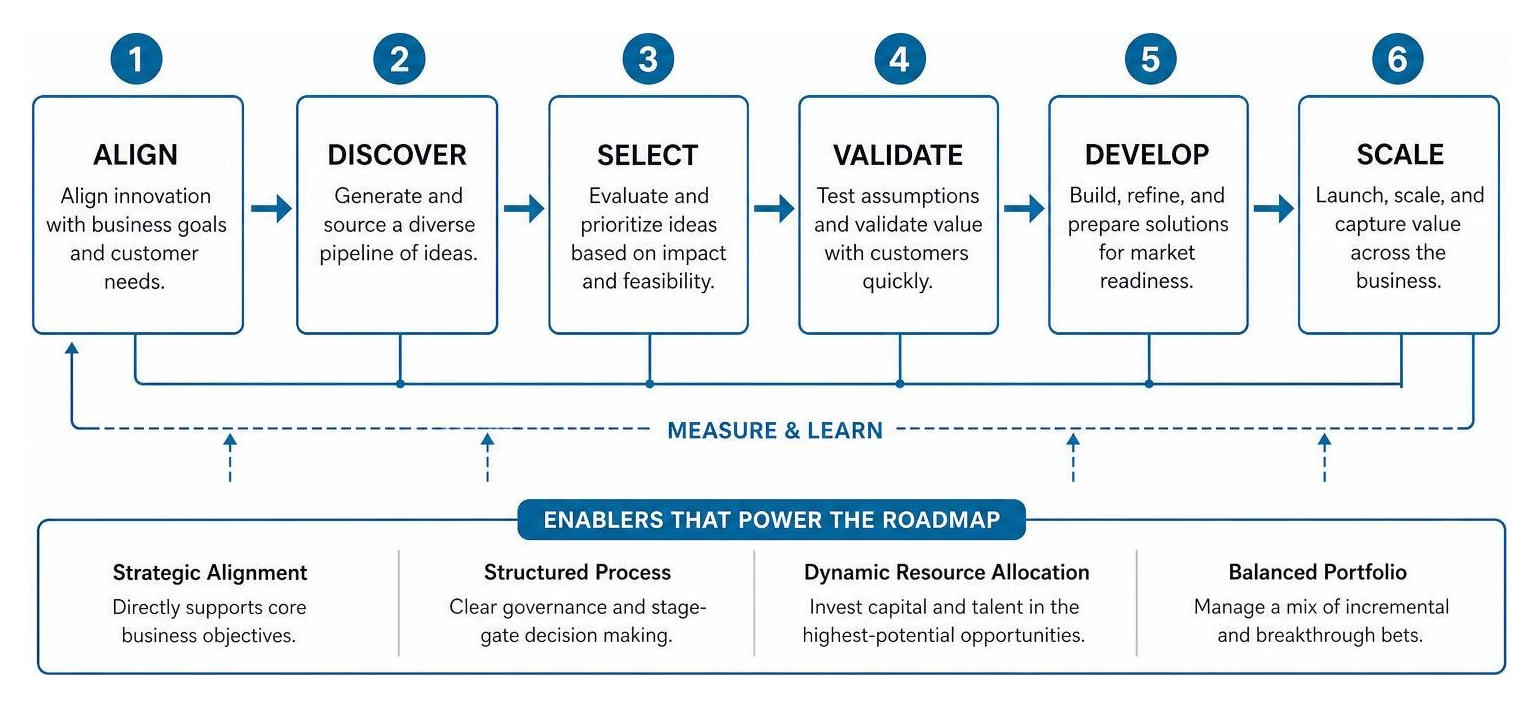
- Strategic Alignment: It must directly support your core business goals, not run as a separate creative hobby.
- Structured Process: It guides ideas through a clear funnel: generation, selection, testing, and scaling.
- Dynamic Resource Allocation: It moves capital and talent to high-potential projects rather than spreading budgets too thin.
- Balanced Portfolio: It mixes low-risk incremental updates with high-risk, high-reward breakthroughs.
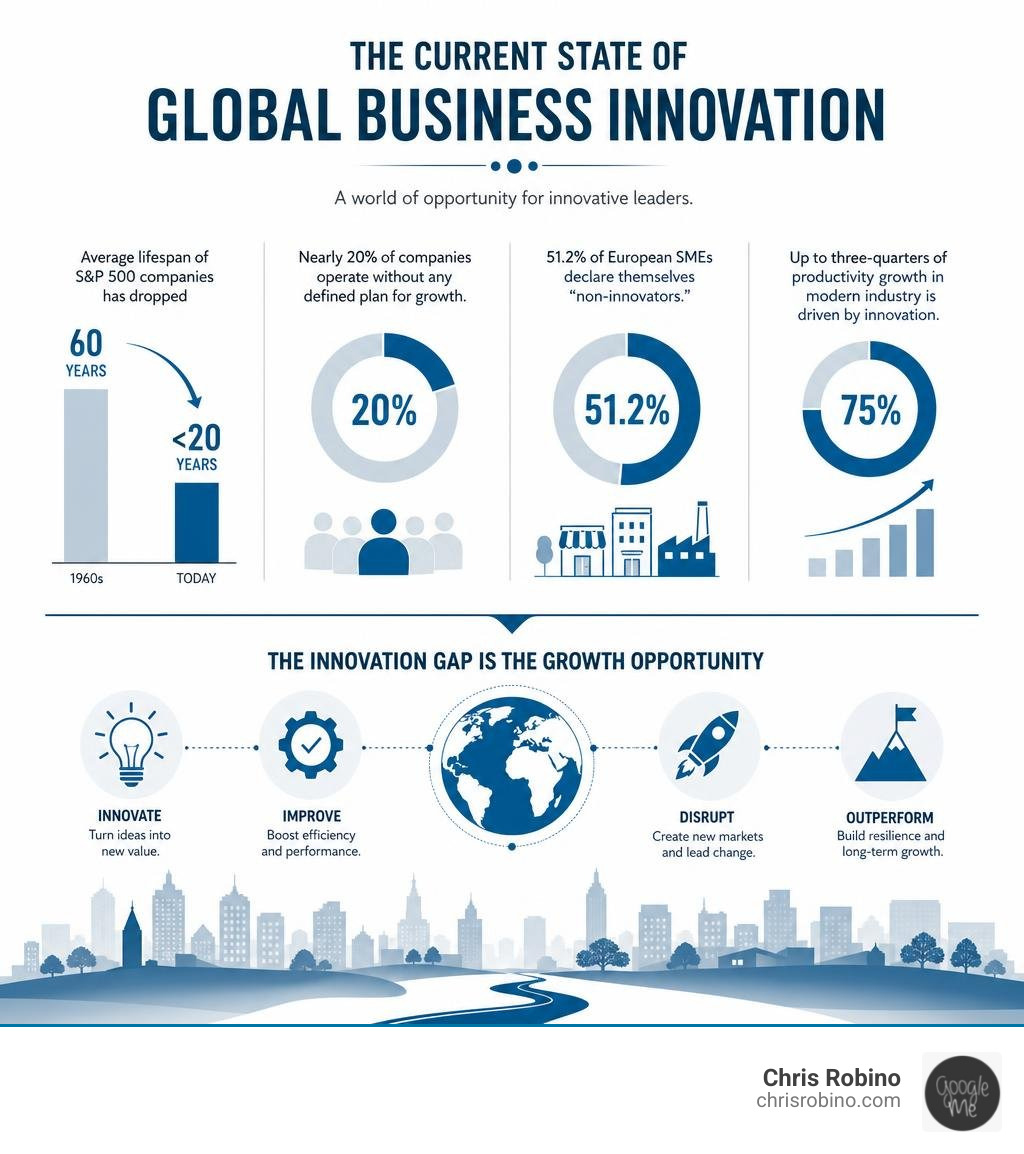
In today’s fast-moving market, the risk of standing still is fatal. The average lifespan of an S&P 500 company has plummeted from 60 years in the 1960s to less than 20 years today. Yet, despite this pressure, nearly 20% of companies operate without any defined plan for growth, and a staggering 51.2% of European small and medium enterprises (SMEs) openly declare themselves as “non-innovators.”
This massive gap represents a historic opportunity for those willing to build a repeatable, disciplined approach to growth. Up to three-quarters of all productivity growth in modern industry is directly driven by structured innovation.
My name is Chris Robino, and over the past two decades, I have helped emerging startups and global enterprises design and execute high-performing innovation strategy models that drive measurable financial returns. Through my work in digital strategy and AI integration, I help organizations move past the chaos of ad-hoc brainstorming to build predictable systems for long-term survival.
Innovation strategy further reading:
To move from ad-hoc brainstorming to a repeatable engine of growth, we must treat innovation as a core strategic discipline. Many organizations treat R&D as a cost center rather than a dynamic capital allocation exercise. However, top-performing companies realize that strategic clarity acts as a multiplier.
Leading innovators do not necessarily outspend their competitors on R&D instead, they excel at resource allocation. In fact, roughly half of top-performing innovators spend the same or less than their industry peers on R&D, but they focus over 60% of their spend on transformative or disruptive projects rather than minor product updates.
When done correctly, this targeted allocation correlates directly with superior market performance. To explore how to build these roadmaps from the ground up, see our comprehensive guide on innovation strategy development.
Defining Innovation and Aligning Your Business Goals
What is the most widely accepted definition of innovation? Broadly, it is the creation and application of new knowledge to improve the world and capture new value. Yet, a major challenge in modern business is the lack of a global consensus on this definition.
To some executives, upgrading an existing product with a minor feature is “innovation.” To others, only market-disrupting technology qualifies. This definitional ambiguity is not just academic—it matters deeply for business strategy. Without a shared vocabulary, organizations struggle to align their departments, leading to misallocated budgets, mismatched expectations, and isolated creative teams that fail to impact the core business.
Integrating innovation directly into your overall business strategy is the only way to reverse shrinking corporate lifespans. As regional data shows, only 25.1% of companies in Catalonia made product or business process innovations, and a tiny 7.53% had a specific innovation strategy. This lack of planning directly limits growth. To bridge this gap, we must apply rigorous business planning methodologies directly to our creative efforts. For a deeper academic look at this integration, read the Scientific research on integrating innovation into business strategy.
Core Types of Innovation Strategy
When designing your approach, you can target several distinct areas of value creation:
- Product Innovation: Developing entirely new offerings or significantly improving the capabilities of existing ones to meet customer needs.
- Process Innovation: Applying new technologies or workflows to improve internal operational efficiency, such as automating a supply chain.
- Business-Model Innovation: Changing how your business creates, delivers, and captures value (e.g., shifting from transactional sales to recurring subscriptions). For more on this, read about the art of business model innovation.
- Open Innovation: Collaborating with external partners, customers, or startups to co-create solutions.
- Disruptive Innovation: Introducing simpler, more affordable solutions that challenge established industry leaders.
These types map to different competitive postures, which can be categorized into four strategic archetypes:
| Strategy Type | Market Stance | Key Characteristics | Risk Level |
|---|---|---|---|
| Proactive | First-Mover | Strong research orientation; seeks to disrupt markets and lead technology trends. | High |
| Active | Rapid Follower | Defends core tech while preparing to respond quickly once a market is proven. | Medium-High |
| Reactive | Market Follower | Copies proven innovations only after competitors establish clear demand. | Medium-Low |
| Passive | Conservative | Waits until customers explicitly demand changes before making updates. | Low |
For practical insights on choosing the right path, explore our guides on business innovation strategies and cooperative innovation strategies.
Key Factors Influencing Strategic Choices
The right innovation strategy depends heavily on a balance of internal and external forces:
- Internal Capabilities: Your organizational culture, talent pool, and available resources. If your team lacks specialized technical skills, a highly proactive tech-push strategy may fail.
- External Market Conditions: Competitive intensity, regulatory changes, and shifting customer preferences.
- Technology Push vs. Market Pull: Technology push is driven by R&D breakthroughs looking for a market, whereas market pull is driven by explicit, immediate customer demand.
These factors dictate how much revenue companies invest back into R&D. For example, Apple historically invests around 5% of its annual revenue in R&D, relying on highly focused, late-stage product integration. Meanwhile, Google invests over 16%, Meta over 13%, and Amazon leads with an intense 28% of revenue reinvested to fuel constant infrastructure and platform expansion.
Top performers use these investments to grow both within and beyond their core markets. For a detailed breakdown of these dynamics, consult the Scientific research on top performers and innovation growth. To keep up with technological shifts, read our emerging tech insights.
Executing Your Innovation Strategy
To translate high-level business goals into a working innovation engine, we recommend a three-step framework:
- Define the Strategic Problem: Identify the core threat or opportunity your business must address (e.g., stagnating sales, shifting customer demographics, or new competitive technologies).
- Determine the Innovation Goals: Formulate clear, quantified ambitions that resolve the strategic problem (e.g., “Generate 20% of revenue from new digital services within three years”).
- Create the Execution Plan: Outline who is responsible, who will participate, what resources are allocated, and which workflows will guide ideas from concept to reality.
This structured methodology ensures that your team’s creative energy is focused on the problems that matter most. For academic frameworks on this process, see the Scientific research on designing an innovation strategy. To get started on your own plan, check out our business innovation strategy complete guide and learn about structuring business innovation programs.
Measuring Success Across the Innovation Funnel
A common pitfall is applying traditional financial metrics—like Return on Investment (ROI)—too early in the creative process. Because innovation is inherently uncertain, premature ROI tracking can kill high-potential ideas before they have a chance to be validated. Instead, we must use a mix of qualitative and quantitative metrics tailored to each stage of the innovation funnel:
- Ideation Stage: Focus on input and velocity metrics. (e.g., Number of ideas submitted, employee participation rates, and time spent moving from idea to initial review).
- Validation Stage (PoC/Prototype): Focus on learning and quality metrics. (e.g., Customer feedback scores, technical feasibility ratings, and cost to build a prototype).
- Scaling Stage (MVP to Launch): Focus on commercial and efficiency metrics. (e.g., Time to market, customer acquisition cost, and initial revenue growth).
Using stage-gate logic allows leadership to make conditional investments, releasing budgets only when an idea passes specific validation criteria. For more on these governance principles, read the Scientific research on the core principles of strategic innovation and our guide to future trends analysis.
Governance, Culture, and Scaling for Long-Term Survival

Building a beautiful strategy document is only half the battle. The real test is creating an organizational culture that can sustain it. Without the right mindset and governance, even the best ideas die during implementation.
This cultural gap is why 60% of corporate accelerators fail within just two years. They isolate creative teams in a silo, leaving them disconnected from the core business units that must eventually scale their ideas. To avoid this, leadership must treat innovation as a permanent capability, not a temporary project.
At ChrisRobino.com, we specialize in helping organizations design the exact governance structures, cultural practices, and operational hand-offs required to turn creative concepts into long-term market value. If you are ready to build a sustainable innovation engine, explore our technology innovation consulting services.
Structuring Teams and Managing the Operational Hand-Off
Should innovation live in a dedicated department or operate as a horizontal, cross-functional capability?
While a dedicated department can protect early-stage ideas from daily operational pressures, it risks creating an “us versus them” dynamic. The most successful organizations position their innovation teams as a horizontal capability. In this model, a small core team manages the process, but they collaborate directly with cross-functional experts from product, engineering, marketing, and finance.
Managing the hand-off from these innovation teams to the operational scaling teams requires a structured progression:
At each transition point, clear operational hand-off agreements must define who owns the product, how budgets shift, and how success is measured.
Additionally, companies must match their projects with the right funding models. While core product improvements are usually funded through internal R&D budgets, more radical or disruptive ideas may benefit from government grants, venture capital, corporate spin-offs, or cooperative partnerships.
To see how national policies support these ecosystems, review the Scientific research on the UK innovation strategy. For hands-on help setting up these structures in your own organization, check out our innovation advisory services and stay ahead of future business technology trends.