
What Is Content Marketing 101? (And Why It Changes Everything)
Content marketing 101 is the foundation every business needs before spending another dollar on ads.
Here’s the quick answer:
Content marketing is the strategy of creating and sharing valuable, relevant content — blogs, videos, podcasts, emails — to attract a specific audience and turn them into customers. Instead of interrupting people with ads, you earn their attention by helping them first.
The core idea in 5 points:
- Create content that solves real problems your audience has
- Distribute it through channels where your audience spends time
- Build trust by showing up consistently over time
- Convert that trust into leads, subscribers, and sales
- Measure what works and double down on it
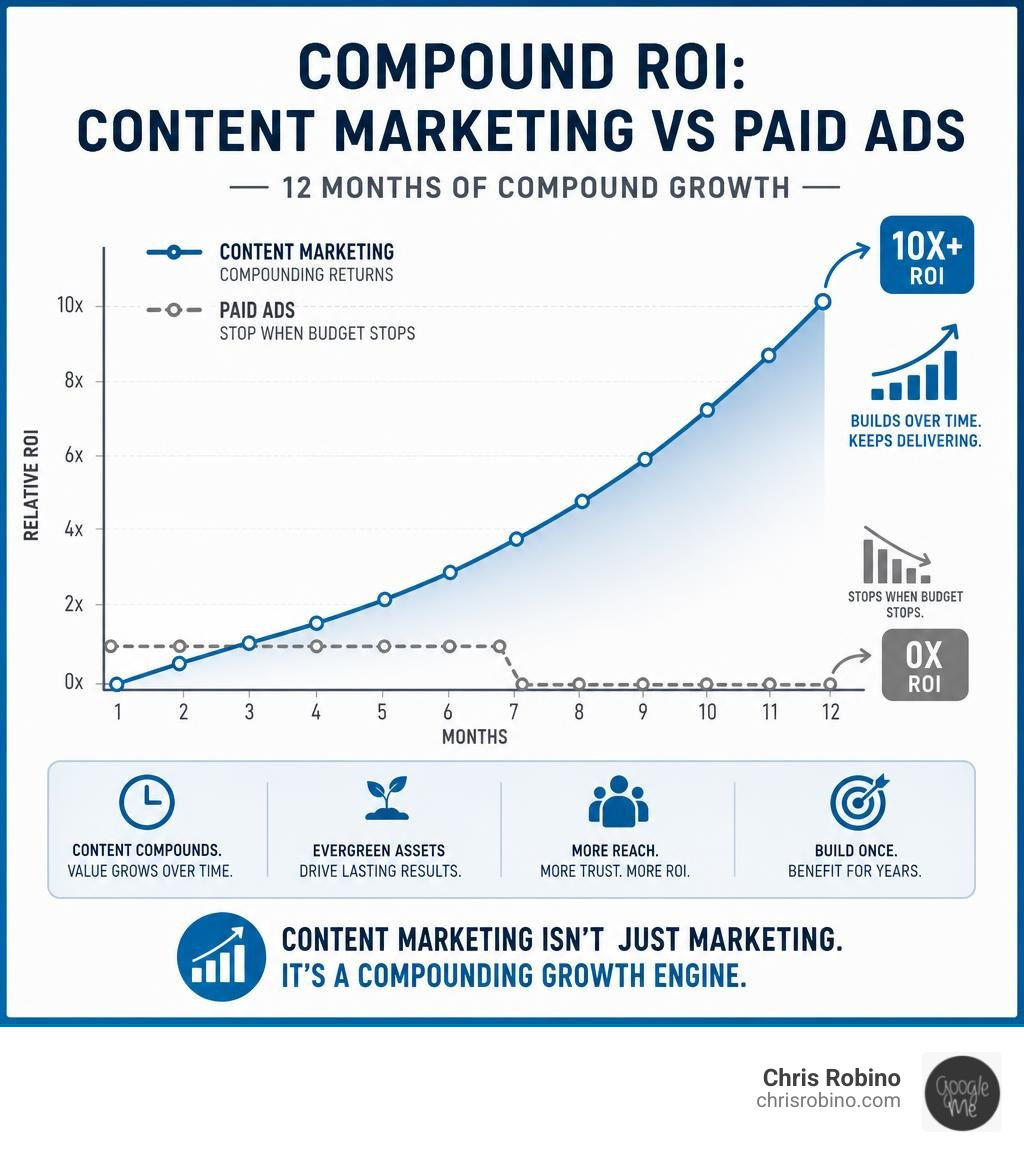
Why does this matter? Because content marketing costs 62% less than traditional advertising — and generates 3x more leads per dollar spent. Unlike paid ads that stop the moment your budget runs out, content compounds. A blog post published today can drive traffic for years.
73% of B2B marketers and 70% of B2C marketers now use content marketing as a core part of their strategy. And 62% of B2B buyers read 3–7 pieces of content before they’ll even talk to a salesperson.
The shift is clear: people don’t want to be sold to — they want to be helped.
I’m Chris Robino, a digital strategy leader with over two decades of experience in SEO, AI-driven search, and content marketing 101 fundamentals for businesses ranging from startups to established enterprises. In this guide, I’ll walk you through exactly how to build a content strategy that earns attention, builds authority, and drives measurable growth.
Basic content marketing 101 vocab:
- SaaS content marketing
- how to use case studies in saas content marketing
- saas content marketing roi metrics
Content Marketing 101: Demystifying the Core Strategy
To understand why this approach is so powerful, we must look at how customer behavior has evolved. Traditional outbound advertising relies on interruption—billboards, TV commercials, and pop-up ads that get in the way of what you are actually trying to do.
Content marketing is the exact opposite. It is an inbound strategy. Instead of pushing your message outward to anyone who will listen, you pull your ideal buyers in by publishing resources they are actively searching for.

What is Content Marketing 101 and Why Does It Matter?
At its core, content marketing 101 is about shifting from a product-first mindset to an audience-first mindset. When we create content that addresses the genuine pain points of our target market, we stop acting like pushy salespeople and start acting like trusted advisors.
This matters because trust is the ultimate currency. According to recent research, 96% of consumers do not trust traditional advertisements. However, 64% of buyers trust brands that publish educational content, and that trust jumps to 73% just one week after they consume it.
By consistently delivering valuable, relevant information, we achieve several critical business goals:
- Lower Customer Acquisition Costs (CAC): Content marketing is highly cost-effective, generating three times as many leads as paid search per dollar spent.
- Long-Term Brand Authority: High-quality resources establish our business as an industry leader.
- A Stable Lead Pipeline: Unlike paid ad campaigns that stop generating leads the moment you stop paying, evergreen content continues to attract organic traffic and capture leads for years.
Key Types of Content: From Blogs to Video
Content marketing is not a one-size-fits-all discipline. Different audiences prefer different formats, and the best strategies leverage a mix of media to reach buyers where they are. Here are the most effective content types for beginners:
- Blog Posts: Despite the rise of other media, 77% of internet users still actively read blog content. Blogs are the cornerstone of organic search discoverability and allow us to explore topics in deep detail.
- Short-Form Video: Video is a powerhouse, with 91% of companies using video marketing in their strategies. Short-form video platforms have become primary discovery engines for younger demographics.
- Email Newsletters: Email is the only distribution channel we truly own and control. It boasts an incredible average return of $40 for every $1 spent.
- Podcasts: Audio content allows us to build deep, intimate connections with busy professionals during their daily commutes or workouts.
- Infographics: Visual summaries make complex data easy to digest and are highly shareable across social platforms, often earning valuable backlinks.
- Case Studies: Real-world proof that shows exactly how we solved a problem for a client. This is crucial for middle- and bottom-of-funnel decision-making.
Integrating SEO and Social Media for Maximum Reach
Creating incredible content is only half the battle; the other half is getting people to see it. This is where search engine optimization (SEO) and social media integration come into play.
Organic search remains the single largest traffic driver for most websites, with 85.19% of all blog traffic coming from organic search. However, the reality is stark: 96.55% of content gets absolutely no organic traffic from Google. To avoid publishing into a void, we must design our content around search intent. We need to identify exactly what our audience is searching for and structure our content to answer those queries better than anyone else.
At the same time, we use social media to build communities and distribute our work. Rather than trying to be active on every single platform, we recommend mastering one or two primary channels where our target audience is most active. For enterprise brands looking to scale these efforts efficiently, we have compiled proven approaches in our guide on Content Marketing Strategies for Tech Companies.
How to Build and Measure a High-ROI Content Strategy
A successful content practice does not happen by accident. It requires a documented strategy. Surprisingly, only 43% of B2B content marketers have their strategy written down. Taking the time to document your goals, audience, and processes is a massive competitive advantage.

Mapping Content to the 2026 Buyer’s Journey
To turn casual readers into paying customers, we must deliver the right content at the right time. This means mapping our content assets to the three primary stages of the buyer’s journey:
| Stage | Buyer Mindset | Content Formats | Goal |
|---|---|---|---|
| Awareness (TOFU) | Realizing they have a problem but don’t know the solution. | Educational blog posts, short-form videos, infographics. | Maximize brand awareness and drive traffic. |
| Consideration (MOFU) | Defining their problem and researching potential solutions. | In-depth guides, webinars, comparison articles, podcasts. | Build trust and capture email leads. |
| Decision (BOFU) | Ready to make a purchase and evaluating specific providers. | Case studies, product-led tutorials, free trials, live demos. | Drive conversions and close sales. |
By tailoring our topics to these specific stages, we ensure we are supporting our audience from their very first search query all the way to the final purchase.
Step-by-Step Content Marketing 101 Execution Plan
When launching our program, we recommend following a clear, structured sequence rather than trying to do everything at once.
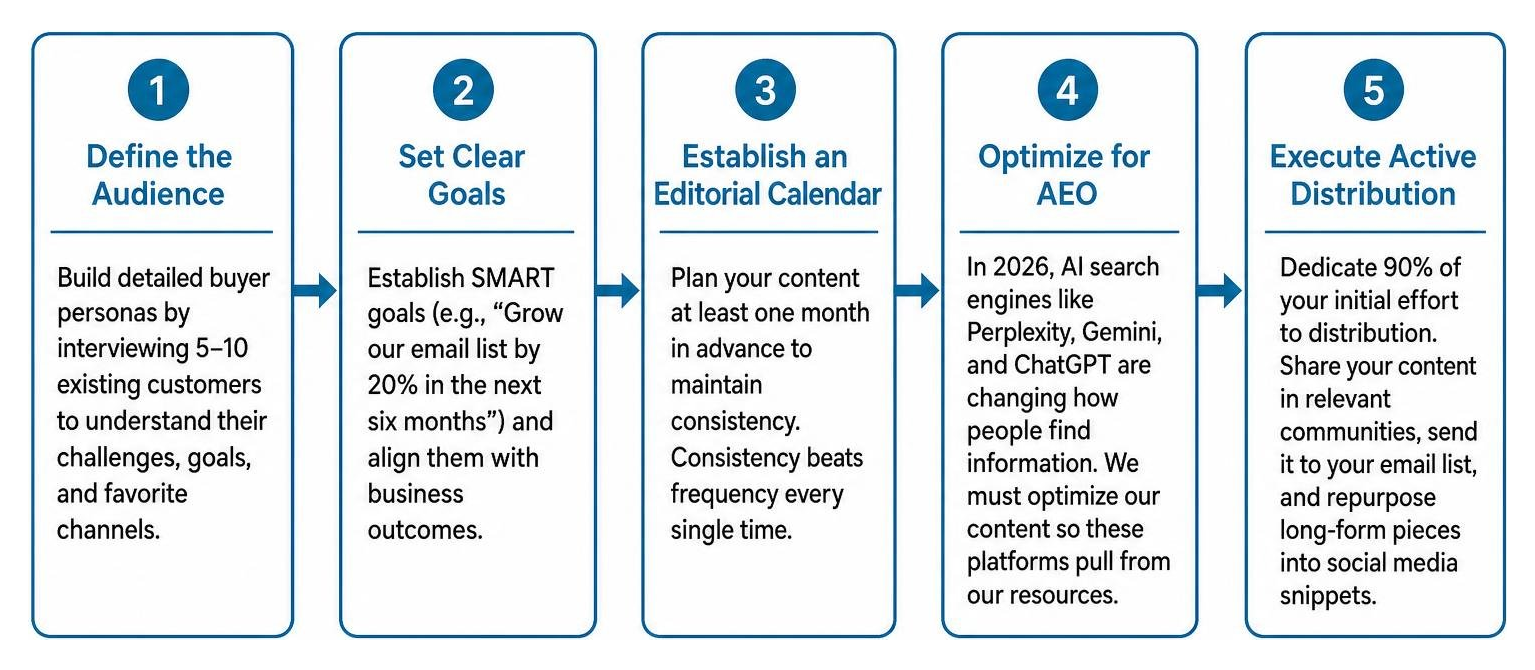
- Define the Audience: Build detailed buyer personas by interviewing 5–10 existing customers to understand their challenges, goals, and favorite channels.
- Set Clear Goals: Establish SMART goals (e.g., “Grow our email list by 20% in the next six months”) and align them with business outcomes.
- Establish an Editorial Calendar: Plan your content at least one month in advance to maintain consistency. Consistency beats frequency every single time.
- Optimize for AEO (Ask Engine Optimization): In 2026, AI search engines like Perplexity, Gemini, and ChatGPT are changing how people find information. We must optimize our content so these platforms pull from our resources.
- Execute Active Distribution: Dedicate 90% of your initial effort to distribution. Share your content in relevant communities, send it to your email list, and repurpose long-form pieces into social media snippets.
If you are operating in the technology sector, you can see how this execution plan applies specifically to your niche in our Tech Content Marketing Ultimate Guide.
Measuring ROI and Tracking Key Performance Metrics
We cannot manage what we do not measure. To prove the value of our content marketing efforts, we must track metrics that connect directly to business growth.
- Traffic Metrics: Organic sessions and unique page views show how well our content is attracting an audience.
- Engagement Metrics: Average time on page and email click-through rates indicate whether our content is actually keeping people interested.
- Nurture Metrics: Total email subscribers and lead magnet download rates show how well we are converting traffic into leads.
- Business Impact: Content-attributed revenue and customer acquisition cost (CAC) prove our ultimate return on investment.
For consultants and service providers, tracking these metrics is essential to scaling a practice. We explore these measurement frameworks in depth in our Content Marketing for Consultants Ultimate Guide.
If you are a contractor looking to outsource or scale your production team, our Content Marketing Contractors Complete Guide outlines how to manage these workflows seamlessly.
Conclusion: Taking Your Next Step
Content marketing is a long-term compounding asset. It is not a quick-fix ad campaign, but a strategic discipline that builds real, owned brand equity over 12 to 36 months.
If you are ready to stop renting attention through expensive paid ads and start earning it with high-impact, strategic content, we are here to help. Whether you need to refine your SEO strategy, optimize for AI-driven search engines, or build a scalable production workflow, you can partner with us to drive real business results.
Explore how we can scale your growth today at the Chris Robino SaaS Content Marketing Consultant Portal.