
Why Online and Social Media Marketing Is the Skill Set You Can’t Afford to Skip in 2026
Online and social media marketing is the practice of using digital platforms — Facebook, Instagram, TikTok, LinkedIn, YouTube, and more — to build a brand, attract customers, and drive measurable business results.
Here’s a quick breakdown of what it involves:
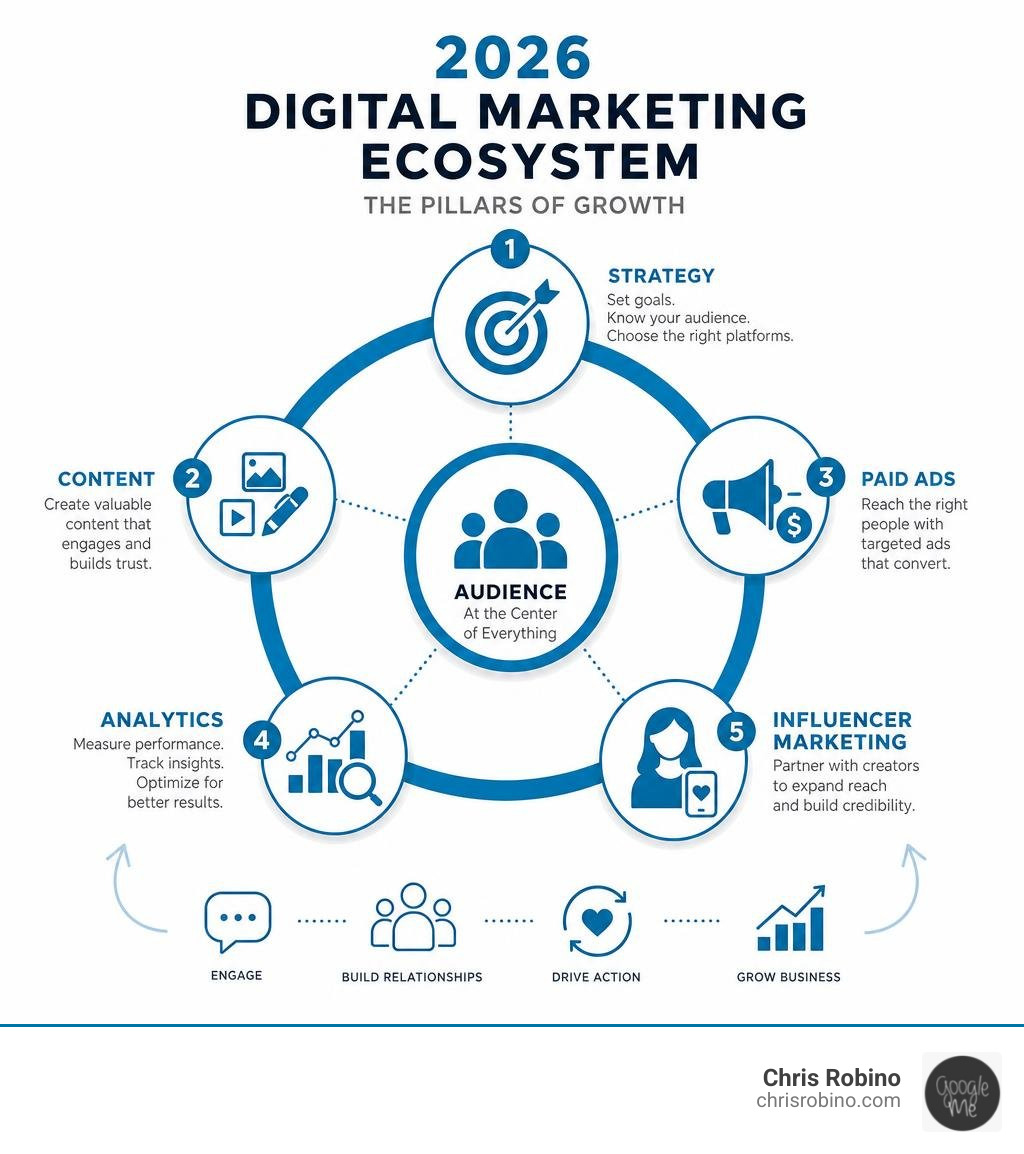
| Area | What It Means |
|---|---|
| Strategy | Setting goals, choosing platforms, defining your audience |
| Content | Creating posts, videos, and campaigns that engage people |
| Paid Ads | Running targeted ads on Meta, Google, TikTok, and LinkedIn |
| Analytics | Tracking ROI, engagement, conversions, and reach |
| Influencers | Partnering with creators to expand your brand’s credibility |
| Customer Care | Using social platforms to respond, support, and build loyalty |
The numbers make the case plainly. As of 2025, more than 6 billion people use social media worldwide. That’s not a niche channel — it’s where your customers live.
Yet most professionals feel overwhelmed. Platforms change their algorithms constantly. New tools like generative AI and augmented reality are reshaping what’s possible. And the gap between random posting and strategic social media marketing has never been wider.
The good news? The fundamentals are learnable — and they work.
I’m Chris Robino, a digital strategy leader and AI and search expert with over two decades of experience helping businesses — from early-stage startups to established enterprises — use online and social media marketing to drive real growth. In the guide below, I’ll walk you through everything you need to build a smarter, more effective approach without the chaos.
Online and social media marketing vocab to learn:
The Core Pillars of Online and Social Media Marketing
To build a social media strategy that converts, we must first understand the foundation. Sane marketers do not try to be everywhere at once. Instead, we focus on three core pillars: connection, interaction, and customer data.
When we treat social media as a bidirectional conversation rather than a unidirectional megaphone, we move from “hard selling” to building genuine brand equity. The magic happens when we map these interactions back to a centralized plan.

Designing a Strategic Framework for Online and Social Media Marketing
A successful framework begins with planning, not posting. If we do not know who we are talking to, we are just whispering in a hurricane.
First, we define our target audience by building detailed buyer personas. What are their pain points? Which platforms do they use to discover products? We then establish SMART (Specific, Measurable, Achievable, Relevant, and Time-bound) goals. For example, instead of saying “we want more followers,” we set a goal to “increase inbound website traffic from Instagram by 15% over the next quarter.”
Next, we focus on platform selection. It is far better to execute brilliantly on one or two channels than to spread ourselves thin across six. Finally, we design “sticky content”—highly engaging, visually attractive assets that capture attention instantly and encourage shares. To maintain consistency, we organize everything into a structured content calendar.
For a deeper dive into establishing these workflows, check out our guide on The Ultimate Guide to Internet and Social Media Marketing Success.
Organic vs Paid: Balancing Your Online and Social Media Marketing Budget
One of the most common debates in digital marketing is organic versus paid social media. The truth is, we need both. Organic social media builds our brand’s personality, fosters community, and nurtures existing customers. Paid social media, on the other hand, is our growth engine, allowing us to bypass algorithm restrictions and target highly specific demographics to drive direct conversions.
For large enterprises, balancing these two budgets requires strategic alignment. While organic efforts build long-term trust, paid campaigns drive immediate, scalable traffic.
| Feature | Organic Social Media | Paid Social Media |
|---|---|---|
| Primary Goal | Relationship building, brand voice, customer retention | Lead generation, rapid reach, direct conversions |
| Reach | Dependent on platform algorithms and follower sharing | Guaranteed reach based on budget and targeting parameters |
| Cost | Time-intensive; low direct financial cost | High financial cost; optimized via bidding strategies |
| Longevity | Long-lasting content library that builds search value | Temporary; runs only as long as the budget is active |
To maximize organic reach, we must optimize our content for platform search engines. Implementing smart on-page strategies is critical here; you can explore our curated SEO Tips to Improve Organic Rankings to learn how to align your social keywords with search intent.
Enterprise SEO Strategies for Large-Scale Organizations
For large companies, search engine optimization (SEO) requires a fundamentally different approach than it does for smaller businesses. When managing websites with tens of thousands of pages, the focus shifts from basic keyword optimization to scalable, programmatic strategies that drive sustainable organic growth.
One of the most effective SEO strategies for large enterprises is optimizing crawl budget and site architecture. Search engine bots have limited time to spend on any single site. By streamlining technical elements—such as resolving duplicate content, fixing broken redirects, and implementing clean XML sitemaps—large organizations ensure that search engines prioritize indexing their high-value, revenue-generating pages.
Additionally, programmatic SEO allows large companies to scale their content creation efficiently. By designing database-driven landing page templates that target long-tail, high-intent search queries, enterprises can capture massive search volume without manually writing thousands of individual posts. This must be paired with a robust internal linking structure, which distributes page authority (PageRank) from high-performing corporate pages down to deeper, transactional subpages.
Finally, large companies must leverage structured data (schema markup) to secure rich snippets in search results. Implementing product, FAQ, and organization schema helps search engines understand the context of your content, significantly improving click-through rates from organic search results.
Measuring ROI and Campaign Effectiveness
If we cannot measure it, we cannot improve it. Far too many brands focus on “vanity metrics” like likes or follower counts. While these indicators show brand awareness, they do not tell us if our marketing is actually driving revenue.
To measure real return on investment (ROI), we must track Key Performance Indicators (KPIs) that align with our business goals. These include conversion rates, click-through rates (CTR), customer acquisition costs (CAC), and customer lifetime value (CLV). By utilizing UTM (Urchin Tracking Module) tags on all our outbound links, we can trace exactly which post or ad generated a sale.
Beyond direct revenue, we also track “social equity”—the indirect value built through customer referrals, positive reviews, and brand advocacy. For a comprehensive look at setting up these attribution systems, review our Digital Marketing Strategy Advice.
Leveraging Influencers and Emerging AI Technologies
The influencer landscape has shifted dramatically. While mega-celebrities still command massive fees, smart brands are shifting their budgets toward micro-influencers. These creators, typically possessing between 10,000 and 50,000 highly engaged followers, are perceived as far more authentic and trustworthy. When a micro-influencer shares a first-person recommendation, their audience listens.
Simultaneously, emerging technologies are redefining how we create and optimize campaigns. Generative AI tools now assist us with rapid content creation, ad copy optimization, and automated customer research. We are also seeing the rise of virtual (CGI) influencers and augmented reality (AR) filters that allow consumers to “try on” products directly from their social feeds.
If you are looking to build a career in this rapidly evolving space, check out our Work from Home and Win: The Ultimate Freelance Digital Marketing Roadmap.
Customer Care, Privacy, and Omnichannel Integration
Social media is no longer just a marketing channel; it is our front-line customer service department. Consumers expect rapid, personalized responses when they reach out to a brand online. Deleting negative reviews or ignoring complaints is a quick way to destroy brand trust. Instead, we must acknowledge issues publicly and move the detailed resolution to private channels.
At the same time, we must navigate growing consumer concerns around data privacy. With nearly 40% of digitally connected individuals having deleted at least one social media account due to data privacy fears, brands must be highly transparent about how they collect and use consumer data, complying with regulations like GDPR.
Finally, we must integrate our online social media efforts with our offline marketing to create a seamless omnichannel experience. Whether a customer interacts with us via a physical storefront, a print ad, or a TikTok video, the brand voice, messaging, and customer experience must remain entirely cohesive.
To ensure your digital assets are fully optimized to support this omnichannel journey, check out The Ultimate Guide to Search Engine Ranking Tips.
Conclusion

Mastering online and social media marketing in 2026 does not require chasing every fleeting trend or algorithm update. Sane, successful marketing is built on strategic agility, clear data measurement, and establishing genuine human connections with your audience. By focusing on the fundamentals — target audience research, structured content calendars, and balanced organic and paid budgets — you can build a powerful digital engine that drives consistent business growth.
At Chris Robino, we help brands navigate this fast-changing landscape with clarity and precision. If you are ready to elevate your digital presence, streamline your campaigns, and build a cohesive omnichannel strategy, explore our Media Production Consulting services today. Let’s build something remarkable together.