
The AI Search Revolution Is Already Here — Are You Visible?
The biggest generative engine optimization trends in 2026 are reshaping how brands get discovered online. Here’s a fast snapshot for anyone who wants the short version:
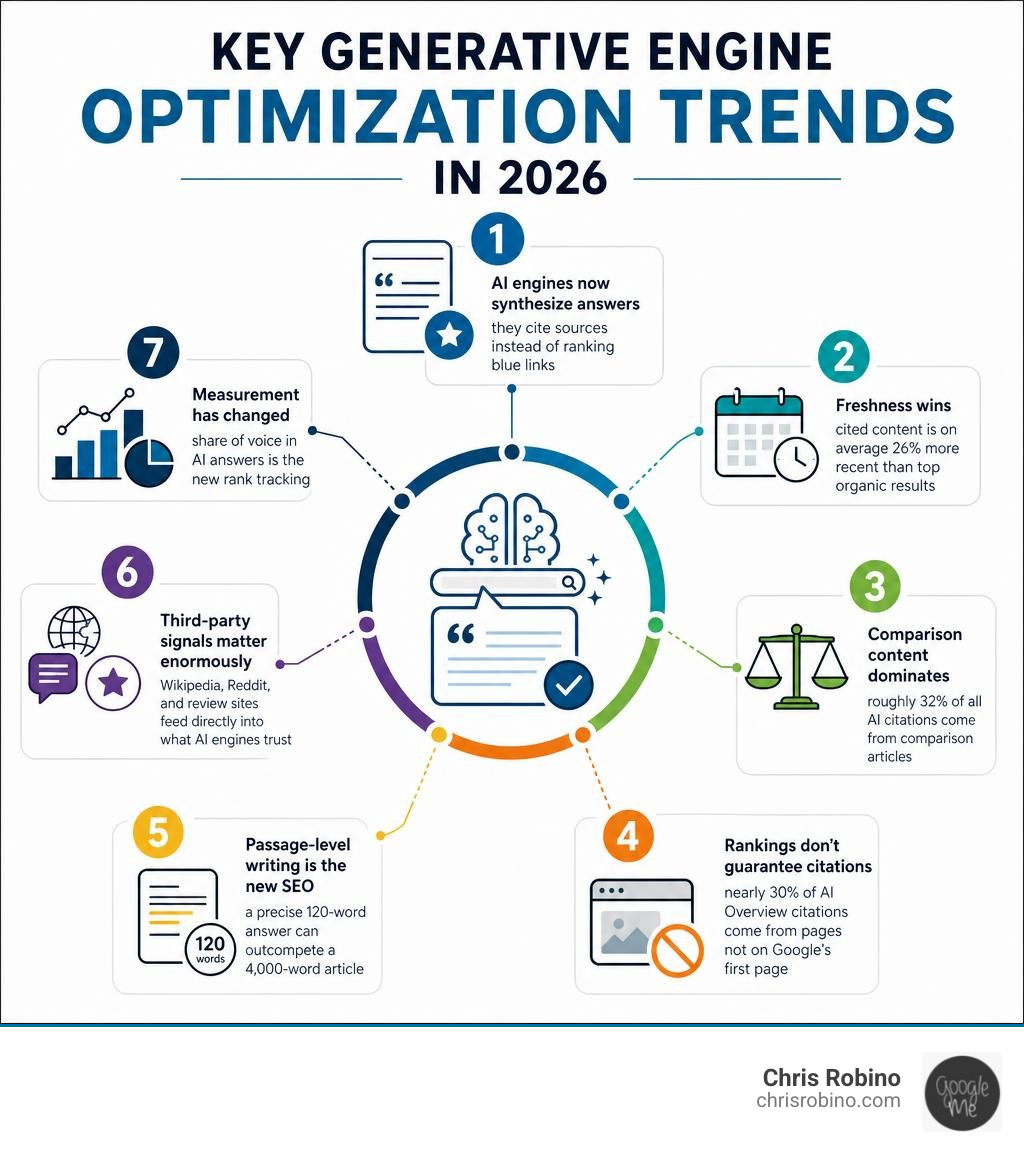
- AI engines now synthesize answers — they cite sources instead of ranking blue links
- Freshness wins — cited content is on average 26% more recent than top organic results
- Comparison content dominates — roughly 32% of all AI citations come from comparison articles
- Rankings don’t guarantee citations — nearly 30% of AI Overview citations come from pages not on Google’s first page
- Passage-level writing is the new SEO — a precise 120-word answer can outcompete a 4,000-word article
- Third-party signals matter enormously — Wikipedia, Reddit, and review sites feed directly into what AI engines trust
- Measurement has changed — share of voice in AI answers is the new rank tracking
Search used to be simple. You wrote a good page, earned some backlinks, and climbed Google’s rankings. Then people clicked your link.
That model is breaking down — fast.
Google AI Overviews now reach over 2.5 billion monthly users. ChatGPT pulls in over 3.8 billion visits per month. And according to Ahrefs, AI Overviews have already cut click-through rates for top Google results by 34.5%.
But here’s the twist: the traffic that does arrive from AI engines converts 4.4x better than standard organic traffic, according to Semrush.
So the volume is shrinking. The quality is rising. And the rules for getting cited — not just ranked — are completely different.
The brands winning in this new landscape aren’t necessarily the biggest or the best-funded. They’re the ones whose content is structured to be retrieved, understood, and cited by AI engines like ChatGPT, Perplexity, Google Gemini, and Google AI Overviews.
That’s what Generative Engine Optimization (GEO) is about.
I’m Chris Robino, a digital strategy leader with over two decades of experience in SEO, AI automation, and intelligent search — and tracking generative engine optimization trends sits at the center of my work with brands navigating this shift. In the sections ahead, I’ll walk you through exactly what’s changing, what it means for your visibility, and the practical steps you can take right now.
The Rise of Generative Engine Optimization Trends in 2026
As we navigate the mid-point of 2026, we are witnessing a massive transition. The search landscape is fracturing. Users no longer just type keywords into a bar; they have ongoing, multi-turn conversations with AI assistants to make complex purchasing decisions.
To stay visible, we must adapt to how these engines find information. We call this new frontier Generative Engine Optimization (GEO).

At the heart of modern GEO is Retrieval-Augmented Generation (RAG). AI engines do not rely purely on their static, pre-trained knowledge base to answer user queries. Instead, when a user asks a time-sensitive, highly specific, or commercial question, the engine queries a live search index (like Google’s index for Gemini or Bing’s index for ChatGPT), retrieves relevant web pages, and synthesizes an answer in real-time, complete with inline citations.
Furthermore, these platforms utilize a process called query fan-out. When a user types a complex prompt, the AI’s internal model generates multiple concurrent, related sub-queries to fetch a comprehensive set of search results. For example, a search like “how to fix a lawn that’s full of weeds” triggers fan-out queries such as “best herbicides for lawns” and “remove weeds without chemicals”.
To capture these citations, our content must be optimized to answer not just the primary keyword, but the entire cluster of sub-queries generated during fan-out.
How Generative Engine Optimization Trends Differ from Traditional SEO
If we treat the retrieval layer of Large Language Models (LLMs) the same way we treated Google’s PageRank algorithm back in 2010, we will lose. Traditional SEO is built around keywords, backlink profiles, and securing a spot in the “ten blue links.” GEO, on the other hand, is built around semantic relevance, passage extractability, and entity authority.
To help visualize this shift, let’s look at how the disciplines compare:
| Feature | Traditional SEO | Answer Engine Optimization (AEO) | Generative Engine Optimization (GEO) |
|---|---|---|---|
| Primary Goal | Rank a page in the top 10 blue links | Be selected as the single featured snippet/voice answer | Earn citations, quotes, and recommendations in AI answers |
| Core Metric | Organic rankings, impressions, CTR | Position Zero impressions, voice search share | AI Share of Voice, citation rate, brand-mention density |
| Unit of Optimization | Entire web page / URL | Short Q&A blocks and microdata | Self-contained passages and structured evidence files |
| Primary Signal | Keywords, PageRank, backlinks | Schema markup, direct question-matching | Entity authority, semantic grounding, inline citations |
Traditional SEO is still highly relevant because search engines rely on core indexing to feed their retrieval systems. However, we must layer GEO tactics on top of our existing search foundations. As we detailed in our Search Engine Rankings Ultimate Guide 2025, ranking first on Google no longer guarantees you will be the source cited in the AI summary.
The Retrieval Stack: How AI Engines Retrieve and Cite Content
To win the citation game, we need to understand how the AI retrieval stack operates. It generally follows a three-stage pipeline:
- Retrieval: The engine uses a traditional search index to pull a shortlist of potentially relevant documents based on the user’s prompt and fan-out queries.
- Reranking: A secondary machine learning model evaluates the retrieved documents at a passage level (typically analyzing blocks of 100 to 300 words) to score them for directness, factual density, and authority.
- Synthesis: The LLM reads the highest-scoring passages and synthesizes them into a cohesive, natural-language response, generating inline citations to the source documents.
Because citation competition happens at the passage level, a highly specific 120-word support page can easily outcompete a generic 4,000-word ultimate guide. The models prefer passages that resolve the user’s question within the first 100 words. If your content is buried deep under fluff introductory paragraphs, the reranking model will likely skip it.
Key Generative Engine Optimization Trends Shaping Enterprise Strategy
At the enterprise level, the focus is shifting away from commodity content. AI models are incredibly efficient at summarizing generic web information. If your content simply repackages the same tips found on fifty other websites, AI engines have no reason to cite you—they can generate that summary themselves.
To stand out, we must focus on:
- Non-Commodity Content: Publishing original data, first-hand case studies, proprietary research, and distinct points of view.
- E-E-A-T (Experience, Expertise, Authoritativeness, Trustworthiness): Showing real-world experience. For instance, a first-hand expert case study detailing a home inspection will easily out-cite a generic listicle of home-buying tips.
- Agentic Search: We are preparing for the rise of autonomous AI agents that browse the web on behalf of users. These agents analyze visual renderings, DOM structures, and accessibility trees to perform tasks, relying on clean structural layouts.
- Multimodal Answers: AI engines increasingly synthesize answers using text, images, and videos. Ensuring our visual assets are well-optimized is crucial.
For a comprehensive look at planning these assets, check out our guide on AI-Driven Content Strategy and learn how to build high-value Generative AI Content.
Actionable Frameworks to Survive the AI Search Revolution
Surviving the shift to AI-driven search requires a systematic, repeatable workflow. We cannot rely on guesswork or scattered copywriting tips.

A landmark academic study by researchers from Princeton, Georgia Tech, and other top institutions tested various content-modification tactics. They discovered that adding inline citations to authoritative external sources boosted a site’s visibility in generative responses by up to 40%. Furthermore, lower-ranked sites (such as those sitting at position five on Google) saw a 115% visibility lift when they integrated authoritative external citations inline.
To put these evidence-based findings into practice, we use structured approaches like the CLEAR Framework (Crawlable, Lead with the answer, Extractable, Authority, Refreshed/distinct).
On-Page Optimization: Structuring Content for Passage-Level Extraction
To make our content highly extractable for AI rerankers, we recommend structuring our pages with the BLUF (Bottom Line Up Front) writing style.
- The BLUF Formula: Lead each section with a direct, 20-to-40-word answer immediately below a question-style H2 heading. Follow this direct answer with supporting evidence, statistics, and expert quotes.
- Answer Cards: Design your layout so that key facts, pricing tiers, and product comparisons sit in distinct, self-contained visual blocks or tables.
- Semantic HTML: Use clean, nested HTML tags. Avoid burying important data inside complex JavaScript elements or images that crawlers might struggle to parse.
- Comparison Tables: Comparison pages account for roughly 32% of all AI citations. Always include a clean, semantic HTML comparison table within the first 40% of your comparison articles.
By organizing our pages this way, we make it incredibly easy for retrieval models to chunk our text and feed it directly into the LLM synthesis layer. For more on-page execution tips, see our SEO Tips to Improve Organic Rankings.
Technical Infrastructure and Off-Site Entity Authority
Our technical setup must signal trust and clear categorization to machine crawlers.
- Robots.txt Tuning: We must establish a clear bot policy. We want to allow live retrieval bots (like
OAI-SearchBotandPerplexityBot) so our brand gets cited in real-time searches, while carefully managing or blocking scraping bots that use our data solely for model training without giving attribution. - The llms.txt File: Creating a flat-text index of our most valuable, groundable content at
/llms.txthelps friendly AI assistants quickly discover our core resources. - Schema Markup (JSON-LD): Implement comprehensive
Organization,Person,Product, andFAQPageschemas. This builds a clean, machine-readable map of our brand’s entities. - Wikidata & Third-Party Signals: AI engines rely heavily on established knowledge graphs. Securing a presence on Wikipedia, Wikidata, and highly authoritative review platforms (like G2 or Trustpilot) establishes our brand as a verified entity. Unlinked brand mentions across the web also help models connect our brand to specific topical niches.
For a step-by-step technical checklist to support your rankings, check out The Ultimate Guide to Search Engine Ranking Tips.
Measuring Visibility and ROI in the AI Era
Traditional rank tracking is no longer sufficient. Because generative search is highly conversational and non-deterministic, we must track our AI Share of Voice and citation rates across a controlled distribution of prompts.
We recommend setting up a weekly prompt-testing tracker. Select 30 to 50 high-intent, long-tail queries that your target buyers are likely to ask AI assistants. Run these prompts across ChatGPT, Perplexity, and Google AI Overviews to monitor:
- Whether your brand is cited.
- Which specific pages are being retrieved.
- The overall sentiment of the synthesized response.
- Which competitors are winning the citations you missed.
At Chris Robino, we help businesses navigate this transition by building cohesive, future-proof search strategies. We streamline your technical infrastructure, optimize your content for passage-level extraction, and establish the strong entity signals required to dominate AI search results.
The search landscape is changing, but the opportunity to capture high-converting, highly motivated traffic has never been greater. Let’s work together to ensure your brand is the one the AI engines recommend.