

Why Future of Work Consulting Is the Strategic Priority You Can’t Ignore
Future of work consulting helps organizations navigate major shifts in technology, talent, and workplace models that are reshaping how businesses operate today and through 2030. For large enterprises, this transformation increasingly overlaps with digital visibility, making strong SEO strategies a practical part of modern operating strategy.
Here is a quick breakdown of what it covers:
- What it is: Advisory and implementation support to prepare organizations for automation, AI, skills shifts, and new ways of working.
- Why it matters: 39% of current skills will be transformed or obsolete by 2030, and many organizations also need scalable digital systems that help customers and talent find them online.
- Who it is for: Leaders and executives who need a structured plan to manage workforce change, technology adoption, and enterprise-scale digital operations.
- What it delivers: Better talent mobility, stronger productivity, and more resilient digital performance.
- Core focus areas: Automation strategy, skills-based workforce design, AI integration, enterprise SEO scalability, and hybrid work models.
The stakes are real. Incremental improvements are no longer enough. The organizations that thrive will be the ones that treat the future of work and digital visibility as connected strategic priorities rather than isolated HR or marketing initiatives.
Work itself is changing at its core. Tasks that were once done manually are being automated. Jobs are being redesigned around skills rather than titles. At the same time, the way customers discover organizations is evolving through AI-assisted search and complex digital ecosystems. The question is not whether your organization will be affected. It is how prepared you will be when the shift accelerates.
I’m Chris Robino, a digital strategy leader and AI and search expert with over two decades of experience helping organizations apply automation, AI-driven systems, and intelligent workflows to drive measurable growth. My work in future of work consulting sits at the intersection of emerging technology, workforce strategy, and digital transformation. In the sections ahead, I will walk you through a practical framework to build a resilient, future-ready organization.
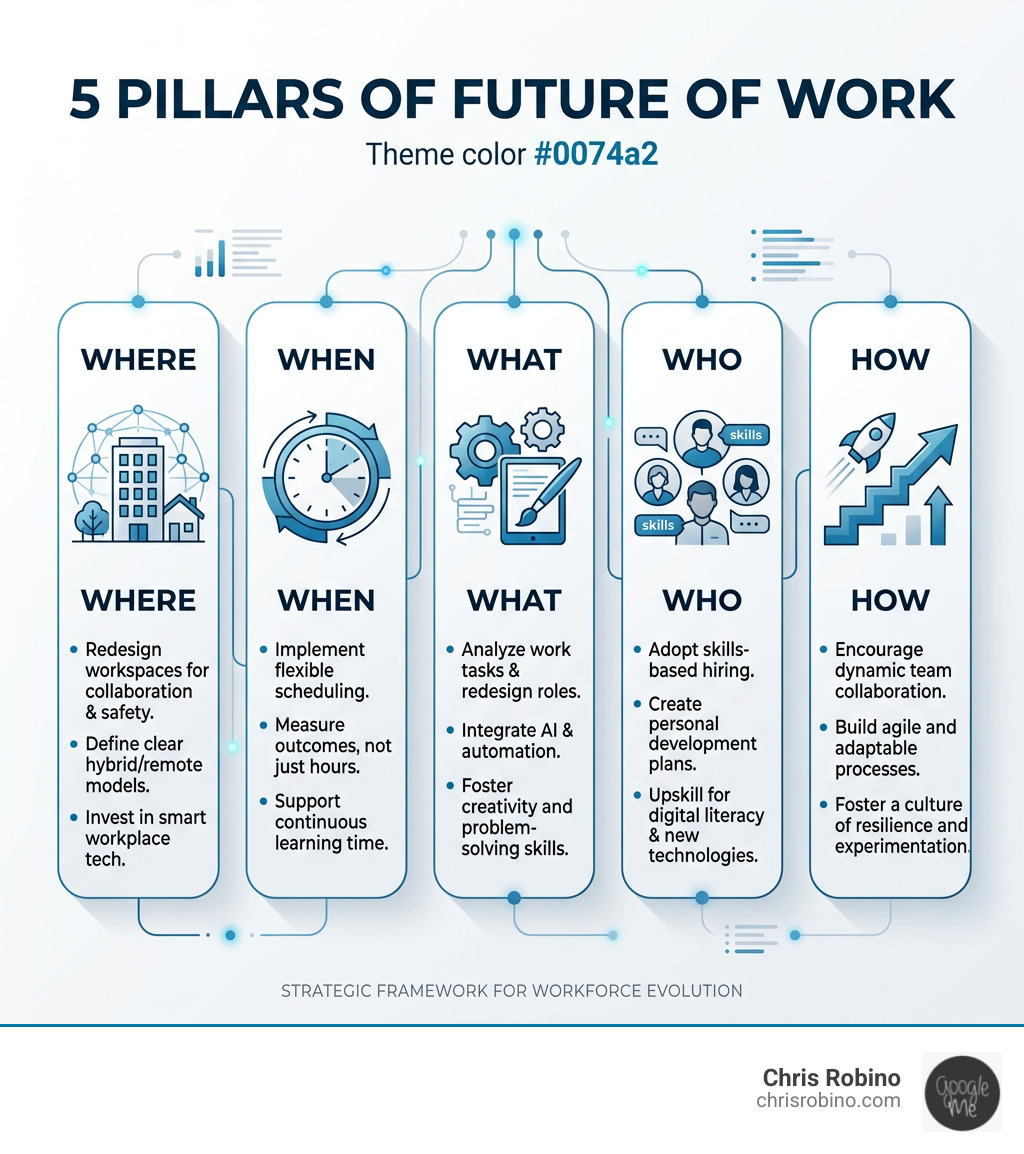
Learn more about Future of work consulting:
The Strategic Framework of Future of Work Consulting
To navigate the modern workplace, organizations need more than software upgrades. Future of work consulting provides a roadmap that aligns technology, talent, and operating models. A key part of that roadmap for large companies is building SEO systems that scale.
When we talk about automation, we mean using technology to execute tasks or workflows with minimal manual intervention. This improves speed, consistency, and auditability. To implement it effectively, organizations need to identify high-value areas where automation can improve cost, quality, or customer experience.

The 4 Types of Automation
Understanding these categories helps avoid over-investing in the wrong tools:
- Task Automation: Handling individual, repetitive actions like data entry.
- Process Automation: Managing end-to-end workflows like invoice processing.
- Decision Automation: Using AI to support data-driven choices.
- Physical Automation: Robotics and autonomous systems in operational environments.
Before implementation, work should be redesigned end-to-end to remove waste. Automating a broken process only makes it fail faster. Industry research highlights the importance of aligning workforce advisory with broader business strategy. By pairing automation with a clear AI-Driven Automation strategy, organizations can ensure technology supports business goals.
SEO Strategies That Perform Well for Large Companies
For large companies, SEO requires operational discipline, not isolated keyword tactics. Complex sites with thousands of pages need systems, governance, and repeatable workflows that support discoverability at scale.
The SEO strategies that tend to perform best include:
- Technical SEO at Scale: Improve crawl efficiency, indexation, site speed, structured data, and site architecture so search engines can consistently reach important pages.
- Programmatic Content Systems: Use templates, structured data, and editorial controls to scale high-quality pages for products, services, locations, and categories without sacrificing consistency.
- Internal Linking Architecture: Build strong internal linking patterns that pass authority to strategic pages and help both users and search engines navigate large sites.
- Content Governance: Standardize metadata, templates, redirects, canonicals, and publishing workflows so teams across departments can maintain quality as the site grows.
- E-E-A-T Signals: Publish expert-led content, maintain clear author attribution, and keep important pages accurate and up to date to strengthen trust.
For enterprise teams, the most effective SEO programs are tied to business priorities. That means aligning organic search efforts with product lines, revenue categories, regional expansion, and customer intent rather than treating SEO as a standalone channel.
Transitioning to a Skills-Based Workforce Strategy
The traditional job-based model is becoming less effective. In a skills-based strategy, the workforce is viewed as a portfolio of capabilities that can be deployed more flexibly. This matters for digital teams, where SEO, analytics, automation, and AI skills increasingly overlap.
A skills-based approach involves creating a skills taxonomy, building a skills inventory, and developing learning pathways to close capability gaps. This supports talent mobility and helps organizations adapt as automation changes the task mix. For more on these broader transformation models, explore our Business Transformation Consultant resource.
Navigating AI Integration and Future of Work Consulting Services
Generative AI is now part of the workplace. The goal is not simply replacing people, but designing human-AI workflows where AI handles routine synthesis and drafting while humans focus on judgment, creativity, and strategic reasoning.
Future of work consulting services often support hybrid human-AI operating models across HR transformation, talent strategy, and workforce redesign. For a deeper look at implementation, see our AI Strategy Consulting Ultimate Guide.
Building a Change-Ready Culture for 2030
Change management remains essential. Without a change-ready culture, even strong AI or SEO strategies will underperform. A resilient organization needs leadership alignment, clear communication, practical training, and enough psychological safety for teams to adopt new tools and workflows. Read more in our Digital Innovation Consultancy Complete Guide.
Implementing the Roadmap: Metrics and Procurement Evolution
How do we know these changes are working? The answer is to track KPIs tied to agility, productivity, and digital performance rather than relying only on headcount or activity metrics.
Redefining Procurement in Future of Work Consulting
The way organizations buy consulting services should evolve as well. Traditional price-only procurement often falls short for complex projects like future of work consulting and enterprise SEO, where outcomes depend on expertise, execution quality, and cross-functional coordination.
Instead, we recommend:
- Precision Bundling: Group related initiatives, such as AI integration and SEO automation, to capture synergies.
- Tiered Supplier Panels: Match broad delivery needs with specialist expertise where appropriate.
- Value-Based Negotiations: Focus on measurable impact, including operational efficiency, revenue influence, and long-term scalability.
This helps organizations secure the right expertise at the right time. It is also part of working with an Agile Tech Consulting partner.
Measuring Success with Future-Fit Metrics
To measure progress, organizations should track a mix of automation, skills, and digital outcomes. For large companies, SEO metrics should be visible within the broader business dashboard so leaders can connect organic performance to commercial results.
| Metric Type | Key Performance Indicator (KPI) |
|---|---|
| Automation | Cycle time reduction, error rate decrease, process auditability |
| Skills | Proficiency growth in AI, SEO, and data capabilities; internal mobility rates |
| Digital Visibility | Organic share of voice, technical site health, non-branded keyword growth |
| Business | Revenue per employee, Employee Net Promoter Score (eNPS), productivity gains |
By monitoring these indicators, leaders can better evaluate the impact of their Accelerate Digital Transformation efforts. For leadership-focused guidance, see our Senior Business Transformation Consultant Guide 2026.
Conclusion: Partnering for a Resilient Future
The future of work is not a destination we reach; it is a capability we build. At ChrisRobino.com, we centralize the insights and expertise needed to help you navigate this transition. Whether you are looking to integrate AI-Driven Business Solutions, redefine your entire workforce strategy, or implement advanced SEO strategies for large companies, the goal remains the same: to create an organization that is as resilient as it is innovative.
We are standing at a crossroads. One path leads to obsolescence through incrementalism. The other leads to growth through transformative change. By embracing future of work consulting, you aren’t just preparing for 2030—you are building the foundation for long-term success in an ever-evolving digital landscape. Let’s build that future together. Explore our Technology Innovation Consulting Firm resources to take the first step.