
How Big Is Social Media in 2026? (The Numbers That Matter)
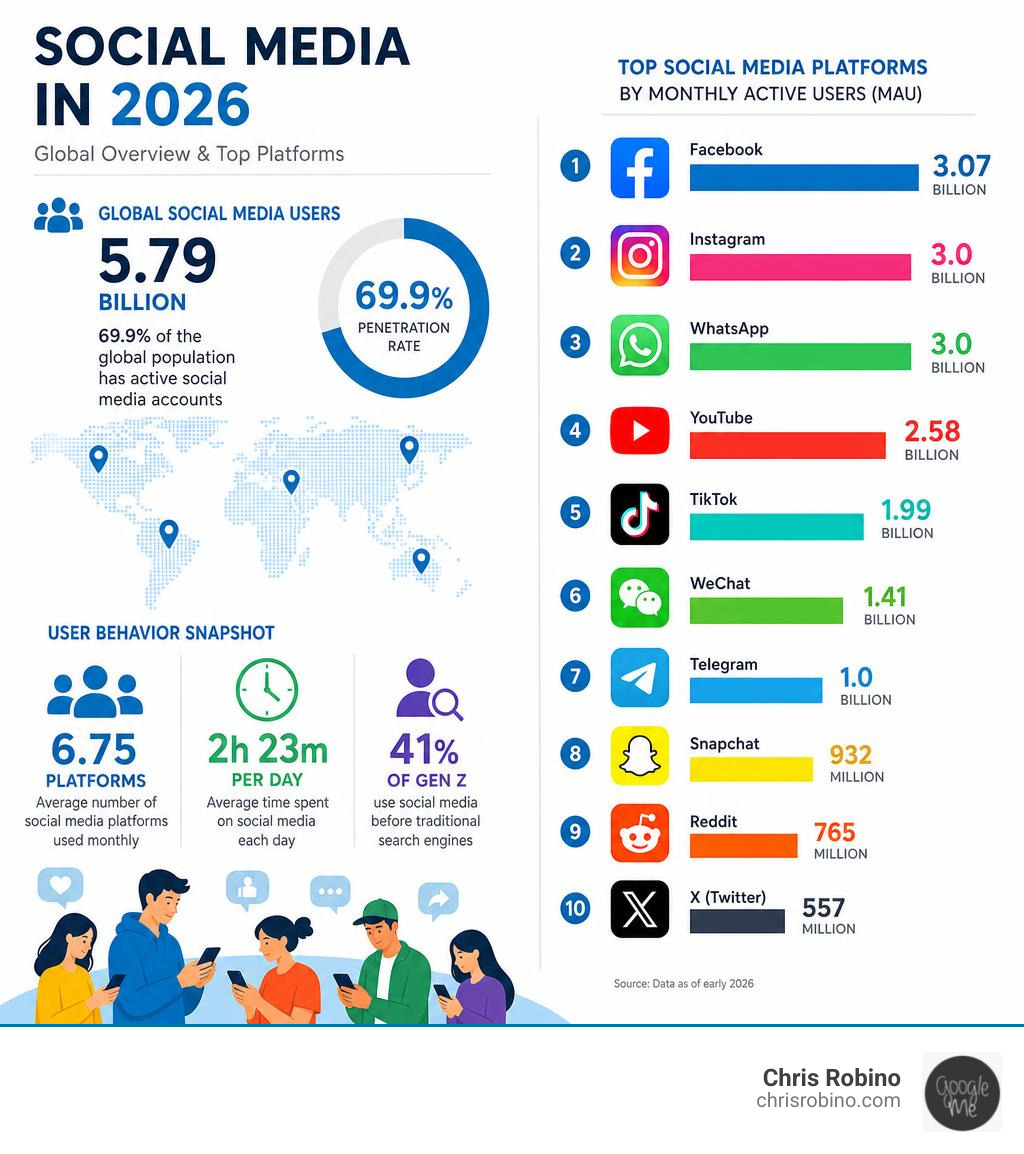
The biggest social media platforms now reach more than two-thirds of every person on Earth. As of early 2026, roughly 5.79 billion people have active social media accounts — that’s 69.9% of the global population.
If you just want the quick answer, here are the top platforms ranked by monthly active users (MAU):
| Rank | Platform | Monthly Active Users |
|---|---|---|
| 1 | 3.07 billion | |
| 2 | 3.0 billion | |
| 3 | 3.0 billion | |
| 4 | YouTube | 2.58 billion |
| 5 | TikTok | 1.99 billion |
| 6 | 1.41 billion | |
| 7 | Telegram | 1.0 billion |
| 8 | Snapchat | 932 million |
| 9 | 765 million | |
| 10 | X (Twitter) | 557 million |
But raw user counts only tell part of the story.
The average internet user is active on 6.75 different platforms every month. People spend around 2 hours and 23 minutes per day on social media. And for Gen Z, social platforms have replaced Google as the first stop for finding information — 41% of Gen Z users now turn to social media before traditional search engines.
That shift changes everything for how brands, creators, and professionals should think about where to show up online.
Not every platform deserves your time. Knowing which ones actually move the needle — and why — is the real challenge.
I’m Chris Robino, a digital strategy and SEO expert with over two decades of experience helping organizations navigate platforms across the biggest social media landscape to drive real business growth. This guide cuts through the noise so you can make smarter decisions about where to invest your attention.
Biggest social media basics:
The Biggest Social Media Platforms Ranked by Active Users

When we look at the sheer scale of the biggest social media networks, the numbers are almost hard to comprehend. The global social media landscape has grown from a collection of niche websites into a massive, multi-billion-dollar industry. In fact, global social media advertising spend is projected to reach an astronomical $310.48 billion in 2026.
But where is all that money and attention actually going? To understand the landscape, we must look at the actual Monthly Active Users (MAU) and how deeply users are engaged. Some platforms have billions of accounts but lower daily usage, while others have slightly smaller user bases but capture hours of undivided attention every single day.
For a deeper dive into these metrics, global industry reports provide a comprehensive breakdown of active accounts, while the List of most popular social platforms remains the definitive historical record for platforms crossing the 100-million user milestone.
The Meta Empire: Facebook, Instagram, and WhatsApp
Meta Platforms remains the undisputed king of the digital world. By owning three of the top four biggest social media platforms on Earth, Meta commands an unparalleled share of human attention.
- Facebook (3.07 billion MAU): Despite years of critics claiming “Facebook is dead,” it remains the world’s largest social network. It is the digital directory of the modern age, especially valuable for localized businesses, community building through Facebook Groups, and older demographic targeting.
- Instagram (3.0 billion MAU): Instagram has evolved from a simple photo-sharing app into a visual commerce powerhouse. Through Reels, Stories, and direct shopping features, it is the go-to platform for lifestyle, fashion, and influencer marketing.
- WhatsApp (3.0 billion MAU): As the world’s most popular messaging app, WhatsApp has successfully transitioned from a personal utility into a major business communication tool. With over 200 million WhatsApp Business users, it has redefined conversational commerce.
According to the Meta Platforms, Inc (META) 8-K Earnings Release – Jan 2025, Meta’s Family of Apps reached an astonishing 3.35 billion daily active people. This massive reach means that for most businesses, ignoring Meta is simply not an option. For a strategic look at how to position your brand across these evolving networks, check out our insights on Beyond the Scroll: What’s Next for the Social Media Industry.
Video Giants: YouTube and TikTok

If Meta rules communication, YouTube and TikTok rule entertainment. The battle for video dominance has completely reshaped how we consume content, with short-form and long-form video fighting for every second of our screen time.
- YouTube (2.58 billion MAU): YouTube is much more than a social media platform; it is the world’s second-largest search engine. It boasts the highest search intent of any social platform, making it incredibly valuable for educational content, product reviews, and long-tail SEO traffic.
- TikTok (1.99 billion MAU): TikTok is the undisputed culture engine of 2026. What makes TikTok terrifyingly effective is its engagement: users spend an average of 1 hour and 35 minutes per day on the platform. It has pioneered the concept of “social commerce,” allowing users to discover and buy products seamlessly within the app.
While TikTok dominates Western youth culture, its Chinese sister app, Douyin, processes hundreds of billions of dollars in social commerce transactions annually. This ecosystem highlights how video-first platforms are capturing the majority of global attention.
Emerging Challengers and Regional Powerhouses
Beyond the top five, the social landscape splits into specialized platforms and regional giants that dominate specific markets.
- Telegram (1.0 billion MAU): Telegram has emerged as a massive hybrid of messaging and social broadcasting, driven by its focus on privacy, large group channels, and developer-friendly features.
- WeChat (1.41 billion MAU): Known as China’s “everything app,” WeChat handles messaging, social networking, payments, and transportation for over a billion people daily.
- Xiaohongshu / RedNote: Often called China’s answer to Instagram, this platform has seen massive search growth globally. Its focus on authentic user reviews and lifestyle content has made it a major player in social search.
- Reddit (765 million MAU) & Discord: These platforms serve as the digital watercoolers of the internet. They are built around highly moderated, niche communities where users value authenticity and reject blatant self-promotion.
- Threads (380 million MAU): Meta’s text-based challenger has grown rapidly, capitalizing on shifts in the microblogging landscape to establish a more positive, community-centric alternative to X.
For a live look at how these platforms compare in overall internet traffic and referral share, you can monitor the Social Media Stats Worldwide | Statcounter Global Stats.
SEO Strategies That Perform Well for Large Companies
For enterprise-level organizations, the biggest social media platforms are not just engagement hubs—they are critical search engines. Implementing SEO strategies that perform well for large companies requires a unified approach across these networks:
- Social Search Optimization: Optimize profiles and video descriptions on YouTube and TikTok with structured keyword mapping, as Gen Z increasingly uses these platforms for search.
- Enterprise-Scale Video SEO: Large companies should leverage YouTube’s high search intent by creating hub-and-spoke content libraries, targeting high-volume informational queries that support main domain authority.
- Cross-Platform Authority Building: Use social signals and high-authority links from platforms like LinkedIn and Reddit to support traditional search engine visibility, ensuring brand consistency across all digital touchpoints.
For brands looking to optimize their reach, partnering with micro-influencers often yields much higher organic engagement rates than working with massive entities. To learn how to build an authentic presence that captures this attention, you may want to work with a Social Media Branding Consultant to craft a tailored strategy.
Strategic Selection: Which Biggest Social Media Channels Fit Your Business?
You do not need to be everywhere. In fact, trying to manage accounts on all the biggest social media sites is a fast track to burnout and diluted results. Instead, we recommend focusing on one or two core channels where your target audience is most active.
- For B2B Marketing: LinkedIn remains the gold standard. It generates a visitor-to-lead conversion rate of 2.74%, which is three times higher than Twitter or Facebook. It is the premier space for professional networking, thought leadership, and high-value lead generation.
- For B2C & Visual Brands: Instagram and Pinterest are essential. Pinterest, with its highly active female demographic (70% of users), serves as a visual discovery engine where users actively plan future purchases.
- Resource Allocation & Repurposing: Start by mastering one platform. Once you have a working content pipeline, you can repurpose long-form YouTube videos into TikToks, or turn LinkedIn text posts into Instagram graphics.
To build a comprehensive digital strategy that ties your social efforts directly to your search engine visibility, read The Ultimate Guide to Internet and Social Media Marketing Success.
Key Challenges Facing Major Platforms in 2026
The social media landscape is not without its risks. As we navigate 2026, the largest networks are facing unprecedented headwinds:
- Regulatory Pressure: Governments worldwide are cracking down on social media’s impact on youth. Australia’s landmark ban on social media for users under 16 has forced platforms to implement strict age verification controls, changing how brands target younger audiences.
- User Fatigue and Mental Health: More users are experiencing “digital burnout,” leading to a rise in private messaging apps and closed communities over public broadcasting.
- The AI Capex War: Platforms are spending historic amounts on artificial intelligence infrastructure. As detailed in the report, Meta reports record $56.3B revenue but daily users decline for first time as capex rises to $145B and 8,000 jobs are cut, major tech giants are aggressively cutting traditional jobs to fund massive AI data centers. This shift will fundamentally change how algorithms serve content and target ads.
Conclusion: Navigating the Social Media Landscape
The world of the biggest social media platforms is fast, loud, and constantly shifting. But beneath the staggering billions of active users and massive corporate AI investments, the core principle of social media remains exactly the same: authentic human connection.
Whether you are a business looking for B2B leads on LinkedIn, a brand driving social commerce on TikTok, or a creator building a community on Reddit, success comes down to choosing the right platform for your goals and delivering genuine value to your audience.
If you are ready to stop guessing and start building a high-impact media presence, we can help you design, produce, and optimize your content strategy. Explore our Media Production Consulting services today to elevate your brand’s digital footprint.