

Why SaaS Content Marketing ROI Metrics Are a Survival Imperative in 2026
SaaS content marketing ROI metrics are the specific measurements that tell you whether your content is actually generating revenue — or just traffic that goes nowhere. For large-scale enterprises, these metrics become even more complex. Managing SEO across thousands of pages requires a shift from manual optimization to programmatic excellence and robust governance. In the enterprise landscape, content is not just a marketing asset; it is a defensive moat against rising acquisition costs.
Here are the core metrics you need to track:
| Metric | What It Measures | Benchmark |
|---|---|---|
| Content Marketing ROI | (Revenue – Investment) / Investment x 100 | 844% avg. over 3 years |
| CAC | Total acquisition cost / new customers | Varies by stage |
| LTV:CAC Ratio | Customer value vs. acquisition cost | 3:1 minimum |
| Visitor-to-Lead Rate | % of visitors who become leads | 2-5% |
| MQL-to-SQL Rate | % of marketing leads accepted by sales | 50%+ target |
| Pipeline Contribution | Revenue influenced by content | 30-60% of pipeline |
| Organic Traffic Growth | Month-over-month SEO-driven visits | Compounding over time |
| Time on Page / Scroll Depth | Content engagement quality | 7+ min for guides |
| Bounce Rate | % leaving after one page | ~50% avg. |
| Cost Per Lead (CPL) | Cost to acquire one qualified lead | $18-$240 by channel |
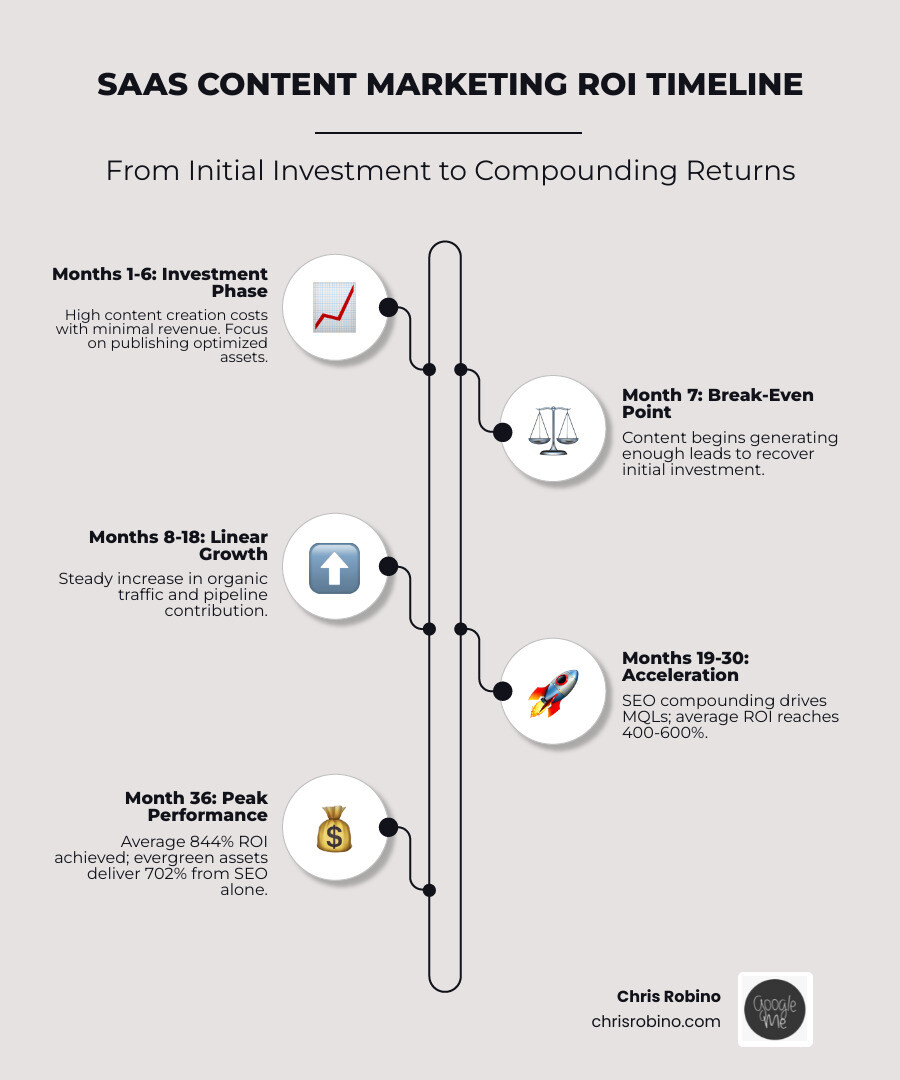
Content marketing is not just a traffic play. For B2B SaaS companies, it is a revenue engine — one that compounds over time in ways that paid ads simply cannot match. While a paid campaign stops delivering the moment you pause the budget, a well-optimized blog post or technical tutorial can drive qualified leads for two to five years. The numbers back this up: B2B SaaS companies see an average three-year content marketing ROI of 844%, with SEO alone averaging 702% over that same window.
Yet most SaaS teams are still flying blind. Only 22% of marketers say they effectively measure content ROI, even though 72% acknowledge that content increases engagement and leads. That gap — between knowing content works and actually proving it — is exactly where growth gets left on the table. For large companies, this gap is often caused by data silos between SEO, product, and sales teams.
Rising ad costs are making this problem more urgent. Data from Q4 2025 shows a 22% year-over-year increase in average digital advertising cost-per-lead for SaaS companies. In that environment, owned and organic content channels are no longer a “nice to have.” They are a competitive necessity. Large organizations must leverage their existing domain authority to dominate high-intent keywords before competitors with smaller budgets but faster execution can catch up.
I’m Chris Robino, a digital strategy leader and AI and search expert with over two decades of experience helping SaaS companies turn content into measurable growth. My work spans SEO, attribution modeling, and data-backed content strategy — exactly the disciplines that define SaaS content marketing ROI metrics. In the sections ahead, I’ll walk you through the metrics that matter most, how to calculate them accurately, and how to build a content program that compounds year over year.
Quick look at saas content marketing roi metrics:
Core saas content marketing roi metrics and KPIs
Before we dive into the deep end, we need to clarify the difference between a metric and a KPI. While people often use them interchangeably, they serve different masters. A metric is a “business-as-usual” measurement (like how many people read a blog post), whereas a Key Performance Indicator (KPI) is a strategic target that directly impacts the bottom line (like how many of those readers signed up for a demo). In large organizations, the challenge isn’t just tracking the metric, but aligning it across departments. Enterprise SEO requires “Share of Voice” (SoV) tracking against a broader set of non-traditional competitors to ensure market dominance.
To truly understand content marketing ROI, we must look at the financial health of our acquisition funnel.
The ROI Formula
The standard math for content ROI is: [(Revenue Generated – Total Investment) / Total Investment] x 100
In SaaS, “Total Investment” must include not just the freelancer’s fee, but also the “fully loaded” costs: internal team hours, tool subscriptions, and distribution spend. For large companies, this also includes the cost of technical SEO maintenance and content governance software.
The SaaS “North Star” Metrics
For any growth-stage company, three metrics reign supreme:
- Customer Acquisition Cost (CAC): Total sales and marketing spend divided by new customers. Content marketing is a powerhouse here, often generating leads at 62% less cost than traditional outbound methods.
- Lifetime Value (LTV): The total revenue a customer brings in before they churn.
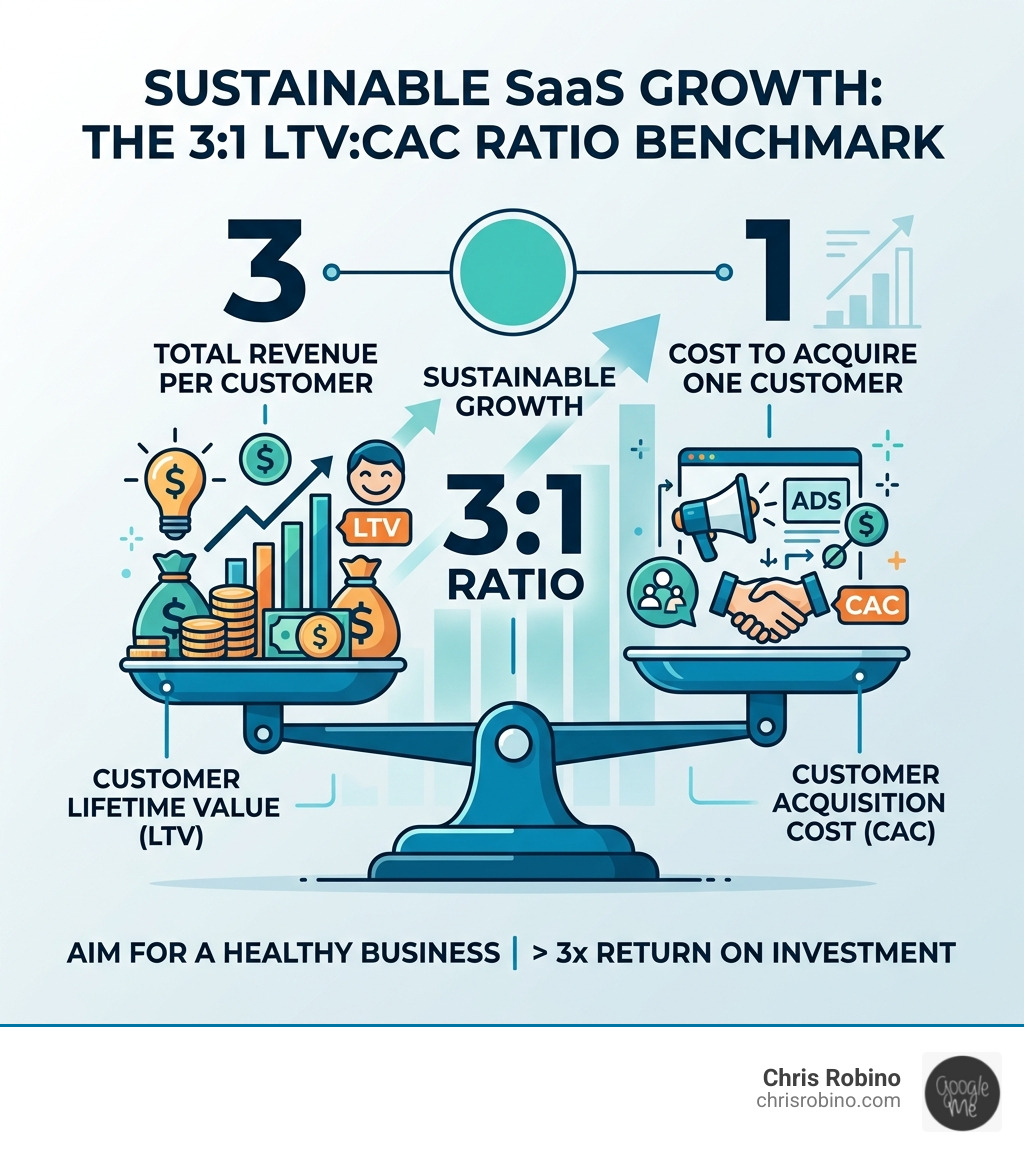
- LTV:CAC Ratio: This is the ultimate health check. An ideal ratio is 3:1 or higher. If you are at 1:1, you are just trading dollars; if you are at 5:1, you might actually be under-investing in growth.
Finally, we track Pipeline Contribution. Research shows that content contributes to 30–60% of the overall B2B SaaS sales pipeline. If you aren’t tracking which blog posts were touched by a lead before they became a Sales Qualified Lead (SQL), you are likely undervaluing your best assets. For a deeper dive into building this foundation, check out our SaaS Content Marketing Guide.
Tracking Consumption and Engagement saas content marketing roi metrics
Consumption metrics are the “early warning system” for your content strategy. They don’t always show immediate dollars, but they show if your audience actually cares about what you’re saying.
- Organic Traffic & SERP Rankings: This is the bread and butter of SEO. Being in the top three results is critical, as they capture over 50% of all clicks. Moving from the second spot to the first can boost your CTR by nearly 75%.
- Bounce Rate: Often called the “ugly stepchild” of metrics, a high bounce rate (above 70% for blogs) usually means your content didn’t match the search intent or was simply too hard to read.
- Scroll Depth & Time on Page: These are “quality” indicators. If someone spends seven minutes on a guide and scrolls 90% of the way down, you’ve built significant brand authority.
- Pages Per Session: Are they reading one post and leaving, or are they falling down the rabbit hole of your expertise?
We also see a massive trend in SaaS Video Marketing, where 82% of video marketers report that video increases time on site. If you aren’t embedding video in your high-value pillars, you’re missing a key engagement lever.
Measuring Conversion and Lead Gen saas content marketing roi metrics
This is where the rubber meets the road. In B2B SaaS, the journey from “stranger” to “customer” is long—often 6 to 18 months with dozens of touchpoints. Large companies must use multi-touch attribution to account for the complexity of the enterprise buying committee.
- Visitor-to-Lead Conversion: The benchmark here is 2–5%. If you have 10,000 visitors but zero sign-ups, your CTAs are either missing or irrelevant.
- MQL-to-SQL Ratio: A healthy benchmark is around 13% to 50%, depending on how strictly you define a Marketing Qualified Lead.
- Content-Assisted Demos: How many people requested a demo immediately after reading a specific piece of content? This “bottom-of-funnel” metric is a direct line to ROI.
Using How to Use Case Studies in SaaS Content Marketing is one of the most effective ways to bridge the gap between MQL and SQL. Case studies provide the social proof needed to push a skeptical buyer toward a demo.
Optimizing Strategy for Long-Term Compounding Returns
Content marketing is an asset, not an expense. Unlike paid ads, which have linear returns, content has compounding returns.
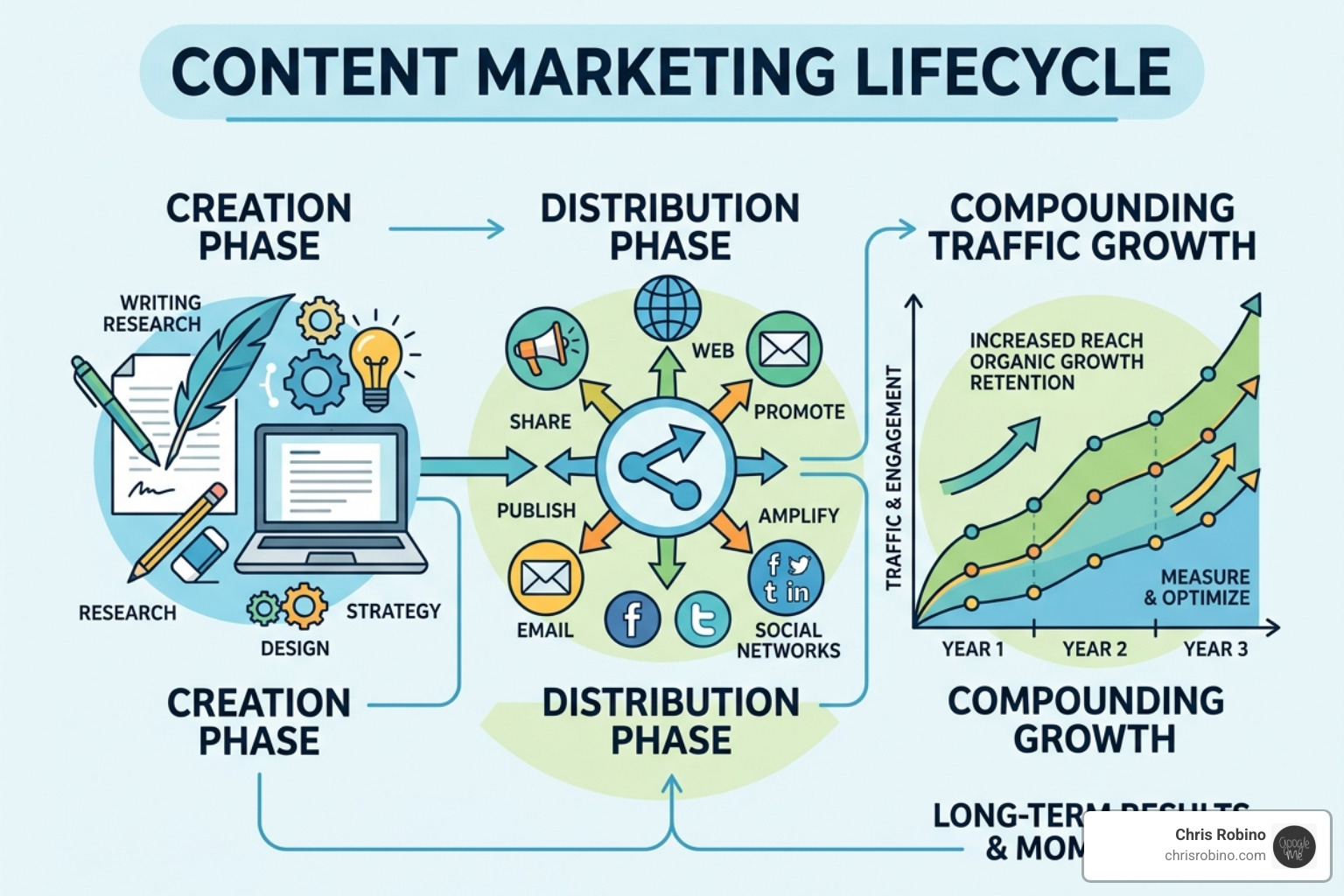
A typical piece of SaaS content breaks even by month 7, reaches 300% ROI by month 12, and can skyrocket to 1,100% ROI by month 36. This is due to Content Lifetime Value (LVC)—the idea that a post published today will continue to earn backlinks and traffic for years without additional spend. To maximize this, we focus on Content Marketing Strategies for Tech Companies that prioritize evergreen assets over “newsy” fluff.
SEO Strategies for Large-Scale SaaS Enterprises
For large companies, SEO is a game of scale and technical precision. When managing thousands of URLs, manual optimization is impossible. Successful enterprise strategies include:
- Programmatic SEO (pSEO): Large SaaS companies use data-driven templates to create thousands of high-quality landing pages for specific integrations, use cases, or geographic locations. This allows for capturing long-tail search volume at a fraction of the cost of manual creation.
- Topic Clusters and Content Hubs: Instead of isolated blog posts, large companies build comprehensive hubs. By grouping content into clusters around a “pillar” page, you signal deep topical authority to search engines, which is essential for ranking for high-competition keywords.
- Technical SEO at Scale: Managing crawl budget is critical for large sites. Ensuring that search engines prioritize your high-value revenue pages over low-value archive pages can lead to a 20-30% increase in organic visibility without adding new content.
- Internal Linking Automation: Large organizations use AI-driven tools to ensure that new content is automatically linked from relevant older posts. This distributes link equity across the site and improves the user journey, directly impacting saas content marketing roi metrics.
Reducing CAC and Improving Lead Quality
To lower your CAC, you need to stop chasing “empty” traffic. We use the BANT criteria (Budget, Authority, Need, Timeline) to ensure content attracts the right people.
- Original Research: In 2026, original data is the ultimate currency. Data-driven reports achieve a CPL nearly 80% lower than generic blog posts.
- Technical Tutorials: For product-led growth (PLG), tutorials are gold. Users who engage with three or more help articles in their first week have a 310% higher activation rate.
- Content Repurposing: Don’t just write a blog. Turn it into a segmented email sequence, a LinkedIn carousel, and a webinar script. This spreads the production cost across multiple channels.
For a full breakdown of these tactics, our Tech Content Marketing Ultimate Guide covers how to align content with technical buyer personas.
Advanced Attribution and Tech Stack Integration
The biggest challenge in saas content marketing roi metrics is attribution. Because B2B buyers touch a brand 7–15 times before converting, “last-click” attribution is a lie. It gives all the credit to the final ad, completely ignoring the five blog posts that educated the buyer over the previous three months.
We recommend:
- W-Shaped Attribution Models: These give credit to the first touch, the lead creation touch, and the opportunity creation touch.
- Extended Windows: Use at least a 180-day attribution window to account for the long SaaS sales cycle.
- Dark Social Tracking: Use “How did you hear about us?” fields in forms to capture the impact of podcasts and Slack communities that Google Analytics can’t see.
Integrating your enterprise CRM with your content platform is non-negotiable for “closed-loop” reporting. This is a core focus when we evaluate Beyond the Buzz: A Deep Dive into SaaS Content Marketing Agencies.
Benchmarking Success Across the Marketing Funnel
Your metrics should shift as the user moves through the funnel:
- Awareness (Top): Focus on organic traffic, branded search volume, and backlinks.
- Nurturing (Middle): Focus on email open rates, webinar registrations, and multi-page sessions.
- Conversion (Bottom): Focus on demo requests, trial starts, and ACV (Average Contract Value).
- Retention (Post-Purchase): Content can even reduce churn. Companies with mature content programs report 45% better customer retention.
By tracking how content influences these stages, you can see where the “leaks” are in your funnel. If your awareness is high but conversions are low, your middle-of-funnel content likely needs a refresh. We see this often in our SaaS Case Studies.
Conclusion and Strategic Implementation
In 2026, measuring saas content marketing roi metrics is no longer optional—it is a strategic imperative. For large companies, the ability to scale SEO through programmatic methods and technical excellence is the difference between market leadership and obsolescence. The companies that win aren’t necessarily the ones spending the most; they are the ones that measure most effectively and reinvest in high-performing assets.
Content is a “moat” that protects your SaaS from rising ad costs and aggressive competitors. By focusing on compounding returns, multi-touch attribution, and lead quality over vanity metrics, you can transform your marketing department from a cost center into a predictable revenue engine. Large-scale SEO requires a blend of creative storytelling and rigorous data science.
If you’re ready to stop guessing and start growing, let’s talk. Whether you need a comprehensive audit or a full-scale strategy, a SaaS Content Marketing Consultant can help you build the frameworks and cross-functional alignment needed to dominate your category.
Data-driven decisions are the only way forward in the SaaS landscape. Start by auditing your current attribution, setting clear KPIs for each funnel stage, and treating every piece of content as a long-term business asset.