

What Are Content Marketing Services for SaaS Products?
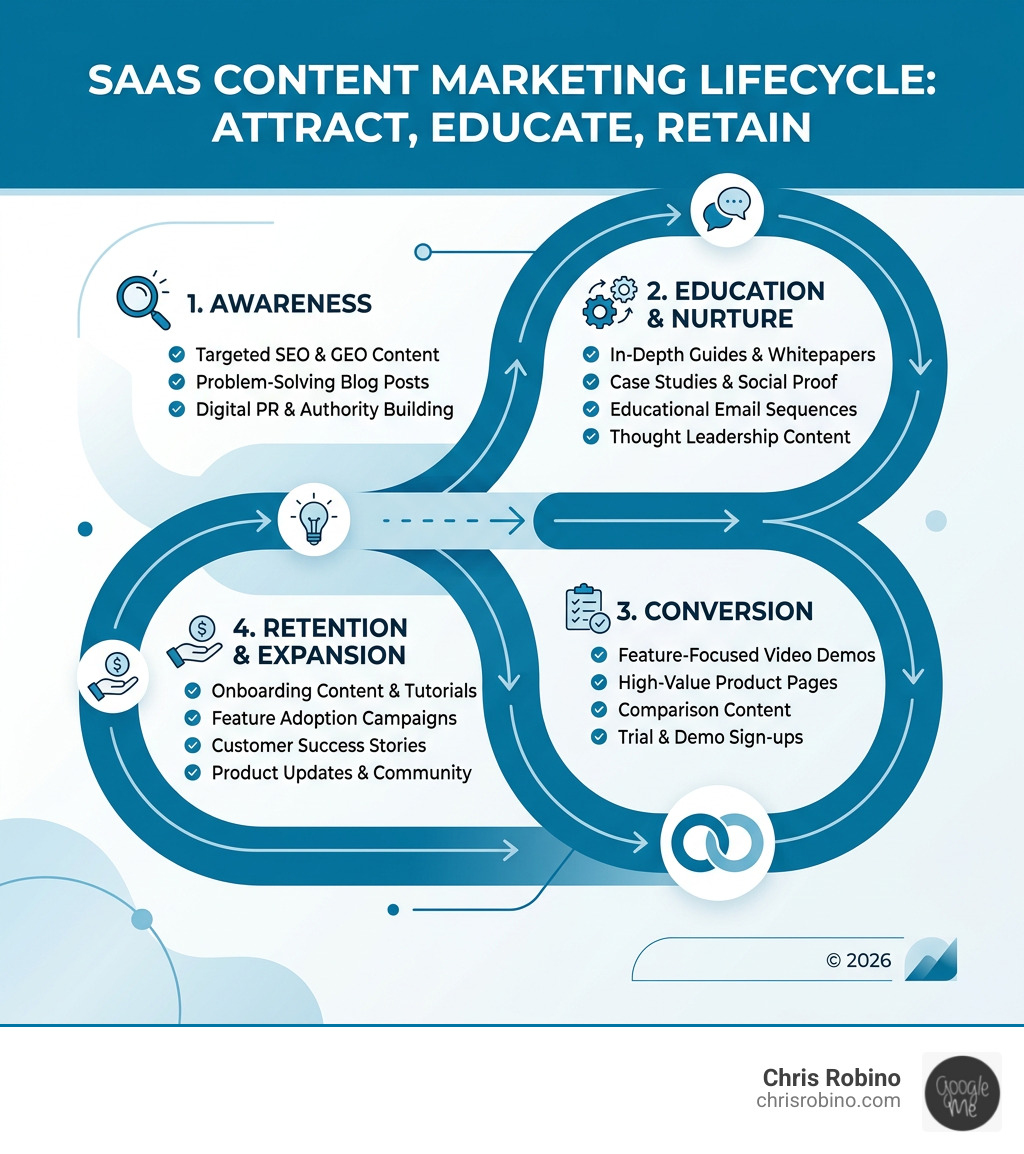
Content marketing services for SaaS products are specialized services that help software companies attract, educate, and convert buyers through strategic content — across the full customer lifecycle.
Here’s a quick overview of what these services typically include:
| Service | Purpose |
|---|---|
| SEO & GEO Content | Drive organic traffic from Google and AI tools like ChatGPT |
| Blog Posts & Guides | Build awareness and educate buyers at every funnel stage |
| Case Studies & Whitepapers | Build trust and support complex B2B buying decisions |
| Video Production | Explain intangible product value quickly and engagingly |
| Email Marketing | Nurture leads, reduce churn, and drive feature adoption |
| Technical Writing | Speak directly to dev-first or technical buyer personas |
| Digital PR | Earn backlinks and media mentions that build authority |
| Thought Leadership | Position your brand as the go-to expert in your category |
The goal isn’t just traffic. It’s pipeline — trial signups, demo requests, and recurring revenue.
SaaS is different from other industries. Sales cycles run 6–18 months. Products are largely intangible. Buyers do deep research before they ever talk to sales. And unlike a one-time purchase, you have to keep customers month after month.
That’s exactly why generic content strategies fall flat for SaaS companies. You need content built around how SaaS buyers actually search, evaluate, and decide.
The good news? When done right, content-led SEO delivers an average ROI of 702%, with a break-even point of just seven months.
I’m Chris Robino, a digital strategy leader and AI search expert with over two decades of experience helping companies — from early-stage startups to established enterprises — build high-performance content systems that drive real growth through content marketing services for SaaS products. In the sections below, I’ll break down exactly what these services include, how to evaluate them, and how to build a content engine that actually moves revenue.
Content marketing services for saas products definitions:
Essential Content Marketing Services for SaaS Products
In B2B SaaS, content isn’t just “filler” for a blog; it is the infrastructure of your sales funnel. Because software is intangible, your content serves as the primary way a prospect interacts with your product’s value before they ever log in.
Modern content marketing services for saas products have evolved beyond simple keyword stuffing. Today, a robust strategy requires a blend of technical precision and creative storytelling.
- SEO & GEO (Generative Engine Optimization): While traditional SEO focuses on ranking in Google’s blue links, GEO ensures your brand is the one cited by AI models like Perplexity, ChatGPT, and Gemini.
- Technical Writing: For DevTools or infrastructure SaaS, you need writers who can speak “engineer.” This involves creating documentation, API guides, and deep-dive tutorials that build credibility with technical gatekeepers.
- Case Studies: These are the “social proof” engines of SaaS. High-performing agencies use case studies to show exactly how a product solved a specific pain point, often resulting in massive conversion lifts. For instance, one B2B analytics platform saw a 340% increase in trial signups after a messaging overhaul.
- Video Production: Video is no longer optional. It is the most efficient way to demonstrate a UI and explain complex workflows.
- Email Marketing: This remains the “bread and butter” for retention. From onboarding sequences to feature announcements, email keeps your Monthly Recurring Revenue (MRR) stable by reducing churn.
Why B2B SaaS Companies Need Specialized Content Marketing Services for SaaS Products
The B2B buying journey is rarely a straight line. It involves multiple stakeholders—from the end-user who loves the features to the CFO who cares about the ROI. Specialized content marketing services for saas products understand these nuances.
Unlike B2C, where a purchase might be impulsive, B2B SaaS involves long sales cycles and high stakes. You aren’t just selling a tool; you’re selling a solution to a business problem. Content must build trust and authority over months of interaction.
If your content is generic, you become invisible. But if your content addresses specific pain points—like compliance, security, or integration—you move from being a “vendor” to a “partner.”
SEO Strategies for Large Companies: Scaling the Enterprise SaaS Engine
For large-scale SaaS organizations, SEO is no longer about individual keyword rankings; it is about managing a massive digital ecosystem. Enterprise SEO requires a different set of strategies compared to early-stage startups.
- Programmatic SEO: Large companies often have thousands of potential use cases. Programmatic SEO allows brands to create high-quality, templated pages at scale (e.g., “How to use [Tool] for [Specific Industry]”). This captures long-tail, high-intent traffic without manual overhead.
- Advanced Internal Linking: On sites with thousands of pages, link equity often gets trapped. Large companies must implement “hub and spoke” models to ensure high-authority pages pass value to deeper content.
- Global SEO and Localization: Enterprise SaaS strategies must include hreflang implementation and localized keyword research to maintain authority across different search engines and regional contexts.
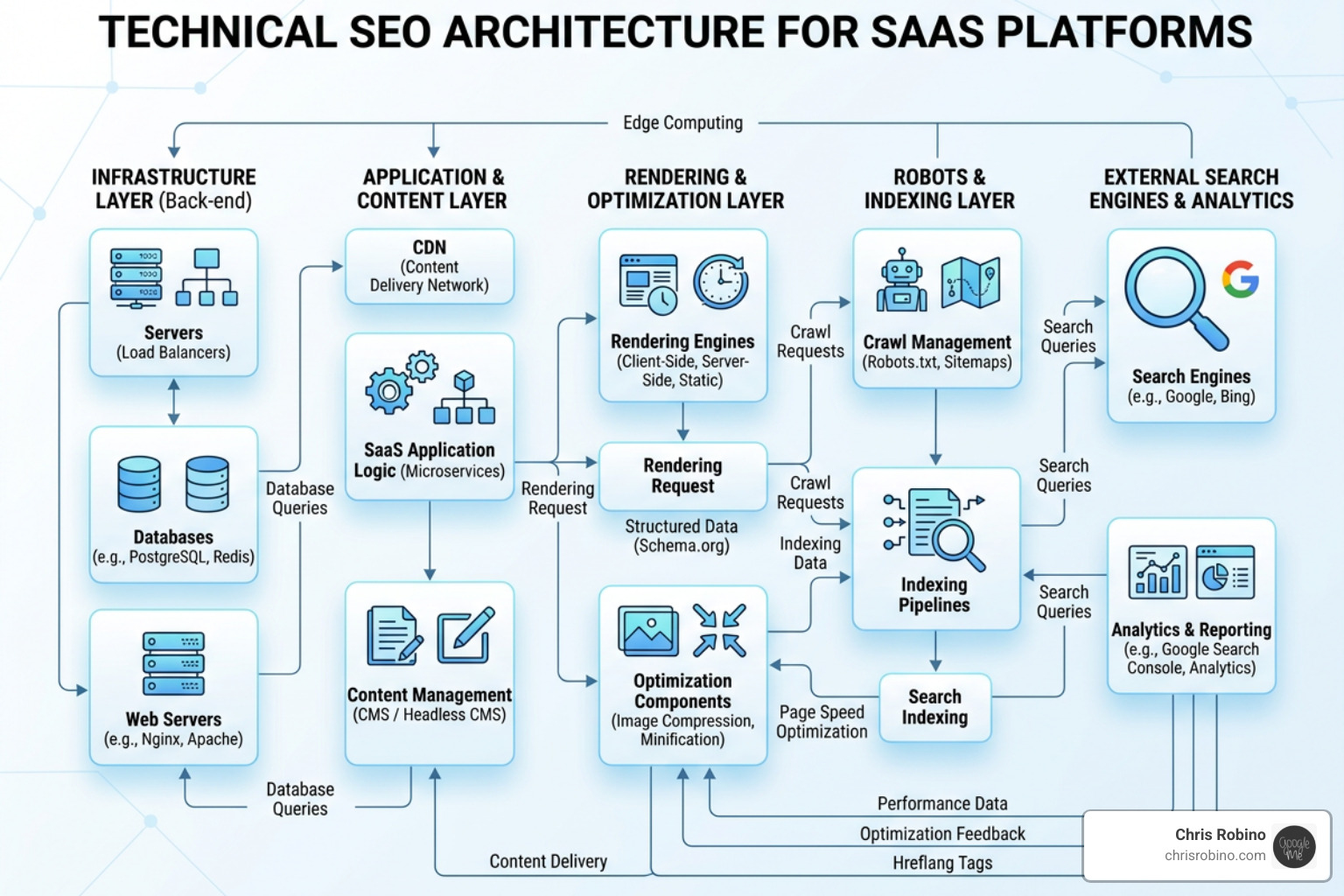
- Technical SEO at Scale: Large sites face unique challenges like crawl budget optimization and JavaScript rendering. Ensuring search engines can efficiently index revenue-generating pages is critical for enterprise growth.
- Entity SEO: For large companies, the brand itself is a ranking factor. Enterprise strategies focus on ensuring the brand is correctly mapped in the Knowledge Graph and cited across authoritative industry publications.
- Content Refresh Cycles: Large companies leverage historical data to systematically refresh “decaying” content. Identifying pages dropping from top positions and applying targeted updates is often more cost-effective than creating new content.
Navigating the Shift to GEO and AI-Driven Search
The search landscape is fragmenting. In March 2025, just 40.3% of U.S. Google searches resulted in an organic click, down from the previous year. This “zero-click” trend is driven by AI Overviews that answer queries directly on the search page.
Furthermore, nearly three-quarters of global organizations now use AI for content creation. This has led to a “sea of sameness” where mediocre, AI-generated articles are everywhere. To stand out, SaaS companies must pivot toward Generative Engine Optimization (GEO).
GEO involves structuring your content so that Large Language Models (LLMs) recognize you as an authoritative source. This means focusing on original research, proprietary data, and expert interviews—things an AI cannot simply “hallucinate” or scrape from a generic site.
Key Performance Indicators: Measuring Content ROI and Pipeline Impact
We don’t track “vanity metrics” like page views in a vacuum. For SaaS, the metrics that matter are those tied to the bottom line.
- MRR (Monthly Recurring Revenue): The ultimate goal of any SaaS marketing effort.
- CLV (Customer Lifetime Value): Content that helps with onboarding and feature adoption directly increases how much a customer is worth over time.
- Churn Rate: If users aren’t finding value, they leave. Educational content acts as a “retention shield.”
- Trial Signups & Demo Requests: These are the primary lead indicators for SaaS growth.
The data is clear: the average ROI from content-led SEO is approximately 702%. When you treat content as a revenue engine rather than a cost center, the break-even time can be as short as seven months.
Strategic Frameworks for Scaling Content Marketing Services for SaaS Products
To scale, we use a full-funnel approach. You cannot simply target “Bottom of Funnel” (BOFU) keywords and expect to win the market. You need a cohesive tech content marketing strategy.
- TOFU (Top of Funnel): Educational content that addresses broad pain points. (e.g., “How to improve remote team productivity”).
- MOFU (Middle of Funnel): Comparison guides and “How-to” articles that introduce your product as a potential solution.
- BOFU (Bottom of Funnel): Product-led content, pricing pages, and alternatives (e.g., “YourProduct vs. Alternatives”).
This framework supports Product-Led Growth (PLG) by ensuring that no matter where a prospect is in their journey, they find value in your brand.
Choosing the Right Partner: Agency vs. In-House Teams
Should you build an in-house team or hire an agency?
| Feature | In-House Team | Specialized Agency |
|---|---|---|
| Speed | Slow to hire and ramp (3–6 months) | Immediate start |
| Expertise | Deep product knowledge | Broad industry insights & proven frameworks |
| Scalability | Limited by headcount | Can scale production up or down instantly |
| Cost | High (Salaries, benefits, overhead) | Predictable monthly retainer |
Many SaaS founders find that a SaaS content marketing consultant or agency provides the editorial rigor and domain fluency needed to compete in a crowded market without the overhead of a massive internal department.
Avoiding Red Flags in the Modern Content Landscape
As you evaluate content marketing services for saas products, watch out for these common pitfalls:
- Ranking Guarantees: No one owns Google or the AI models. Anyone promising a “#1 spot in 30 days” is likely using black-hat tactics that will eventually lead to penalties.
- AI-Only Content: If an agency is just “prompt engineering” their way through your blog, your brand will suffer. AI is a tool for research, but human insight is what wins trust.
- Vanity Metrics: If an agency reports on “impressions” but can’t show you how those impressions turned into “qualified leads,” they aren’t focused on your revenue.
- Opaque Processes: You should know exactly how your content is being made, who is writing it, and what data is driving the strategy.
Conclusion: Building a Sustainable Revenue Engine
At the end of the day, content marketing services for saas products are about more than just words on a page. They are about building a sustainable revenue engine that works for you 24/7.
At ChrisRobino.com, we specialize in helping emerging tech and media companies navigate the complexities of modern search and AI. By focusing on high-intent strategies and technical authority, we help SaaS brands move beyond the buzz and into a state of consistent, measurable growth.
If you’re ready to stop guessing and start growing, it might be time to work with a SaaS content marketing consultant who understands the intersection of technology, media, and revenue. Let’s build something that lasts.