

Why Technology Trend Analysis Is the Skill Every Business Needs Right Now
Technology trend analysis is the process of tracking how technologies evolve over time — using data from patents, research, investment, talent demand, and news — so organizations can make smarter decisions about where to focus and what to build next.
Here’s what technology trend analysis covers at a glance:
| What It Tracks | Why It Matters |
|---|---|
| Patent filings | Shows where innovation is being protected |
| Scientific publications | Reveals breakthroughs before they hit the market |
| Venture capital investment | Signals where smart money is moving |
| Talent demand | Indicates which skills are becoming critical |
| Search and news trends | Measures public and industry interest |
The pace of change has become hard to overstate. Generative AI reached 100 million users in just two months — a milestone that took the telephone 50 years to hit. One CIO put it plainly: the time it takes to study a new technology now exceeds the window in which that knowledge stays relevant.
That’s exactly why a structured approach to spotting and evaluating trends matters more than ever.
I’m Chris Robino, a Digital Strategy Leader and AI & Search Expert with over two decades of experience helping organizations cut through the noise and act on what actually matters in technology trend analysis. In the sections below, I’ll walk you through the key methodologies, the most important trends shaping 2026, and practical frameworks you can use to turn trend data into real business decisions.
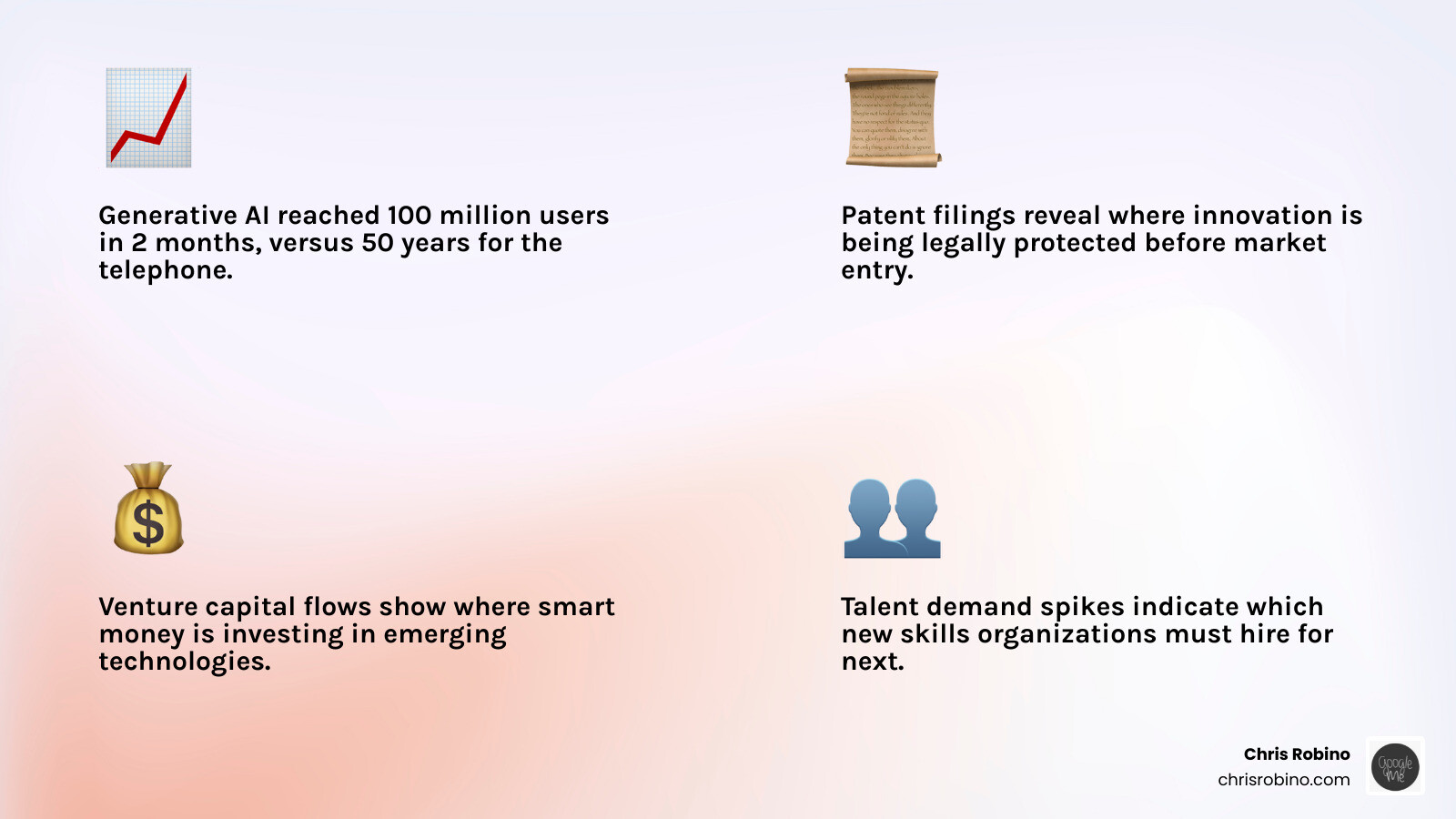
Technology trend analysis terms made easy:
Core Methodologies of Technology Trend Analysis
To stay ahead of the curve, we cannot rely on gut feeling or hype cycles. True competitive advantage comes from a systematic, data-driven approach. By combining multiple quantitative and qualitative indicators, we build a clear, multi-dimensional view of where the market is headed.

When we conduct a Future Trends Analysis, we evaluate technologies across their entire lifecycle—from early-stage academic discovery to late-stage enterprise adoption. This structured evaluation helps us separate passing fads from foundational shifts. We look at innovation scores (combining patents and research) and interest scores (combining news and search queries) to map exactly where a technology sits on its evolutionary path.
Data Sources for Technology Trend Analysis
To build an accurate trend forecasting model, we look at five primary data sources that act as leading indicators of technological change:
- Patents and IP Filings: Patent databases show us exactly what new ideas are being legally protected. Analyzing patent volume and inventor tracking helps us identify “white spaces” for new inventions and evaluate freedom to operate.
- Scientific Literature: Reviewing peer-reviewed journals and research publications allows us to detect early scientific discoveries years before they become commercial products.
- Venture Capital and Equity Investment: By tracking where the “smart money” is flowing, we can gauge the financial viability of emerging tech. For instance, hyperscalers are committing over $700 billion in capital expenditures this year alone, with $12 trillion in AI capex projected between 2026 and 2031.
- Talent and Job Demand: Recruitment patterns reveal which technologies companies are actively trying to build. A sudden spike in demand for specialized engineers is a surefire sign of an impending deployment wave.
- Search Queries and News Sentiment: Search volume and media coverage help us measure public curiosity and market readiness.
By combining these datasets, we gather deep Emerging Tech Insights that help organizations align their business, innovation, and funding strategies with confidence.
Key Emerging Trends in the 2026 Landscape
As of May 2026, the technology landscape has shifted from basic AI experimentation to building durable, heavy-duty digital foundations. Based on our latest Future Trends Analysis and gathered Emerging Tech Insights, four major macro-trends are defining the current enterprise landscape:
- Agentic and Multiagent AI Systems: We are moving rapidly from static chatbots to autonomous, silicon-based workforces. These modular AI agents can collaborate with one another to execute highly complex, multi-step business workflows.
- Physical AI and Advanced Robotics: AI is breaking out of digital screens and entering the physical world. Humanoid robots are transitioning from warehouse pilots to mainstream operations, with projections of 2 million workplace humanoids globally by 2035.
- Confidential Computing: As businesses run high-volume AI workloads across hybrid environments, protecting data in use has become non-negotiable. Confidential computing encrypts data directly within the CPU during processing, enabling secure collaboration even on untrusted infrastructure.
- Sovereign Silicon and Geopatriation: Geopolitical tensions and supply chain vulnerabilities have triggered a race for technological sovereignty. Nations and major corporations are investing heavily in local semiconductor manufacturing and specialized, domain-specific hardware to secure their supply chains.
Moving from AI Experimentation to Scaled Business Impact
For the past few years, businesses have asked, “What can AI do?” In 2026, the question has changed to, “How do we scale this for measurable bottom-line impact?”
The transition from pilot to production is where many organizations stumble. Currently, while 38% of organizations are actively piloting AI agents, only 11% have successfully deployed them into production. Industry analysts even predict that 40% of agentic projects will fail by 2027.
The main reason for this high failure rate is that companies often try to automate existing, broken processes rather than redesigning their operations from the ground up. True value is unlocked when we rebuild workflows around AI capabilities. Early adopters who embrace this structural redesign are already reporting productivity gains of 7% to 18% across core digital and software operations. To learn more about structuring your workflows for this transition, read our guide on Technology Trends for Business.
Actionable Frameworks for Future Technology Decisions
Navigating this rapid rate of change requires a repeatable framework for decision-making. We must balance our appetite for innovation with rigorous risk management and a clear understanding of our infrastructure capabilities.

To maximize return on investment, we recommend aligning your strategy with the current economics of computing, security, and organizational readiness.
Overcoming Infrastructure and Security Challenges in Technology Trend Analysis
The infrastructure required to power modern AI is undergoing a major reckoning. While token costs have dropped an incredible 280-fold over the last two years, high-volume production inference still drives monthly cloud bills into the tens of millions for large enterprises.
To manage these costs, we are seeing a massive shift from cloud-first to strategic hybrid and multi-cloud architectures:
- Public Cloud: Used for highly elastic, variable training workloads.
- On-Premises Infrastructure: Used for consistent, high-volume production inference to control long-term run costs.
- Edge Computing: Used for real-time, low-latency decision-making.
Simultaneously, security and trust have become paramount. With the time between vulnerability discovery and active exploitation collapsing to near-zero, organizations must adopt preemptive cybersecurity powered by defensive AI. Furthermore, as synthetic media proliferates, establishing digital provenance (verifying the origin and history of digital assets) is critical to maintaining brand trust. For deeper strategies on protecting your digital assets, explore our Emerging Tech Insights.
Strategic Frameworks for Enterprise Adoption
How should your organization decide which technologies to adopt, which to watch, and which to ignore? We use a structured three-step approach:
- Continuous Environmental Scanning: Regularly monitor patent filings, academic research, and talent trends to spot weak signals of disruption before they become mainstream.
- Capability Mapping: Assess your current data maturity, infrastructure capabilities, and talent pool. Do not purchase advanced tooling if your foundational data layer cannot support it.
- Outcome-Linked Experimentation: Connect every technology pilot directly to a measurable business outcome. If a pilot cannot demonstrate a clear path to improving productivity, reducing costs, or enhancing customer experience, pivot quickly.
At ChrisRobino.com, we specialize in helping organizations design and execute these exact frameworks. By centralizing cutting-edge research, hands-on digital strategy, and practical search expertise, we provide a streamlined portal to help you turn technological disruption into your greatest unfair advantage.
To take the next step in future-proofing your organization, read our comprehensive guide on Technology Trends for Business or reach out to us directly to discuss your technology roadmap.