
How Americans Use Social Media in 2026
American social media has reached a scale that is hard to overstate. Here is a quick snapshot of where things stand right now:
| Metric | Stat |
|---|---|
| Total US social media users | ~310 million |
| Population penetration rate | 93%+ |
| Average daily time spent | 2 hours 24 minutes |
| Most used platform | YouTube (84% of adults) |
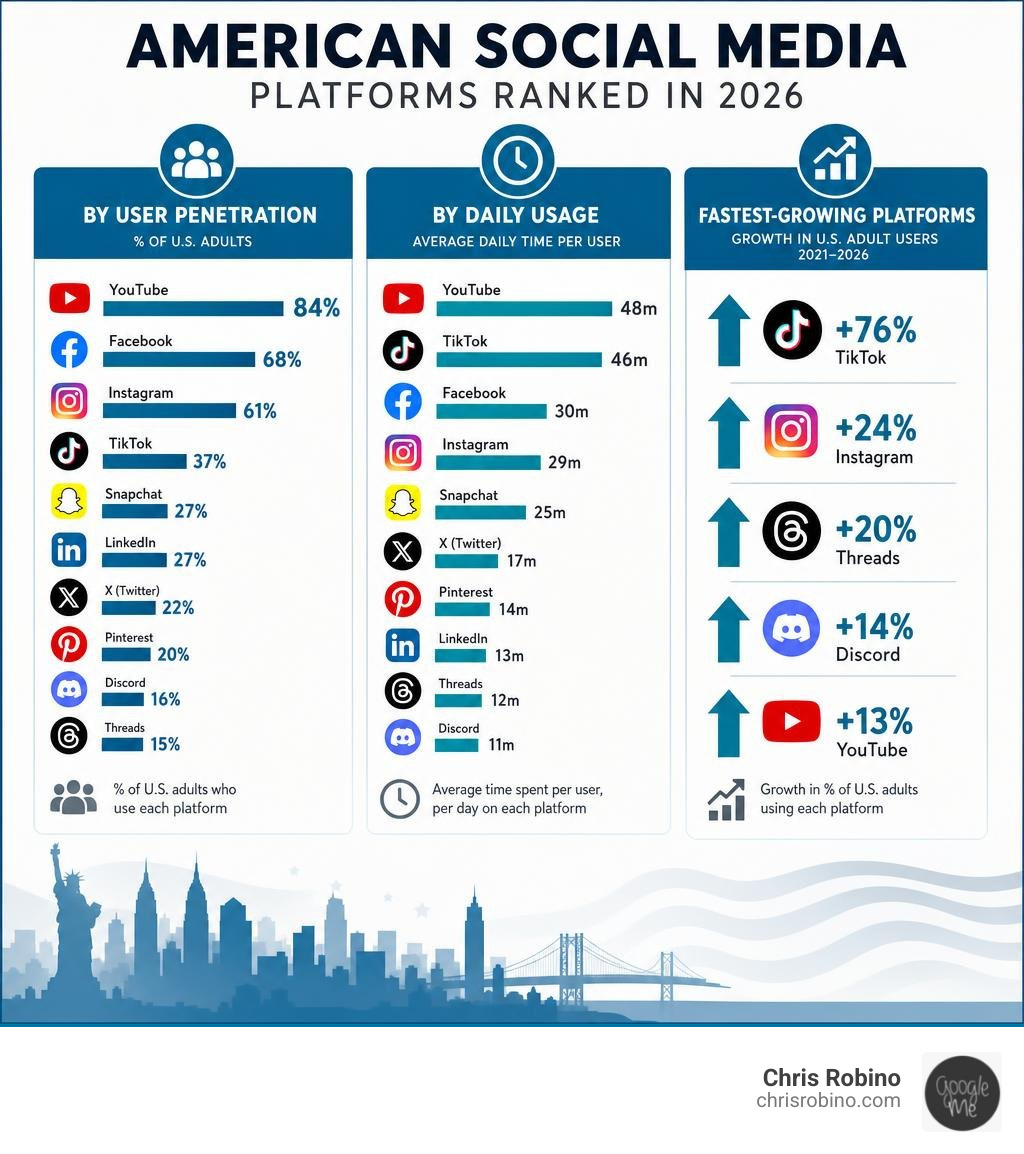
| Fastest growing platform | TikTok (up from 21% to 37% since 2021) |
| Social commerce sales (2026) | $90 billion+ |
The United States is one of the most connected social media markets on the planet. Nearly every American with internet access is on at least one platform. And most are on several.
This is not just casual scrolling. People are shopping, reading news, building careers, and forming opinions — all through social feeds. For businesses and professionals trying to reach American audiences, understanding which platforms matter, who uses them, and why is no longer optional.
Below, we break down the full landscape: the biggest platforms, the key demographics, the trust issues, the business opportunities, and where things are headed.
I’m Chris Robino, a digital strategy and AI search expert with over two decades of experience helping brands navigate the American social media landscape and the broader digital ecosystem. In this guide, I’ll cut through the noise and give you a clear, data-backed picture of how social media works in the US today.
American social media word guide:
Mapping the Landscape of American Social Media

To successfully navigate this hyper-connected market, we must understand that the american social media ecosystem is not a monolith. For enterprise-level companies, a winning SEO strategy requires optimizing brand presence across multiple touchpoints, ensuring that content is discoverable whether a user is searching on a traditional search engine or within a platform’s native search bar.
To achieve this, large companies should implement three core enterprise SEO strategies:
- Brand SERP Domination: Treat social profiles as authoritative content hubs to occupy multiple positions on search engine results pages (SERPs) for branded queries.
- Cross-Channel Search Optimization: Optimize social video assets (like YouTube and TikTok) with keyword-rich descriptions and transcripts to capture search traffic directly within those platforms.
- Entity-Based SEO: Align social media topics with the brand’s core entities and schema markup on the main website, reinforcing topical authority to search engine algorithms.
This structured approach ensures that high-quality, optimized assets—ranging from short-form videos to professional networking articles—are positioned exactly where target audiences spend their time.
The Most Popular American Social Media Platforms
When we look at which networks dominate the daily lives of Americans, the hierarchy reveals a fascinating mix of established giants and rapidly growing networks. If you are trying to figure out Which Biggest Social Media Sites Are Actually Worth Your Time, here is how the top players stack up:
- YouTube (84% reach): Boasting over 239 million active users, YouTube is the undisputed heavyweight. Its dual identity as a video platform and the world’s second-largest search engine makes it a critical asset for enterprise SEO strategies.
- Facebook (71% reach): Despite endless predictions of its demise, Facebook remains a dominant force with roughly 194.1 million users. It is still the go-to hub for local communities, family connections, and daily interactions.
- Instagram (50% reach): With 166.2 million users, Instagram has captured half of the adult population. Its visual-first format and seamless shopping features make it a favorite for lifestyle brands and younger audiences.
- TikTok (37% reach): Climbing rapidly from 21% in 2021 to 37% today, TikTok has over 170 million active users in the US. It is the undisputed king of short-form video and cultural trend generation.
- WhatsApp (32% reach): Driven by its utility, WhatsApp is used by nearly a third of Americans, proving that messaging is a crucial part of the social ecosystem.
- Reddit (26% reach): With 48.2 million daily active users in the US, Reddit has become a massive repository of human-curated information, highly valued by users looking for authentic reviews and discussions.
Demographic Shifts in American Social Media Usage
Demographic segmentation is crucial for large companies looking to tailor their messaging and maximize their return on ad spend. According to the latest data from the Pew Research Center, age remains the most significant differentiator in platform preference:
- The Generational Divide: An incredible 80% of young adults aged 18 to 29 use Instagram, compared to a mere 19% of adults aged 65 and older. Similarly, 50% of those under 30 visit TikTok daily, while only 5% of seniors do the same.
- Gender Preferences: Women are statistically more likely to use Facebook, Instagram, and TikTok, whereas men show higher adoption rates for Reddit and X (formerly Twitter).
- Cultural and Ethnic Trends: Cultural preferences are highly visible on platforms like WhatsApp, which sees 56% adoption among Hispanic adults and 54% among Asian adults, compared to 23% among White adults. TikTok also sees high engagement among Black (53%) and Hispanic (57%) adults compared to White adults (28%).
- Socioeconomic Factors: College graduates and high-income households ($100k+) are significantly more likely to use Reddit, LinkedIn, and Instagram. Lower-income households show higher relative engagement with TikTok.
- Political Affiliation: Even politics plays a role in where we hang out online. Democrats show higher usage of TikTok and Bluesky, while Republicans are more active on platforms like Truth Social and X.
For a deeper dive into how messaging habits are shifting, check out our guide on Chatting in the Modern Age and the Best Apps to Do It.
How Americans Use Social Media for News, Shopping, and Business
The utility of social networks in the U.S. has expanded far beyond personal updates. Today, these platforms serve as vital search engines for product discovery, news consumption, and professional advancement.
For brands looking to scale, understanding How to Master Online and Social Media Marketing Without Losing Your Mind starts with recognizing these three core behaviors:
- Social Commerce: U.S. social commerce sales are expected to surpass $90 billion this year. Platforms like Instagram and TikTok have built seamless in-app checkouts, turning casual scrolling into instant purchasing.
- Influencer Marketing: Brands are projected to invest $6.24 billion in influencer collaborations this year. Influencers act as trusted intermediaries, helping companies bypass traditional ad fatigue.
- Social Listening: To capture high-intent traffic, we must leverage social listening. By monitoring untagged brand mentions, companies can identify customer pain points and address them in real-time. This feeds directly into The Ultimate Guide to Internet and Social Media Marketing Success.
Trust, Privacy, and Mental Health Concerns

Despite high usage rates, the relationship between Americans and social media is increasingly fraught with skepticism and concern. A profound trust deficit exists across the digital landscape: 41 percent of U.S. adults report that they do not trust the information posted on social media platforms very often, and an additional 16 percent state that they do not trust it at all.
This skepticism is compounded by growing anxieties over data privacy, with a large portion of the population expressing deep concern over how platforms track, store, and monetize their personal information.
Mental health also remains a central point of discussion. While some users report positive connection benefits, studies show a clear correlation between prolonged scrolling and increased rates of anxiety and depression, particularly among young women. Large companies must navigate these sensitive dynamics carefully. Brands that prioritize data transparency, ethical advertising, and community safety are far more likely to build long-term authority and consumer loyalty.
The Future of Digital Connection in the United States
As we look toward the horizon, the american social media landscape is undergoing a profound structural transformation. The convergence of artificial intelligence, shifting regulatory frameworks, and corporate consolidation is redefining how platforms operate and how users interact with digital content.
AI Integration and the Evolving Regulatory Environment
The integration of advanced artificial intelligence is fundamentally altering platform mechanics. A prime example of this is the corporate restructuring of X. Following a period of declining user engagement and the departure of CEO Linda Yaccarino, as reported by Linda Yaccarino is leaving Elon Musk’s X after two years as CEO | KRDO, Elon Musk’s AI startup, xAI, acquired X in an all-stock transaction valuing the social media platform at $33 billion, according to NBC News.
This deal directly links social data with AI development, embedding the Grok chatbot deeply into the user experience. However, this rapid AI integration has brought severe regulatory scrutiny. Musk was recently summoned to Paris by prosecutors investigating the spread of deepfakes, child abuse material, and AI-generated disinformation on the platform, as covered by The Independent, highlighting the growing international tension over content moderation.
Domestically, regulatory pressures are reshaping marketing budgets. The ongoing threat of a TikTok ban under legislation like the RESTRICT Act and the DATA Act has forced large companies to diversify their digital assets. To mitigate the risk of losing access to TikTok’s massive audience, enterprise marketers are rapidly migrating their short-form video strategies to alternative channels like Instagram Reels and YouTube Shorts, ensuring their search visibility remains uninterrupted regardless of legislative outcomes.
Trends and Predictions for 2026 and Beyond
Looking forward, several key trends will define the future of digital connection in America:
- Short-Form Video Dominance: Short-form video will maintain its position as the preferred format for user engagement and product discovery.
- Social Commerce Maturity: Social commerce will continue to mature, blending seamless checkout experiences directly into entertainment feeds.
- Hyper-Personalized AI Feed Engines: AI-driven personalization will become highly sophisticated, delivering hyper-customized content recommendations that challenge traditional search engine models.
As digital pioneers have noted, the platforms that successfully blend utility with community are the ones that survive major industry shifts. For a deeper look at what lies ahead, explore our insights on Beyond the Scroll: What’s Next for the Social Media Industry.
For large companies, navigating this rapidly shifting landscape requires a sophisticated blend of technical SEO, creative content production, and strategic foresight. Enterprise SEO strategies must evolve to include AI-search optimization (GEO/AIO), ensuring brand mentions are cited by LLMs and AI search engines. To master these emerging technologies and build a resilient digital presence, brands must partner with industry experts who understand the intersection of media, technology, and consumer behavior. Through the specialized consulting services of Chris Robino Media Production Consulting, enterprises can access the streamlined expertise and strategic insights needed to dominate the evolving American digital landscape and drive sustainable, long-term growth.