

Why Your Enterprise Automation Strategy Determines Whether You Scale or Stall
An enterprise automation strategy is one of the most consequential decisions a modern organization can make — and most companies are still getting it wrong.
Here is what you need to know right away:
What is an enterprise automation strategy? A structured roadmap that guides how your organization identifies, prioritizes, and implements automation — from simple rule-based tasks to AI-powered workflows — across departments, in alignment with core business goals.
Why does it matter in 2026?
- Up to 30% of U.S. employee work hours could be automated by 2030, according to McKinsey
- Global automation investment is on track to surpass $350–400 billion by 2030
- 89% of automation users report higher job satisfaction — freeing people from repetitive work drives real engagement
- Organizations using automation strategically achieve 3x more cost savings than those deploying it opportunistically (Gartner)
- Yet 95% of enterprise AI pilots deliver zero measurable P&L impact (MIT, 2025) — because strategy, not technology, is the gap
The core problem? Most organizations jump into automation tool-first. They buy an RPA platform, automate a few tasks, and call it a strategy. What they end up with is a patchwork of disconnected bots, data silos, and mounting maintenance costs — with no clear path to scale.
Real automation value comes from treating it as an organizational capability, not a technology project.
Without a deliberate strategy, you get fragmented point solutions. With one, you get a compounding, enterprise-wide efficiency engine that frees your people to do higher-value work.
I’m Chris Robino, a Digital Strategy Leader and AI & Search Expert with over two decades of experience helping organizations — from startups to large enterprises — build and execute enterprise automation strategies that actually deliver ROI. In this guide, I’ll walk you through exactly how to do it without the usual headaches.
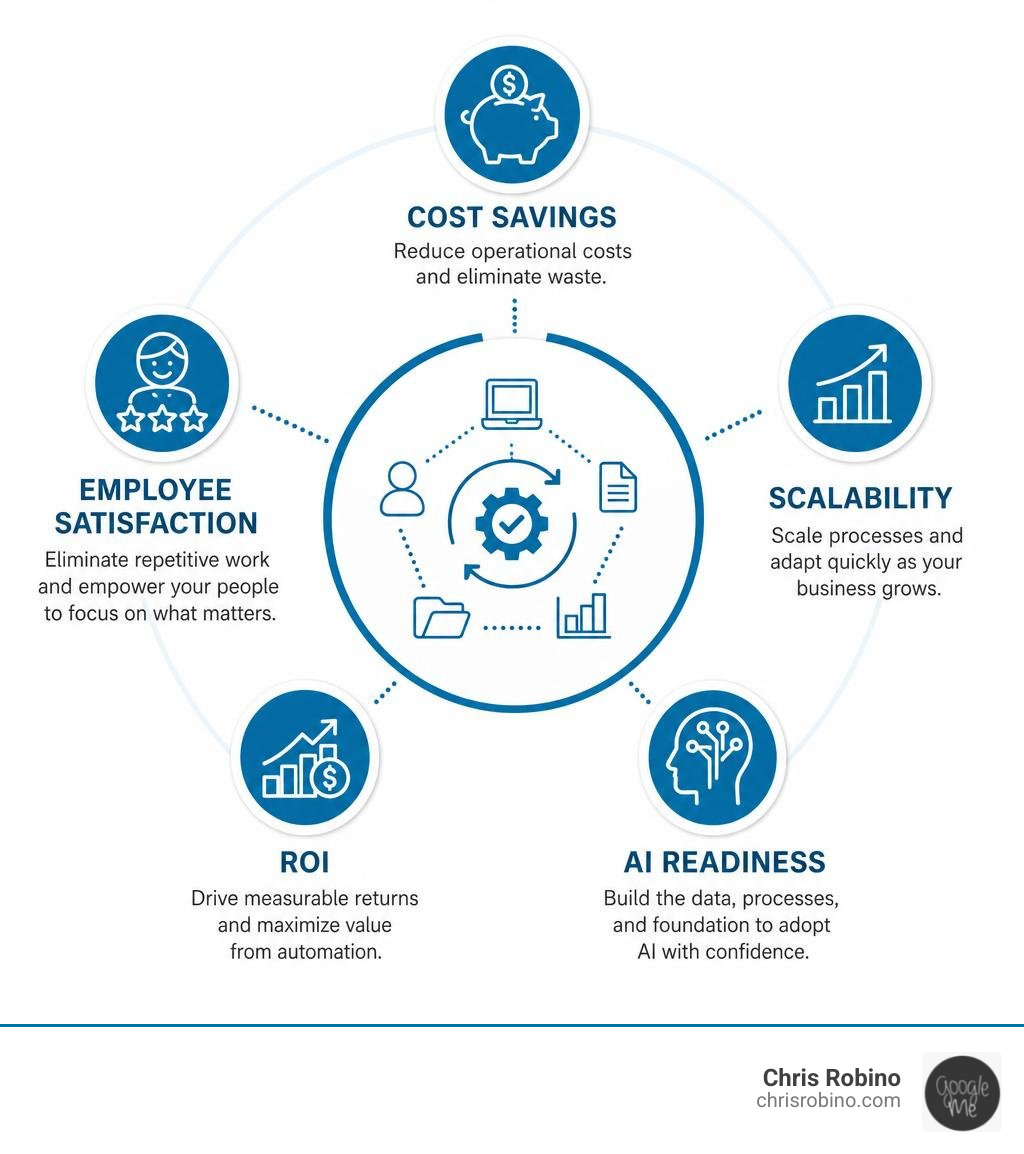
Discover more about enterprise automation strategy:
Designing a Modern Enterprise Automation Strategy

When we set out to design an enterprise automation strategy, we are not just looking to replace a few manual clicks with a script. We are aiming to transform how our business operates.
To achieve this, we must align our automation initiatives directly with our overarching business goals. If our corporate goal is to improve customer retention by 20%, our automation efforts should focus on customer-facing workflows, such as rapid support routing or automated client onboarding, rather than obscure back-office tasks that do not move the needle.
The Evolution of Automation: From RPA to Agentic AI
Automation has come a long way from the days of simple macros. To build a future-proof strategy in 2026, we need to understand the different layers of the automation stack:
- Basic Automation: Simple, localized tasks like sending an automated email notification or running a scheduled database backup.
- Robotic Process Automation (RPA): Software bots mimicking human interactions with user interfaces to handle structured, repetitive tasks.
- Business Process Automation (BPA): Orchestrating end-to-end, multi-step workflows across different departments and systems.
- Intelligent Automation (IA): Combining RPA and APIs with machine learning to process semi-structured data, such as extracting invoice details using optical character recognition (OCR).
- Agentic AI: The cutting edge of modern automation. Unlike static, rule-based systems, AI agents use real-time data and adaptive learning to reason, make decisions, and execute goal-directed workflows autonomously.
By transitioning from standalone RPA to a multi-technology Intelligent Automation ecosystem, we can increase our average program ROI from 1.5x to over 2x. We move from deterministic “if-this-then-that” rules to adaptive systems capable of handling unstructured data, which makes up roughly 90% of all enterprise information.
To dive deeper into these technologies, read our guides on AI-Powered Automation and Beyond the Scan: Elevating Your Automation with RPA and OCR.
Core Components of an Enterprise Automation Strategy
A resilient enterprise automation strategy is built on seven core pillars:
- Process Discovery & Assessment: Using data-driven methods to find out where our teams are actually spending their time.
- Technology Architecture: Selecting scalable platforms (like iPaaS and AI orchestration layers) that integrate seamlessly with our existing tech stack.
- Operating Model: Establishing a Center of Excellence (CoE) to govern standards while empowering business units.
- Process Redesign: Reimagining and optimizing a workflow before we automate it. Automating an inefficient process simply magnifies its inefficiency.
- Workforce Impact & Change Management: Actively addressing employee anxieties and training staff to work alongside digital assistants.
- Portfolio Management: Managing our automated workflows as a portfolio, tracking their health, and retiring obsolete bots.
- Governance & Continuous Improvement: Ensuring strict security controls, data integrity, and compliance audits.
You can also learn practical tips in our article on How to Put Your Business on Autopilot with Intelligent Automation.
How to Identify and Prioritize Processes for Automation
Not every business process is a good candidate for automation. To avoid wasting our budget on low-value projects, we must evaluate processes based on objective criteria.
| Criteria | High Suitability | Low Suitability |
|---|---|---|
| Rule Consistency | Standardized, highly logical rules | Subjective, requiring human intuition |
| Data Structure | Highly structured (databases, CSVs, standard forms) | Highly unstructured with no clear patterns |
| Transaction Volume | High volume, highly repetitive | Low volume, ad hoc or infrequent |
| System Stability | Stable legacy systems or modern APIs | Systems undergoing frequent UI redesigns |
| Exception Rate | Low exception rate | High exception rate requiring manual reviews |
To discover the “as-is” state of our workflows, we should combine process mining (analyzing system event logs) with task mining (observing user desktop interactions). Actual business processes deviate from official documentation by an average of 40%. Relying solely on manual employee interviews will result in automating the wrong steps.
Building a 90-Day Automation Roadmap
To build momentum and secure long-term buy-in, we recommend executing a structured 90-day rollout plan divided into three distinct phases.

Phase 1: Discovery (Days 0–30)
We begin by establishing our Center of Excellence (CoE) and auditing our existing workflows. We set up a standardized intake form where business teams can submit automation ideas. By the end of this phase, we rank these opportunities by ease of implementation and projected business value.
Phase 2: Pilot (Days 30–60)
We select one or two low-risk, high-impact workflows to serve as our proof of concept. For example, automating password resets in IT or standardizing invoice data entry in finance. We define clear baseline key performance indicators (KPIs) to measure success.
Phase 3: Scale (Days 60–90+)
Once the pilot proves successful, we document our learnings, optimize our playbooks, and begin rolling out automation to other departments. We also introduce citizen developer programs, allowing non-technical business users to build localized automations under the strict oversight of our CoE.
To ensure your infrastructure is ready for this rollout, check out our RPA Infrastructure Setup Guide: From Blueprints to Bots.
Overcoming Challenges in Your Enterprise Automation Strategy
The path to automation maturity is rarely a straight line. We must prepare for several common organizational roadblocks:
- Automation Silos: When individual departments buy disparate point solutions without central coordination. This leads to redundant tools and fragmented data.
- Change Resistance: Employees often worry that automation will make their jobs obsolete. We must foster a culture of clarity, demonstrating that automation is designed to liberate them from mundane tasks so they can focus on creative, high-value work.
- Data Quality: If our input data is inaccurate, our automated workflows will simply scale those errors at lightning speed. Data governance is non-negotiable.
- Hidden Maintenance Costs: Many teams forget that applications change. When software interfaces or data fields get updated, bots can break. We must budget 20% to 30% of the initial development cost annually for ongoing maintenance and support.
To learn more about scaling past these operational hurdles, read our RPA Robotic Automation Ultimate Guide.
Governance, Security, and Compliance Frameworks
In 2026, enterprise governance is no longer a postscript; it is a primary operational requirement. With strict standards like SOC 2 Type II, the EU AI Act (fully enforced as of August 2026), and updated COSO guidelines for Generative AI, audit-readiness must be built into our platforms from day one.
To maintain a secure and compliant automation ecosystem, we must implement:
- Continuous Observability: Moving away from point-in-time audits to real-time monitoring of all automated decision paths.
- Tiered Human-in-the-Loop (HITL): Rather than applying a blanket review process that slows down operations, we tier our reviews by risk. Low-risk tasks are auto-approved with random sampling, while high-risk financial or legal transactions require synchronous human approval.
- Deterministic Guardrails: For highly regulated workflows (such as SOX-relevant financial reporting), we use deterministic architectures to prevent the unpredictable “hallucinations” of probabilistic AI models.
Conclusion

Building a successful enterprise automation strategy is not about chasing the latest technology buzzwords. It is about creating a structured, governed, and human-centric capability that scales with your business goals.
By starting with a clear 90-day roadmap, prioritizing processes based on data rather than assumptions, and building strong governance from the outset, we can turn manual, repetitive bottlenecks into a scalable engine for growth and innovation.
At ChrisRobino.com, we specialize in helping organizations navigate the complexities of emerging technologies, AI integrations, and strategic digital transformations. We provide a centralized portal to access our deep expertise and streamline your path to operational excellence.
Ready to transform your manual operations into intelligent, scalable systems? Explore The Definitive Guide to Robotic Automation to take your next step, or reach out to us today to design an automation roadmap tailored to your business.