

What Is Enterprise Technology Consulting (And Why It Matters in 2026)
Enterprise technology consulting is the practice of helping large organizations align their technology investments with real business goals — from modernizing legacy systems and migrating to the cloud, to scaling AI and fixing broken data infrastructure.
Here’s a quick breakdown of what it covers:
| Area | What It Means |
|---|---|
| Strategy & Roadmapping | Connecting business goals to a clear, executable technology plan |
| Legacy Modernization | Replacing outdated on-prem systems with cloud-based infrastructure |
| AI & Data | Building the data foundations needed to scale AI across the enterprise |
| Change Management | Ensuring people actually adopt the new systems being rolled out |
| Cost Optimization | Reducing technical debt, shadow IT, and wasted technology spend |
The stakes are high. Research shows that 90% of companies have run technology cost programs in recent years — yet three out of four failed to hit their cost targets. Nearly half missed by more than 50%.
Meanwhile, 73% of finance leaders say they feel pressure to adopt AI, but only 31% report making meaningful progress.
That gap — between the pressure to transform and the ability to actually execute — is exactly where enterprise technology consulting lives.
It’s not just about having a strategy. It’s about having the right team, architecture, and governance to deliver that strategy without getting buried in corporate politics or stalled by legacy constraints.
As the research puts it well: enterprise technology consulting should feel like progress, not politics.
I’m Chris Robino, a digital strategy and AI search expert with over two decades of experience helping organizations — from startups to large enterprises — navigate enterprise technology consulting and digital transformation to drive measurable ROI. In the sections below, I’ll break down everything you need to know to move from confusion to clarity.
The Strategic Value of Enterprise Technology Consulting
In the fast-moving landscape of 2026, technology is no longer just a supportive back-office function. Today, a business-led technology strategy must deliver digital transformation at scale. It acts as the primary engine for functional excellence and long-term organizational growth.
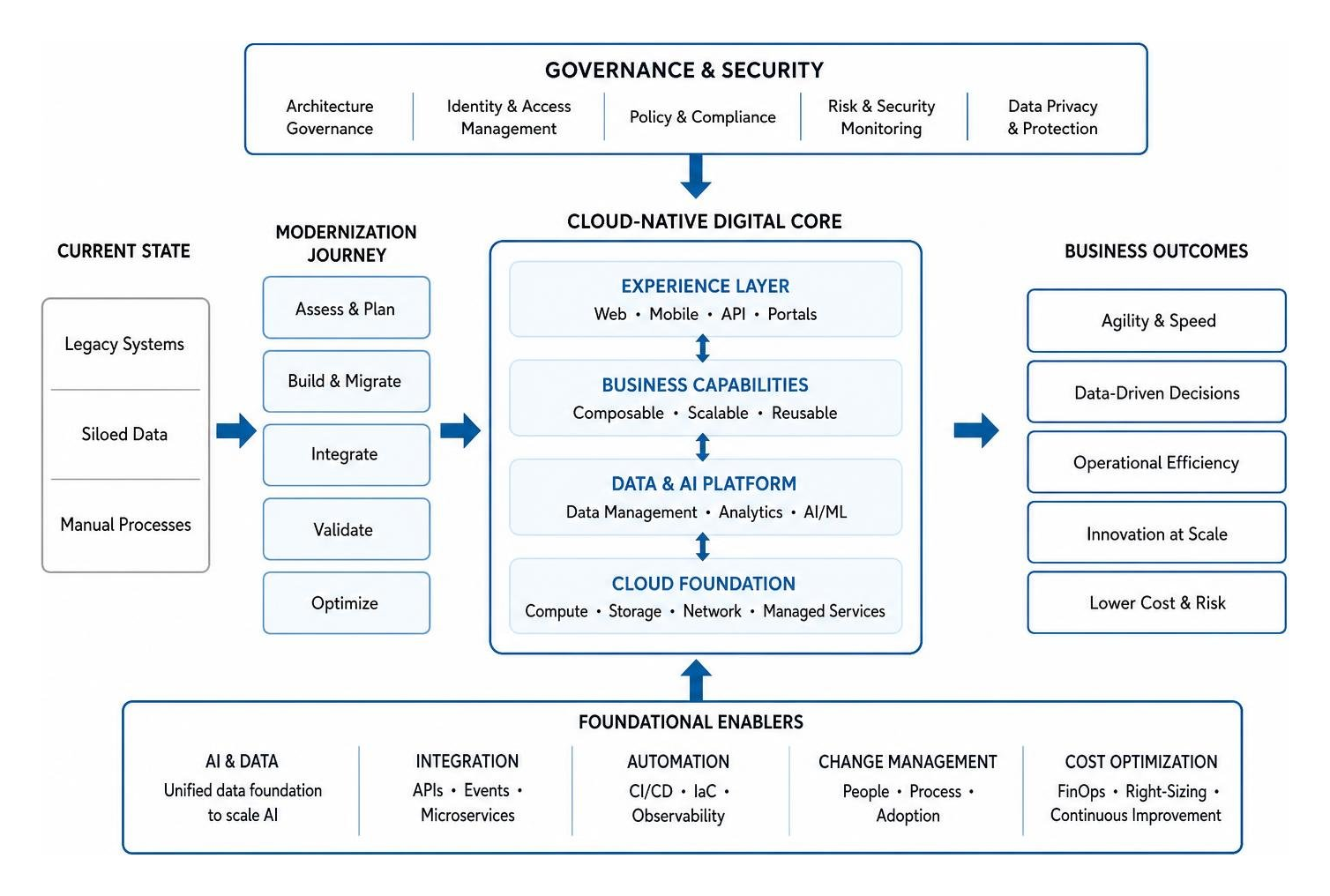
When we look at modern enterprise systems, we must design them to be “reinvention-ready.” This means moving away from rigid, monolithic setups and embracing composable, cloud-based architectures. By doing so, we ensure our clients can quickly adapt to market disruptions and scale new capabilities as they emerge.
Enterprise Technology Consulting vs. Traditional IT Consulting
Many business leaders use the terms “IT consulting” and “enterprise technology consulting” interchangeably, but they serve entirely different strategic purposes.
Traditional IT consulting typically focuses on solving isolated, technical problems – such as upgrading a specific database or setting up a local network. Managed IT services focus on day-to-day operations and “keeping the lights on.”
In contrast, enterprise technology consulting takes a holistic, business-first approach. We analyze how systems, data, and infrastructure interact across the entire organization to drive large-scale digital transformation.
| Feature | Traditional IT Consulting | Managed IT Services | Enterprise Technology Consulting |
|---|---|---|---|
| Primary Focus | Point tools, specific software, and isolated technical issues | Ongoing operations, maintenance, and user support | Strategic transformation, systems integration, and business value |
| Scope | Single department or specific technical stack | Day-to-day infrastructure and network stability | Entire enterprise architecture and organizational workflow |
| Goal | Solve a temporary, immediate technical bottleneck | Maintain operational continuity and minimize downtime | Drive scalable growth, optimize costs, and prepare for emerging tech |
To better understand how these differences impact your overall organizational strategy, read our guide on It Consulting Services and learn how partnering with a dedicated Business Consulting Firm can help align your high-level business goals with your day-to-day technical execution.
Scaling AI and Modernizing Legacy Architecture
One of the most pressing challenges we face in 2026 is scaling artificial intelligence. While many companies run isolated AI experiments, very few successfully integrate AI into their core workflows.
The main blocker? Legacy architecture. Legacy IT stacks were built for predictable, request-response transactions. They are fundamentally ill-suited for the adaptive, multi-step workflows that AI demands.
To scale AI successfully, we must modernize the core. This involves decommissioning expensive on-premise systems and migrating to modern, cloud-based environments. Companies adopting modernized applications see up to 6X faster revenue growth. Because data is the ultimate enabler of AI, we must focus on building a robust digital core before deploying advanced machine learning models. AI programs also need governance, risk controls, and clear operating principles; the NIST AI Risk Management Framework is a useful reference for organizations building responsible AI practices.
To dive deeper into setting up these frameworks, check out our Ai Strategy Consulting Ultimate Guide and our Technology Innovation Consulting Complete Guide.
High-Performance Enterprise SEO Strategies
For large companies, digital transformation must extend to organic search visibility. Enterprise SEO requires a technical, scalable approach to manage millions of pages across complex domains:
- Programmatic SEO & Scalable Architecture: Large enterprises must build database-driven, dynamic page templates that target long-tail search queries at scale while maintaining strict quality controls. This means creating templatized landing pages that serve thousands of keyword variations without sacrificing content depth or relevance.
- Crawl Budget Optimization: Large sites often suffer from crawl inefficiencies. Optimizing internal linking structures, resolving duplicate content through canonical tags, and managing server response times ensure search engine bots index high-value pages efficiently rather than wasting resources on low-priority URLs.
- AI-Search Integration: As search engines transition to AI-driven answer engines, enterprise technology must structure data using schema markup and clean API delivery to ensure brand content is easily parsed by LLMs and search crawlers alike. Implementing structured data at scale gives large organizations a significant edge in AI-generated search results.
- Technical Site Health at Scale: Enterprises must continuously monitor Core Web Vitals, fix broken internal links, and maintain clean URL architectures across subdomains and international properties. Automated auditing pipelines are essential for catching issues before they impact rankings.
- Content Authority & Topical Depth: Large companies should leverage their domain authority by building comprehensive content hubs around core business topics, creating interlinked clusters that signal deep expertise to search algorithms.
Overcoming the Failure Rate of Technology Cost Programs
As mentioned earlier, 90% of companies have run technology cost-reduction initiatives recently, but three out of four failed to achieve their targets. Most organizations rely on risky, across-the-board budget cuts that impair operations and increase technical debt.
To reduce technology costs without disrupting the business, we recommend a disciplined, three-wave cost-reduction roadmap:
- Reduce: Identify immediate, low-risk savings by consolidating redundant software licenses, rationalizing vendors, and optimizing cloud compute usage.
- Replace: Swap out expensive legacy systems with efficient, modern, cloud-native alternatives.
- Rethink: Redesign the entire enterprise architecture and operating model to build long-term operating leverage.
By translating technology investments into reusable platforms and cleaner data, we turn IT spending from a sunk cost into a strategic asset.
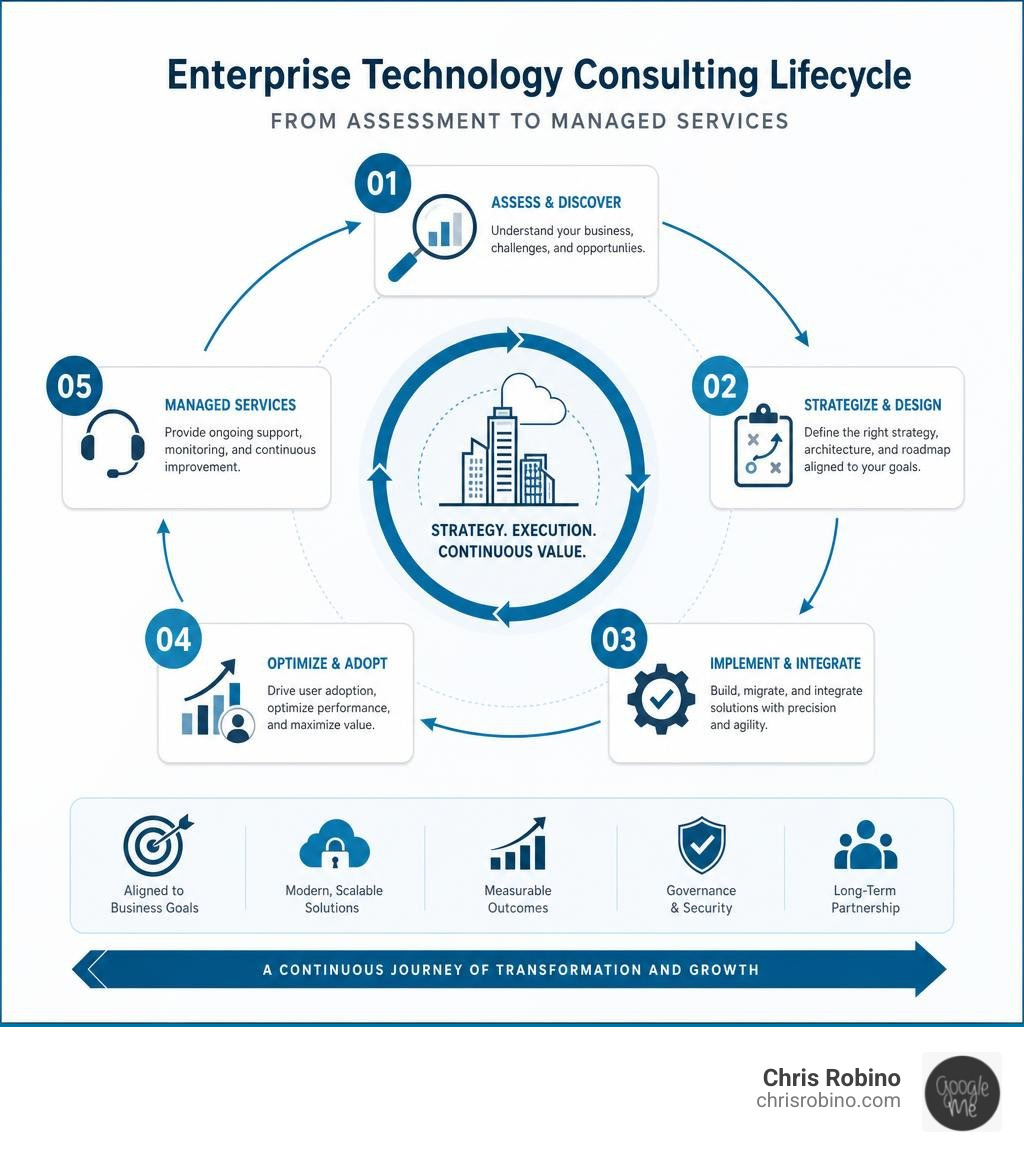
Navigating the Enterprise Technology Consulting Lifecycle
A successful enterprise technology consulting engagement is not a chaotic, open-ended project. It is a highly structured, agile journey designed to deliver rapid, measurable progress. We break this lifecycle down into four distinct phases:
- Evaluate Systems and Architecture: We thoroughly assess your existing environments to identify technical debt, security exposures, and operational bottlenecks.
- Define Your Technology Roadmap: We build a phased, risk-weighted roadmap that directly connects your business goals to clear delivery outcomes.
- Deploy the Right Team: We assemble specialized, agile teams with the exact technical skills needed for your project, minimizing onboarding friction.
- Execute with Agility and Governance: We run rapid implementation sprints with clean reporting, structured reviews, and real-time feedback loops.

To see how this agile approach keeps large-scale projects on track, read our guides on Agile Tech Consulting and choosing a Technology Innovation Consulting Firm.
Key Indicators Your Organization Needs Enterprise Technology Consulting
How do you know when it is time to bring in external expertise rather than handling challenges internally? Look for these key warning signs within your organization:
- Stretched Internal Resources: Your internal IT team is fully consumed by daily maintenance and “firefighting,” leaving no room for strategic innovation.
- Analysis Paralysis: Your leadership team is stuck in endless planning cycles, unable to make a definitive decision on major software or architecture updates.
- Slipping Roadmaps: Key product launches, system migrations, or database upgrades are consistently missing their target deadlines.
- Rising Technical Debt: Your systems are becoming increasingly complex, fragile, and expensive to maintain.
If your organization is experiencing any of these roadblocks, it is time to seek outside advisory. Discover how we help businesses break through these bottlenecks in our guides on Digital Innovation Consulting and Innovation Advisory Services.
Ensuring User Adoption and Change Management
A brilliant technical solution is completely useless if your employees refuse to use it. True digital transformation requires focusing on human capital management just as much as the technology itself.
To ensure high user adoption during enterprise rollouts, we build change management directly into the project lifecycle. This begins with leadership alignment workshops to ensure all executives are on the same page. We then conduct hands-on training sessions and design intuitive, user-centric interfaces that make the transition as smooth as possible.
Whether you are rolling out a new ERP platform or transforming your customer-facing applications, keeping your team aligned is critical. For insights on managing complex digital rollouts, read our article on Digital Transformation For Media.
Measuring ROI and Long-Term Business Outcomes
At the end of the day, enterprise technology consulting must deliver a clear, quantifiable return on investment. We measure the success of our engagements through tangible, strategic metrics:
- Data Maturity Scores: Standardized assessments that track how effectively your organization uses data to drive business innovation (e.g., improving from a 1.6 to a 1.8 out of 2.0).
- Direct Cost Savings: Lowering operational overhead by decommissioning legacy hardware and optimizing cloud compute jobs.
- Revenue Growth: Decoupling revenue growth from headcount growth by leveraging automation and cloud-based “as-a-service” business models.
By partnering with an experienced Tech Consultant, you can confidently navigate digital disruption and build a highly resilient, modern enterprise.
At Chris Robino, we centralize cutting-edge insights and strategic advisory to help you streamline communications, optimize your technical stack, and unlock your enterprise’s true potential. Ready to transform your core and accelerate your growth? Let’s work together to solve your most pressing technology challenges.