

Why Global Social Media Statistics Matter in 2026
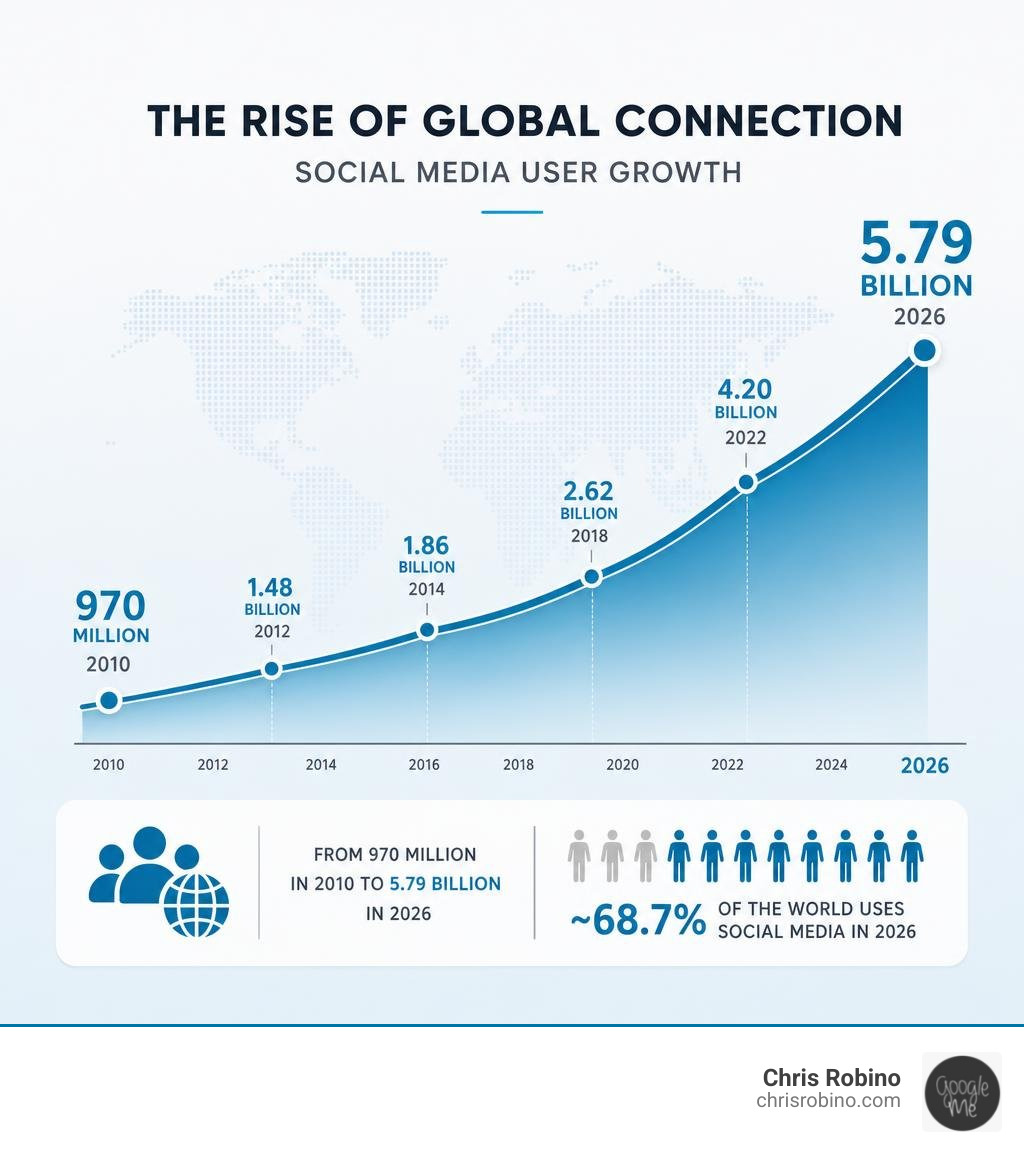
Global social media has crossed a threshold that would have seemed impossible just a decade ago: more than 2 in 3 people on Earth now use it every month.
Here is a quick snapshot of where things stand as of 2026:
| Metric | Figure |
|---|---|
| Total social media user identities | 5.79 billion |
| Share of global population | ~68.7% |
| Share of internet users | 94.7% |
| New users added in the past year | 294 million |
| Average platforms used per month | 6.5 |
| Average daily time spent | 141 minutes (2 hrs 21 min) |
| Global ad spend (2025) | $276 billion |
| Largest platform (MAU) | Facebook — 3.11 billion |
That is not just impressive growth. It is a fundamental shift in how humanity communicates, discovers information, and spends its time.
In 2010, roughly 970 million people used social media. By 2026, that number has grown more than fivefold. The world collectively spends over 15 billion hours on social platforms every single day — the equivalent of 1.75 million years of human existence, consumed in 24 hours.
And yet, the numbers alone do not tell the full story. Which platforms are winning? Which regions are still growing fast? Who is actually using what — and why? Those are the questions worth digging into.
I’m Chris Robino, a digital strategy leader with over two decades of experience helping organizations navigate the evolving landscape of global social media, from platform selection to AI-driven content and paid social strategy. In this guide, I’ve pulled together the most current data to give you a clear, structured picture of where social media stands today.
Global social media terms to learn:
The State of Global Social Media in 2026
When we look at the sheer scale of active usage today, it becomes clear that global social media is no longer a collection of distinct digital networks; it is the primary infrastructure of our global digital experience.
With 5.79 billion active user identities worldwide, social media has achieved “supermajority” status. This means that more than two out of three people on Earth are active monthly users. Growth remains remarkably robust despite high market saturation. Over the past year, the global user base expanded by 294 million new identities—an average of 9.3 new users starting their social media journey every single second.
According to the Digital 2026: 2 in 3 people on Earth now use social media — DataReportal – Global Digital Insights , 94.7% of all active internet users now visit at least one social media platform every month.
Global Social Media Audiences and Platform Rankings
To understand where this massive user base is concentrating, we must look at how the top platforms compare. While new apps frequently try to disrupt the market, the established giants continue to hold the largest shares of the global audience.
| Platform | Monthly Active Users (MAUs) | Key Strength |
|---|---|---|
| 3.11 Billion | Unrivaled global footprint | |
| 2.89 Billion | Visual culture and social commerce | |
| YouTube | 2.58 Billion | Video search and creator ecosystem |
| 2.48 Billion | High-frequency messaging utility | |
| TikTok | 1.99 Billion | Algorithmic entertainment and virality |
While TikTok has captured the cultural zeitgeist with its rapid rise, Facebook and Instagram—both owned by Meta Platforms—still lead TikTok by roughly one billion users each. This dynamic highlights the incredible staying power of Meta’s ecosystem, which generated over $200 billion in annual revenue in 2025.
When evaluating which platforms are worth a brand’s or creator’s focus, it is essential to look beyond raw user numbers to actual engagement and market share. Tools like Social Media Stats Worldwide | Statcounter Global Stats show how referral traffic and platform usage translate to real-world impact. To help you decide where to focus your energy, we have analyzed Which Biggest Social Media Sites are Actually Worth Your Time to break down platform ROI.
Regional Penetration and Growth Trends

The global average penetration rate of 63.8% hides vast regional differences. When we analyze global social media geographically, we find a striking inversion: the regions with the highest volume of users are often very different from those with the highest penetration rates.
According to the Social Network Users Worldwide 2026 by Region — Full Regional Breakdown :
- Eastern Asia leads the world in sheer volume, with 1.095 billion social media users (primarily driven by China’s massive domestic platforms like WeChat, Douyin, and Weibo).
- Southern Asia is the second-largest region with 745 million users, adding the largest number of absolute new users (+65 million) over the past two years.
- Northern America boasts one of the highest regional penetration rates at 82%, accounting for 318 million users.
- Sub-Saharan Africa, by contrast, represents a massive future growth frontier with 286 million users, but currently sits at a lower regional penetration rate of 29% to 33%.
While high-penetration markets like Northern America and Northern Europe are growing slowly (largely at the rate of demographic replacement), emerging markets are expanding rapidly. Middle Africa is the fastest-growing region by percentage, posting a +16.7% growth rate over the last two years.
Time Spent and User Motivations
How do these billions of users spend their time once they log on? On average, internet users spend 141 minutes per day on social platforms. This adds up to roughly 18 hours and 36 minutes every single week.
However, time spent varies dramatically by platform. TikTok users are the most deeply engaged, spending an average of 31 hours and 32 minutes monthly on the Android app alone. This is followed by YouTube, which accounts for the largest total share of video consumption time online.
To understand why people are so deeply attached to these feeds, we must look at their core motivations. According to GWI research, the top reasons people use social media include:
- Keeping in touch with friends and family (50.2%)
- Filling spare time (39.7%)
- Finding content/entertainment (35.1%)
- Reading news and current events (34.8%)
- Researching brands and products (32.4%)
These motivations are highly regional and cultural. For instance, we see unique behavioral patterns in the Western hemisphere, which we dive into in our analysis of The Stars Stripes and Swipes of American Social Media. For a broader look at global behaviors, you can check out the comprehensive Global Social Media Statistics — DataReportal – Global Digital Insights .
Demographics and Platform Dynamics
The “who’s who” of social media platforms has shifted significantly. The old stereotype that certain apps are exclusively for teenagers while others are for older generations no longer holds true in 2026.
According to the Social Media — Statistics & Facts 2026 :
- TikTok has matured. Its largest user segment has officially shifted to the 25-34 age group, proving its broad appeal well beyond Gen Z.
- Instagram remains a powerhouse for young adults, with 30% of its active user base falling into the 18-24 age bracket.
- Facebook maintains a highly balanced demographic, with its largest cohort (32%) also sitting in the 25-34 age group, though it skews older in Western markets compared to emerging economies.
- WhatsApp remains the ultimate cross-generational utility, used equally by almost all age groups for daily communication.
Understanding these demographics is crucial for choosing the right channels to connect with audiences. For a closer look at messaging platforms, read our guide on Chatting in the Modern Age and the Best Apps to Do It.
Advertising Spend and Brand Strategies
With billions of eyes glued to their screens, brands have followed the attention. Global social media advertising spend reached an estimated 276 billion U.S. dollars in 2025, making it one of the largest segments of the global advertising market.
Marketers continue to rely heavily on established networks:
- 86 percent of marketers report using Facebook as part of their active marketing mix.
- 83 percent of professionals cite “increased brand exposure” as the leading benefit of their social media marketing efforts.
- Social Commerce (shopping directly within social apps) reached $1.3 trillion in 2025, accounting for roughly 17% of all global e-commerce.
This commercialization means that platforms are constantly evolving to serve advertisers. To stay ahead of these shifts, we must analyze where the industry is heading next. We cover these commercial evolutions in our industry forecast, Beyond the Scroll Whats Next for the Social Media Industry.
Account Duplication and Data Accuracy in Global Social Media
As digital strategists, we must address an important technical caveat in these numbers: the difference between “user identities” and “unique people.”
The figure of 5.79 billion refers to active user identities. Because many individuals maintain multiple accounts across different platforms (or even multiple accounts on a single platform), the actual number of unique human beings using social media is slightly lower.
According to the Worldwide Social Network Users Forecast 2025 , the number of unique individuals using social networks sits closer to 4.2 to 4.5 billion. For marketers, this means that “reported ad reach” can sometimes be inflated by duplicate accounts, non-human bot accounts, or business profiles. Successful campaign planning requires filtering out this noise and focusing on authentic, localized engagement rather than raw reach metrics.
Integrating Global Social Media with Enterprise SEO Strategies
For large companies, managing a global social media presence goes hand-in-hand with executing high-performing SEO strategies. Enterprise SEO requires a highly scalable, structured approach to capture search demand across both traditional search engines and social platforms.
SEO Strategies That Perform Well for Large Companies
To maintain dominance in a crowded digital landscape, large organizations must focus on specific, high-impact SEO strategies:
- Programmatic SEO and Scalable Content Hubs: Large companies often have thousands of products or regional landing pages. Implementing programmatic SEO allows enterprises to build high-quality, database-driven pages at scale, targeting long-tail search queries without manual creation bottlenecks.
- International and Multilingual SEO: Operating on a global scale requires precise hreflang implementation, localized keyword research, and regional subfolders or subdomains. This ensures that search engines serve the correct language version to users based on their geographic location.
- Social-to-Search Optimization: Modern search behavior is shifting. Users frequently search for brands and products directly on platforms like TikTok, YouTube, and Instagram. Optimizing social media profiles, video descriptions, and captions with relevant keywords ensures that enterprise brands capture search traffic within these closed ecosystems.
- Robust Internal Linking and Site Architecture: Large websites naturally accumulate massive backlink profiles, but they often suffer from poor internal link distribution. Implementing a hub-and-spoke model helps distribute authority from high-performing global social media landing pages to deeper, high-value commercial pages.
Navigating this complex, fast-moving digital landscape requires deep expertise in media production, platform algorithms, and localized content strategies. At ChrisRobino.com, we centralize our specialized insights to help brands, creators, and media companies build authentic relationships with audiences around the globe.
Ready to optimize your global social media strategy, elevate your video production, or scale your brand’s digital presence? Explore our tailored consulting services at Chris Robino Media Production Consulting and let us build the future of your digital reach together.