

Why Most Ad Budgets Underperform — and What Paid Media Services Actually Do
Paid media services are the strategies, channels, and management systems businesses use to place paid advertisements in front of targeted audiences — across search engines, social platforms, display networks, and beyond.
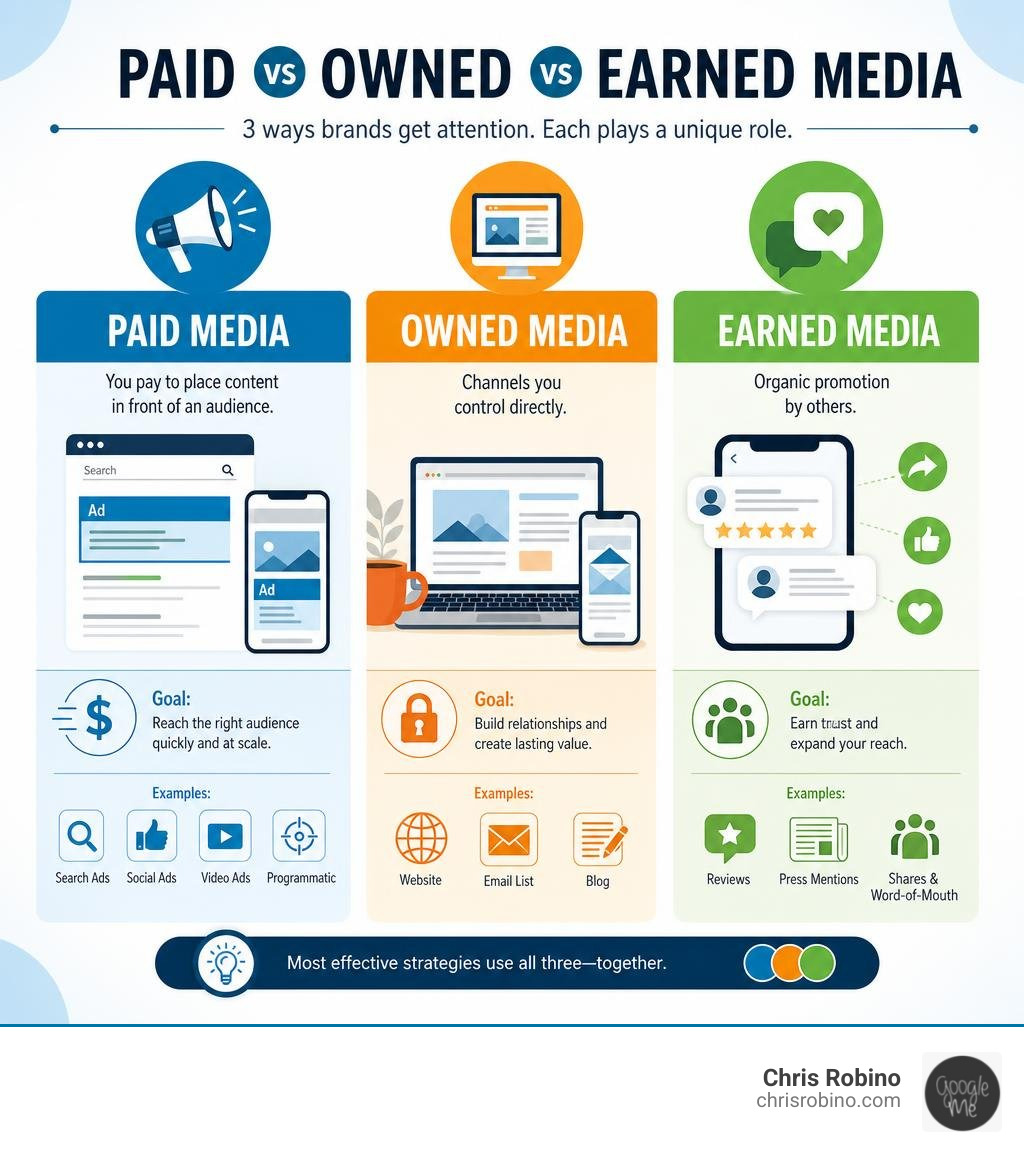
Here’s a quick breakdown of what that means in practice:
| Type | Definition | Examples |
|---|---|---|
| Paid Media | You pay to place content in front of an audience | Google Ads, Meta Ads, YouTube, Programmatic |
| Owned Media | Channels you control directly | Website, email list, blog |
| Earned Media | Organic promotion by others | Reviews, press, shares, word-of-mouth |
Paid media sits at the intersection of speed and precision. Unlike SEO or content marketing — which can take six months or more to show results — a well-run paid campaign can drive targeted traffic today. That’s the appeal. But it’s also where the risk lives.
The reality? Most ad accounts are quietly bleeding budget. Audits of new client accounts consistently find that 30–50% of monthly spend goes to wasted clicks, misaligned audiences, and broken tracking. With Google alone generating approximately 84 billion visits in July 2024, the opportunity is enormous — but so is the room for error.
And the stakes are real: 65% of marketers consider paid advertising “very important” or “critical” to their overall strategy. Yet many businesses launch campaigns without a clear framework, the right attribution setup, or a strategy built around measurable business outcomes.
This guide cuts through the noise. Whether you’re evaluating your first agency or trying to understand why your current campaigns aren’t delivering, you’ll find a clear, honest breakdown of how paid media works — and how to make it work for you.
I’m Chris Robino, a digital strategy leader with over two decades of experience helping organizations — from startups to enterprises — build smarter, data-driven paid media services strategies that connect advertising spend to real business growth. In the sections below, I’ll walk you through everything you need to make confident, informed decisions about your paid media investments.
Handy paid media services terms:
Demystifying Paid Media Services: Channels, Strategy, and ROI

Navigating the landscape of modern digital advertising requires moving past the “set-it-and-forget-it” mindset. For years, businesses could get away with throwing a modest budget at basic keywords and watching the leads roll in. Today, the marketplace is highly sophisticated, and driving real growth demands structured, multi-channel execution.
When we evaluate campaign optimization, we look at the entire lifecycle of a click — from the moment an impression is served to the final closed-won deal in your CRM. Top-tier providers focus heavily on long-term partnerships, boasting an average client retention rate of 4 years or more. This is because they don’t just chase vanity metrics; they align their efforts with true business goals.
While many in-platform managers optimize strictly to ROAS targets (because return on ad spend is easy to calculate inside Google or Meta), experienced strategists look at the bigger picture. They balance in-platform metrics with blended customer acquisition costs (CAC) and customer lifetime value (LTV).
What Are Paid Media Services and Why Do They Matter?
To build an efficient marketing engine, we must understand how different media types support one another. Paid media services do not operate in a vacuum. Instead, they act as an accelerant for your owned media (like your website, blog posts, and email newsletters) and your earned media (like organic word-of-mouth and PR).
While organic growth is essential for long-term brand equity, relying solely on organic reach can leave your pipeline dry during critical sales cycles. Paid media provides instant brand visibility in highly competitive markets. It allows you to bypass the waiting period of organic search indexing and immediately put your core value proposition in front of decision-makers.
By strategically scaling paid campaigns, you gain immediate access to audience behavioral data. This data can then be fed back into your organic strategies, creating a compounding growth loop. To understand how to structure your brand’s overall reach, read our comprehensive audience development media ultimate guide.
Core Channels: From Search and Social to Programmatic
Achieving a healthy return on your ad spend requires selecting the right channel for the right objective. We group these into several primary pillars:
- Paid Search (SEM/PPC): Capturing high-intent users on search engines like Google and Bing. When someone searches for a specific solution, your ad appears at the exact moment they are looking to buy.
- Paid Social: Platforms like Meta (Facebook and Instagram), LinkedIn, TikTok, and Pinterest allow you to build detailed audience profiles. This is where you introduce your brand to users based on their interests, job titles, or online behaviors.
- Display and YouTube Advertising: Visual and video touchpoints designed to build top-of-funnel awareness. YouTube is the world’s second-largest search engine, making it a powerhouse for visual storytelling.
- Programmatic Advertising: Automated, real-time bidding platforms that place your ads across millions of niche websites, apps, and digital channels based on rich user data.
- Amazon PPC & Shopping Ads: Direct-to-consumer product placements that put your inventory right in front of shoppers with high purchasing intent.
For businesses looking to implement these strategies across their organization, understanding platform-specific execution is key. Additionally, you can learn how these channels fit into the broader modern landscape in our media industry guide 2025.
The Agency Ecosystem: Pricing, Metrics, and Avoiding Wasted Spend
When partnering with an external team to manage your ad spend, understanding how they charge is just as important as understanding how they optimize. Traditionally, agencies charged a percentage of ad spend. However, this model can create a conflict of interest, as the agency is incentivized to encourage you to spend more, regardless of campaign efficiency.
To combat this, modern performance-driven agencies are moving toward flat monthly retainer models, sometimes combined with performance bonuses tied to actual business milestones (such as qualified leads or closed revenue). This structure aligns the partner’s incentives directly with your unit economics.
A professional team will constantly hunt down wasted clicks and optimize your budget. For example, Meta’s own internal data attributes 60–70% of campaign performance variance to the creative asset itself, rather than complex backend targeting. This means your agency must be capable of rapid creative testing—shipping fresh static and video assets regularly to avoid creative fatigue. When managed correctly, businesses often see an average of 3.8x ROAS across accounts and a 30% average improvement in paid media efficiency.
Data, Attribution, and CRM Integration
The days of relying solely on the basic Google Analytics tracking pixel are gone. With privacy changes like Apple’s iOS tracking prompts and the ongoing deprecation of third-party cookies, standard browser-based tracking is no longer reliable.
To survive in this environment, we must implement advanced tracking infrastructures, such as:
- Server-Side Google Tag Manager (GTM): Passing conversion data directly from your server to the ad platform, bypassing browser blocks.
- GA4 Enhanced Conversions: Securing first-party data to accurately match conversions back to ad clicks.
- CRM Integration: Connecting platforms like Salesforce or HubSpot directly to your ad accounts. This allows you to optimize campaigns based on down-funnel metrics like “Sales Qualified Leads” (SQLs) rather than simple form fills.
By focusing on closed-loop reporting, we can measure true business impact and calculate a blended CAC (Customer Acquisition Cost) across all channels. For an in-depth look at how global markets are adapting to these data-driven realities, see our global media industry analysis.
Emerging Trends: AI Optimization and Conversational Paid Media Services

The digital advertising landscape is moving at a breakneck pace, driven primarily by the rise of generative AI. Ad networks are increasingly relying on machine learning to handle bid strategies and asset allocation. Features like Meta’s Advantage+ and Google’s Performance Max use AI to automatically mix and match headlines, descriptions, and creative assets to find the highest-performing combinations.
We are also seeing the emergence of LLM (Large Language Model) ad services. As consumers increasingly turn to conversational search tools like ChatGPT and Perplexity to find information, paid media is adapting to place native, helpful placements directly inside these AI-generated responses.
Simultaneously, privacy regulations are forcing a shift toward first-party data strategies. Advertisers who rely on direct, consented relationships with their audiences will thrive, while those relying on rented third-party data will struggle. You can explore how these shifts fit into the broader technology landscape in our guide on 13 future business tech trends to watch.
Overcoming Common Pitfalls in Paid Campaigns
Even the most well-funded campaigns can fail if they fall into common operational traps. To protect your budget, keep an eye out for these frequent mistakes:
- Broken or Incomplete Tracking: Running ads without server-side tracking is like driving in the dark. If you cannot accurately attribute where your sales are coming from, you cannot optimize your budget.
- Siloed Channel Management: Treating Google Ads, Meta Ads, and SEO as completely separate departments leads to wasted spend and mixed messaging. They must work together as a unified ecosystem.
- Neglecting Landing Page Optimization: An ad’s job is to win the click; the landing page’s job is to win the sale. If you send high-intent traffic to a slow, confusing homepage, your conversion rates will suffer.
- Ignoring Negative Keywords: In paid search, what you don’t target is just as important as what you do. Regularly updating your negative keyword list prevents your ads from showing up for irrelevant, costly queries.
To discover more about programmatic setups and full-funnel strategies, it is essential to work with experienced professionals who understand how to align your campaigns with your broader business objectives.
Conclusion: Future-Proofing Your Media Strategy
As we navigate the complexities of digital advertising in 2026, one thing is abundantly clear: success no longer comes from managing channels in silos. The businesses that dominate their industries are those that orchestrate their paid, owned, and earned media into a single, unified growth engine.
By treating your paid media agency as a strategic sparring partner rather than a simple execution vendor, you can build a resilient, future-proof marketing strategy. This approach relies on clean data, continuous creative testing, and a willingness to adapt to emerging technologies like conversational AI. For a forward-looking analysis of where the industry is heading, read our breakdown of digital media growth and the trends defining 2025.
To learn how we can help you integrate your channels, eliminate wasted ad spend, and build a high-performing digital marketing engine, take the next step and Transform your media strategy today.