

What the Technology Consulting Industry Looks Like in 2026
The technology consulting industry is one of the fastest-growing sectors in the global economy — and if you’re trying to get a quick read on where it stands, here’s the short version:
Technology Consulting Industry at a Glance (2026)
| Metric | Data |
|---|---|
| Global market size (2023) | $876.43 billion |
| Projected market size (2032) | $1,658.48 billion |
| CAGR (2023-2032) | 7.8% |
| US market size (2026) | $821.2 billion |
| Largest regional market | North America (38.5% share) |
| Total global workforce | 2.8 million professionals |
| Fastest-growing segment | AI consulting (24.5% CAGR) |
| Top 50 firms’ revenue control | 65% of global market |
The numbers tell a clear story: demand for technology consulting isn’t slowing down. Every industry — from healthcare to financial services to energy — is pouring budget into digital transformation, cloud migration, cybersecurity, and AI implementation. And they need outside expertise to do it right.
What’s driving this isn’t just hype. It’s pressure. Boards want measurable outcomes. CIOs face growing regulatory scrutiny. And the pace of technology change has outrun most internal IT teams. As one industry framing puts it, every business is becoming a technology business — whether they planned to or not.
Over 90% of CxOs expect to increase their consulting spend in 2026, and GenAI implementation consulting bookings alone rose 300% in the first half of 2024. This is no longer an emerging market — it’s a core business function.
I’m Chris Robino, a digital strategy leader with over two decades of experience helping organizations — from early-stage startups to large enterprises — navigate the technology consulting industry and turn complex digital initiatives into measurable growth. In the sections ahead, I’ll break down the key market dynamics, segments, workforce trends, and regional forces shaping this industry right now.
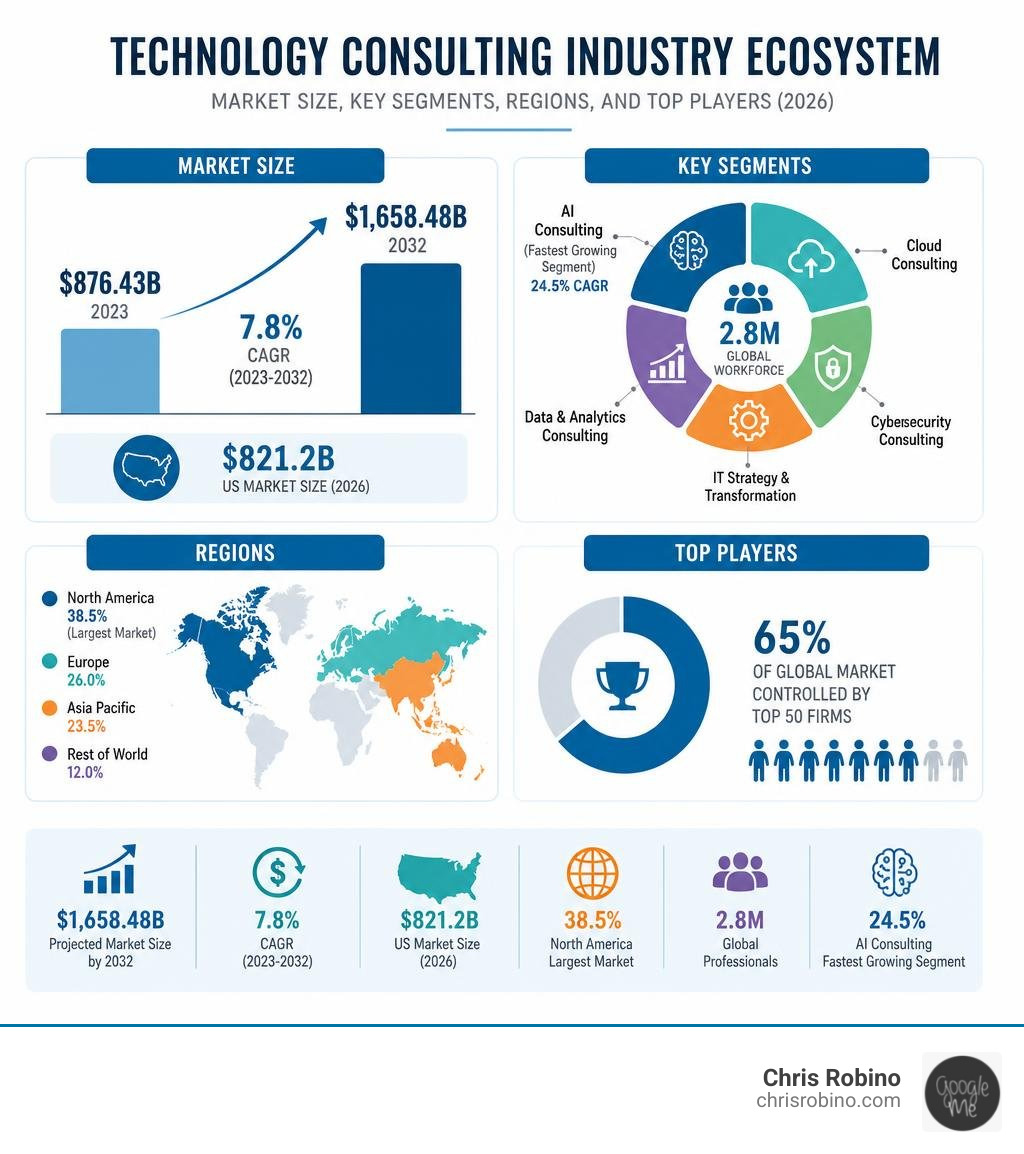
Simple guide to technology consulting industry:
Market Dynamics of the Technology Consulting Industry
The market dynamics of the technology consulting industry are defined by a fascinating push-and-pull between massive consolidation and hyper-specialized fragmentation. On one hand, we see incredible market concentration. The top 50 tech consultancies control roughly 65% of global market revenue, with the top five firms alone holding a market concentration ratio (CR5) of 32%. These giant players leverage massive economies of scale, extensive global delivery centers, and deep-pocketed marketing budgets to dominate enterprise-level contracts.
On the other hand, the low capital requirements of starting an advisory business have preserved a vital role for small nonemployers, independent contractors, and boutique agencies. These smaller players pivot quickly, adopting new frameworks and technologies long before larger institutions can update their training manuals. To bridge this capability gap, larger consultancies frequently acquire specialized boutique firms to capture niche expertise in emerging fields. This active M&A landscape is highly lucrative, with the average EBITDA multiple for tech consulting acquisitions reaching 12.8x in recent years.

Organizations must carefully evaluate their partners to navigate this landscape. To help businesses understand where to focus their efforts, we can look at how the broader market splits across core disciplines.
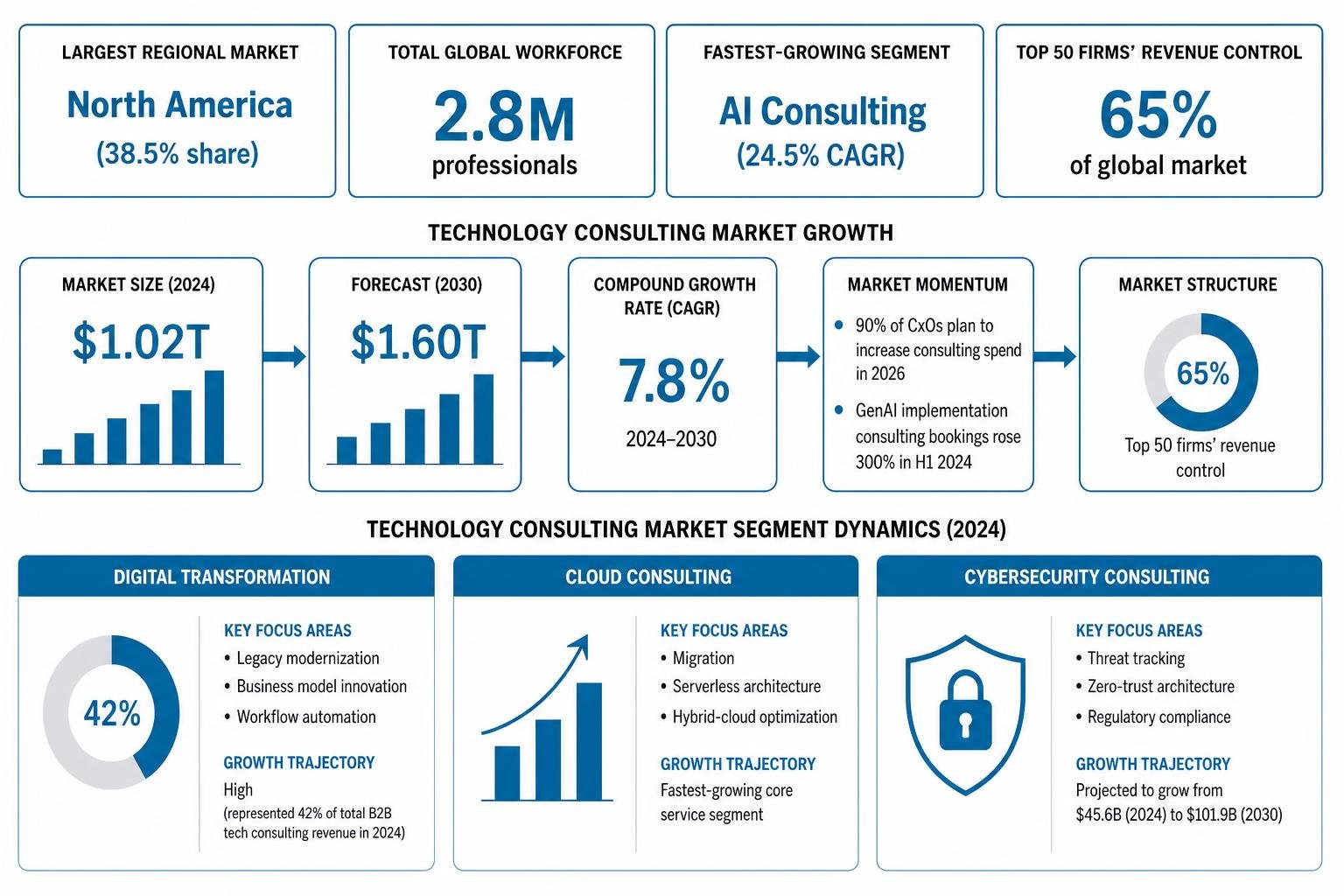
| Service Segment | Key Focus Areas | Growth Trajectory |
|---|---|---|
| Digital Transformation | Legacy modernization, business model innovation, workflow automation | High (represented 42% of total B2B tech consulting revenue in 2024) |
| Cloud Consulting | Migration, serverless architecture, hybrid-cloud optimization | Fastest-growing core service segment |
| Cybersecurity Consulting | Threat tracking, zero-trust architecture, regulatory compliance | Projected to grow from $45.6B (2024) to $101.9B (2030) |
| AI & Advanced Analytics | Machine learning, GenAI governance, predictive modeling | Hyper-growth (forecasted to reach $64.3B by 2032 at a 24.5% CAGR) |
To design an effective roadmap, organizations must align these market segments with their overarching goals. Utilizing structured IT Consulting Services helps businesses choose the right mix of scale and specialization, ensuring their digital strategies remain agile and resilient.
Global Growth and Segments in the Technology Consulting Industry
When we look closely at the global market, specific high-growth segments stand out as the primary engines of expansion. Digital transformation consulting has matured from a buzzword into the largest single segment of the industry, accounting for 42% of all B2B tech consulting revenue. This dominance is driven by the reality that legacy systems are no longer just inefficient—they are operational liabilities.
At the same time, cloud consulting has emerged as the fastest-growing service type. Organizations are moving past simple “lift-and-shift” migrations to embrace cloud-native architectures that support continuous innovation. This cloud foundation is critical because it acts as the launchpad for advanced technologies like artificial intelligence and machine learning.
The AI consulting services market is experiencing a massive surge. Valued at $8.8 billion in 2023, it is on track to reach $64.3 billion by 2032, expanding at an extraordinary CAGR of 24.5%. This exponential growth reflects a fundamental shift: companies are no longer just experimenting with AI; they are actively seeking structured guidance to deploy it safely at scale.
Parallel to this is the critical rise of cybersecurity consulting, which is projected to grow from $45.6 billion in 2024 to $101.9 billion by 2030. As systems become more interconnected, securing data and maintaining privacy are no longer optional add-ons—they are foundational requirements. Aligning these technical capabilities with business strategy requires specialized Technology Consulting Solutions that turn technical complexity into clear business value.
Emerging Tech and Pricing in the Technology Consulting Industry
The rapid adoption of emerging technologies is fundamentally reshaping how consulting services are priced and delivered. Generative AI, low-code/no-code platforms, and quantum computing readiness are changing the economics of consulting. Historically, the industry relied almost entirely on the billable hour—a time-and-materials model that rewarded effort rather than efficiency.
Today, the integration of AI coding assistants and automated workflows means that consultants can deliver technical assets in a fraction of the time. Consequently, clients are demanding a shift from hours billed to measurable business outcomes. Modern engagement models prioritize value-based pricing, fixed-fee sprints, and risk-sharing agreements where a portion of the consultancy’s compensation is tied directly to hitting specific performance metrics.
Furthermore, businesses are looking ahead to future disruptions, with 82% of firms actively seeking quantum computing readiness consulting to future-proof their operations. This shift requires a structured approach to evaluating new technologies, which is covered in detail within our Tech Industry Consultant Guide 2026. By focusing on phased, risk-managed implementations, we help organizations achieve a rapid return on investment without exposing themselves to unnecessary operational hazards.
Workforce Trends and the Global Talent Pool
At its core, the technology consulting industry remains a people business. The sector employs approximately 2.8 million professionals worldwide, but the distribution of this talent pool is highly globalized. India, for example, represents a massive hub of technical expertise, housing 1.2 million tech consultants—roughly 42% of the global total. Meanwhile, the United States technical consulting workforce reached 850,000 professionals, growing steadily at over 4% year-over-year.
This vast talent pool is currently grappling with a severe skills gap. While there is an abundance of general IT support, there is an acute shortage of professionals skilled in specialized domains like AI ethics, cloud security architecture, and data engineering. This scarcity has driven compensation up; the average salary for IT consultants in the US reached $128,000, with senior specialists commanding hourly rates of $185 or more.
To mitigate these talent shortages, consultancies are moving away from traditional on-site models in favor of sophisticated remote and hybrid delivery frameworks. By building cross-border, multidisciplinary teams, firms can source the exact skills needed for a project regardless of geography. Navigating these talent dynamics and choosing the right team structure is a core focus of our Information Technology Consulting Firms Complete Guide.
Regional Investments and Regulatory Compliance
Geographically, North America continues to dominate the technology consulting space, capturing a 38.5% market share. This leadership is fueled by the region’s high concentration of tech conglomerates, rapid cloud adoption, and aggressive venture capital funding. However, European and Asia-Pacific markets are expanding rapidly, driven by their own unique regional priorities.
In Europe, digital transformation is heavily shaped by strict regulatory frameworks. Consultancies in this region must design systems that comply with rigorous data privacy laws (such as GDPR) and emerging AI governance acts. Additionally, sustainability and ESG (Environmental, Social, and Governance) consulting have become major growth drivers in Europe, as companies seek to measure and reduce the carbon footprints of their digital operations.
Meanwhile, investment priorities vary significantly by vertical sector. The energy and resources consulting sector is projected to grow at a stellar 10% rate, driven by decarbonization and infrastructure modernization. Healthcare consulting follows closely at 9% growth, while the public defense sector is also seeing a 10% surge in demand for cybersecurity and risk-preparedness services.
Conclusion
The technology consulting industry has entered an era where technical execution must be completely aligned with business strategy. With the global market projected to exceed $1.6 trillion by 2032, organizations can no longer afford to view technology as a back-office utility. It is the primary driver of competitive advantage, operational efficiency, and customer experience.

Successfully navigating this landscape requires more than just adopting the latest tools; it demands a clear, risk-managed strategy that focuses on measurable outcomes, robust security, and scalable architecture. Whether you are looking to modernize legacy infrastructure, implement a responsible AI governance framework, or secure your cloud environment, we are here to help you turn technological change into sustainable growth.
Let’s build your digital future together. Explore our strategic advisory services and see how we can transform your business by visiting Chris Robino Projects.