

The Technologies Rewriting the Rules of What’s Possible
What is deep tech? Here’s the short answer:
Deep tech refers to companies and innovations built on significant scientific discoveries or engineering breakthroughs — not just software tweaks or business model improvements.
Unlike a typical app or e-commerce platform, deep tech tackles hard, fundamental problems. Think quantum computing, synthetic biology, brain-computer interfaces, and fusion energy.
Key traits that define deep tech at a glance:
- Science-first — rooted in peer-reviewed research and lab discoveries
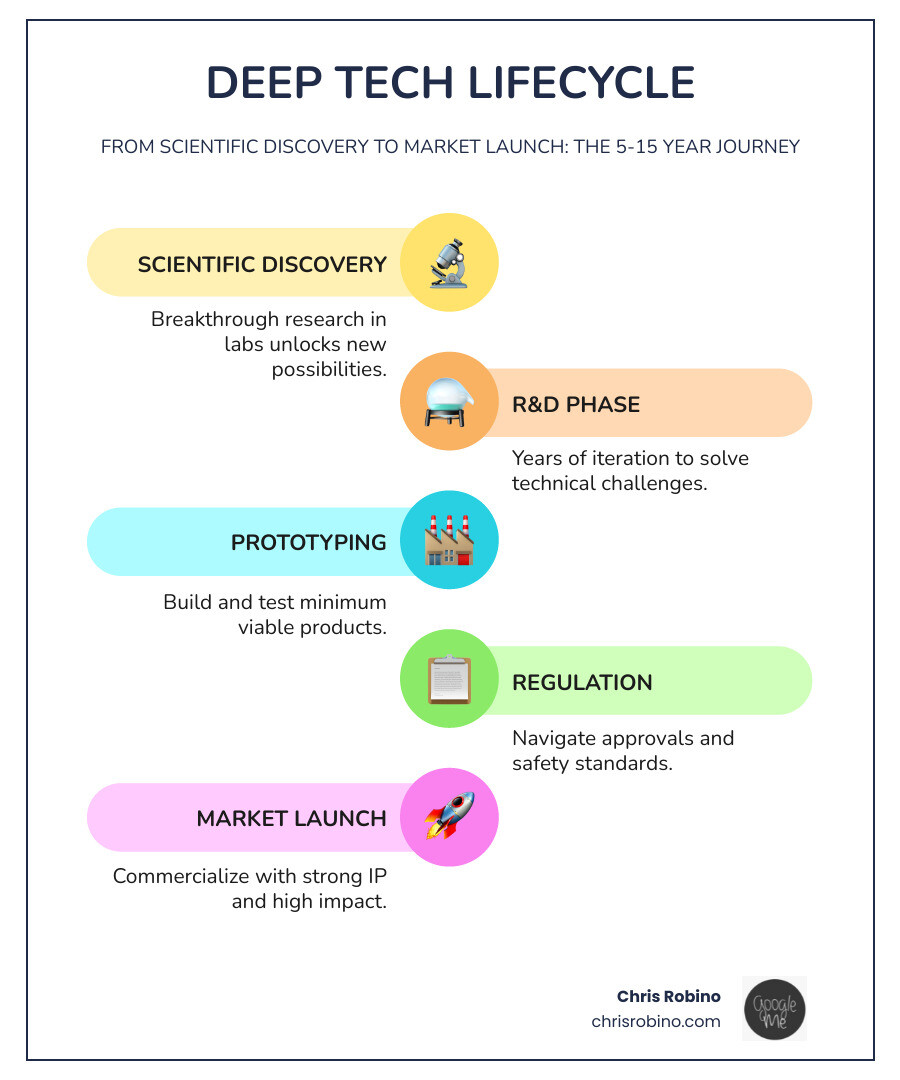
- Long timelines — typically 5 to 15 years from research to market
- Capital intensive — often requires $100M or more to reach commercialization
- High technical risk — the core challenge is making the science work, not just finding customers
- Strong IP — innovations are hard to copy, creating durable competitive advantages
- Societal impact — many deep tech ventures align with major health, energy, climate, and infrastructure challenges
Almost everything we rely on today — electricity, the internet, airplanes — started as deep tech. These weren’t incremental improvements. They were paradigm shifts that reshaped civilization.
And a new wave of them is underway right now.
Deep tech investment has expanded significantly over the last decade, reflecting growing interest in breakthrough innovation across AI, biotech, robotics, energy, and advanced computing. This isn’t a niche trend — it’s a major shift in where foundational innovation is happening.
I’m Chris Robino, a digital strategy and AI expert who has spent over two decades helping organizations — from startups to enterprises — navigate complex technology landscapes, including understanding what is deep tech and how it connects to real business strategy. In the sections ahead, we’ll break down the key concepts, sectors, challenges, and opportunities so you can cut through the noise and get a clear picture of this rapidly evolving space.
What is deep tech vocab explained:
What is Deep Tech? Defining the Frontier
At its core, deep tech is innovation built on real scientific or engineering breakthroughs. That means the hard part is not just packaging, marketing, or user growth. The hard part is proving that the underlying technology actually works at scale.
A useful way to think about it is this: software startups usually optimize convenience, speed, or access. Deep tech startups often try to make something previously impossible become possible.
That is why the best definitions focus on both technology and uncertainty. According to research such as What is “Deep Tech” and what are Deep Tech Ventures?, deep tech ventures are typically grounded in scientific discovery or meaningful engineering innovation and face substantial technical risk. In practice, they sit closer to the research frontier than the average startup.
For organizations trying to understand where these technologies fit into strategy, trend analysis matters as much as terminology. Our guide on Technology Trends for Business is a useful companion if you want to connect frontier innovation with business decision-making.

Core Characteristics of What is Deep Tech
Several traits show up again and again in deep tech ventures.
First, there is high technical risk. A consumer app may fail because users do not care. A deep tech company may fail because the chemistry, materials, biology, or physics do not cooperate. That is a very different problem.
Second, there are long R&D cycles. These companies often need years of experiments, prototypes, testing, validation, and iteration before a market-ready product exists. Research cited above notes that deep tech timelines are much longer than typical digital startups, and in some fields those cycles can stretch toward a decade or more.
Third, deep tech is usually capital intensive. Labs, specialized talent, manufacturing pilots, regulatory testing, and hardware development are expensive. That is why many deep tech ventures require significant early capital before they generate meaningful revenue.
Fourth, there is often valuable intellectual property. Patents, trade secrets, proprietary data, and specialized know-how create durable barriers to entry. If a company builds a breakthrough semiconductor process or a novel therapeutic platform, competitors cannot just clone it over a weekend with coffee and a sprint board.
Finally, deep tech teams are unusually research-heavy. One study cited in the research found that deep tech startups employ 46% of their people in R&D roles and hire disproportionately from top universities. That reflects the reality: this work demands specialized expertise.
If you want to see how frontier technologies move from theory to implementation, our AI-Driven Innovation Complete Guide adds practical context.
Deep Tech vs. Shallow Tech: Understanding the Difference
People often confuse deep tech with general tech, high-tech, or any startup that sounds futuristic. They are not the same.
| Factor | Deep Tech | Typical Digital Startup |
|---|---|---|
| Core risk | Technical feasibility | Market adoption |
| Foundation | Scientific discovery or major engineering advance | Software execution or business model innovation |
| Time to market | Often years | Often months |
| Capital needs | High | Lower relative capital needs |
| Product type | Frequently physical, regulated, or infrastructure-heavy | Usually digital and easier to distribute |
| Defensibility | Strong IP and technical barriers | Often speed, brand, or network effects |
This is why “high-tech” is too broad a label. A polished SaaS tool can be high-tech in a general sense, but it is not necessarily deep tech. Likewise, “hard tech” overlaps with deep tech but usually refers more narrowly to physical products and engineering-heavy systems.
The difference matters for founders, investors, and operators because the playbook changes. Deep tech companies cannot always rely on “move fast and break things.” In biotech or energy, breaking things tends to attract regulators, not applause.
For broader market context, see Tech Industry Insights.
Key Sectors Driving Innovation
Deep tech is not one industry. It is a pattern that shows up across multiple advanced sectors.
Common deep tech domains include:
- Artificial intelligence and machine learning
- Quantum computing
- Biotechnology and life sciences
- Advanced materials
- Robotics and autonomous systems
- Semiconductors and photonics
- Aerospace and space technologies
- Clean energy, climate tech, and fusion
- Brain-computer interfaces
- Advanced manufacturing
Some of the most talked-about areas in 2026 include synthetic biology, quantum systems, humanoid robotics, neural interfaces, and small modular nuclear reactors. But the list keeps evolving, which is why rigid sector-only definitions can be limiting.
What ties these sectors together is not hype level. It is the combination of breakthrough science, difficult engineering, high uncertainty, and transformative potential.

For a strategy lens on one of the biggest deep tech categories, see our AI Strategy Consulting Ultimate Guide.
The Deep Tech Ecosystem: Challenges, Investment, and Impact
Deep tech sits at the intersection of research, capital, regulation, manufacturing, and market creation. That makes the ecosystem both exciting and messy.
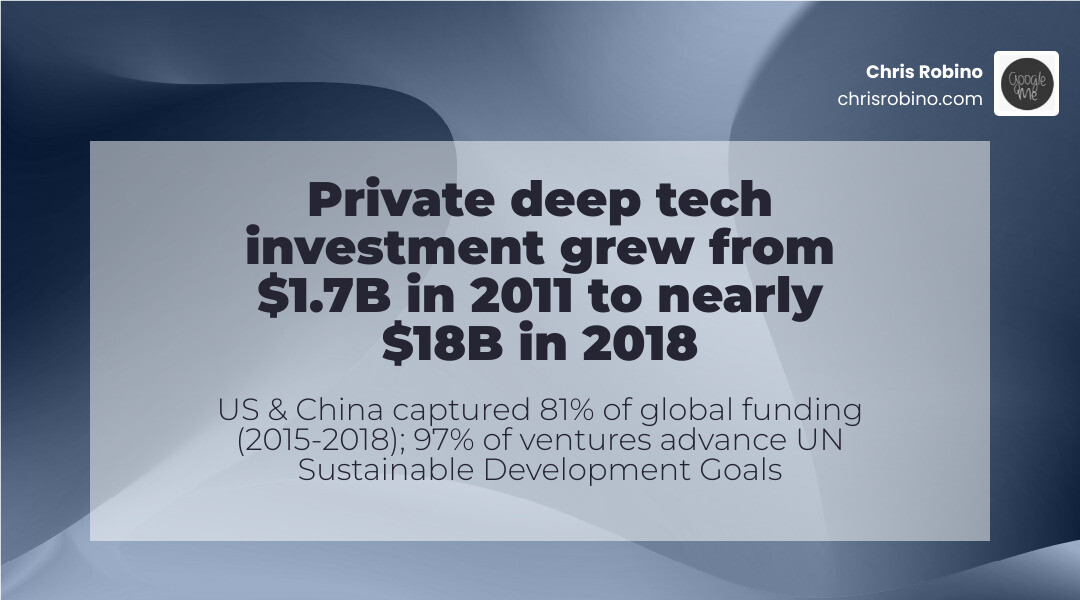
The upside is huge. Deep tech can create entirely new industries, improve productivity, strengthen resilience, and solve public-value problems in health, climate, energy, agriculture, and infrastructure. UN-linked research cited in the source set found that 97% of surveyed deep tech ventures contribute to at least one Sustainable Development Goal.
The downside is that many deep tech companies face a brutal path from promising science to sustainable business.
For a broad reference point, see Deep tech and our related Tech Industry Report.
Navigating the Challenges of What is Deep Tech Development
The most famous challenge is the valley of death: the gap between research success and commercial viability. A breakthrough in a lab is not the same thing as a manufacturable, certifiable, affordable product.
Deep tech companies also face information asymmetry. It can be difficult for investors, customers, and even policymakers to properly evaluate highly technical claims. That creates friction in fundraising and procurement.
Then there are scaling barriers. A software company can grow by adding servers and salespeople. A deep tech company may need pilot plants, clean rooms, clinical trials, supply chain partnerships, safety certifications, or years of field testing.
Regulatory hurdles are another major factor. In life sciences, medical devices, aerospace, energy, and advanced mobility, approval pathways are long and expensive. One stark data point from the research: only 3.4% of oncology clinical trials between 2000 and 2015 eventually received FDA marketing authorization. That gives you a sense of how unforgiving science commercialization can be.
These realities are why deep tech often needs milestone-based funding and “dynamic de-risking” rather than the classic MVP approach. The right question is often not “Can we launch fast?” but “What technical milestone most reduces uncertainty next?”
For more on how organizations structure around emerging technologies, explore Detailed Guide to Technology Trends Consulting Offerings.
Global Investment Trends and Economic Impact
Deep tech investment has grown dramatically over the past decade. Research summarized in the source set shows private investment climbed from $1.7 billion in 2011 to $7.9 billion in 2016, then reached nearly $18 billion in 2018, with annual growth above 20% from 2015.
Historically, the United States and China dominated private deep tech financing, accounting for 81% of global private investment from 2015 through 2018, with $32.8 billion and $14.6 billion invested respectively. Europe also built momentum, reaching about EUR3 billion across 600 deals in 2017.
Beyond investment dollars, the economic case is strong:
- Deep tech companies create highly skilled jobs
- They concentrate talent in R&D-heavy roles
- They generate hard-to-replicate IP
- They often enable downstream industries, not just one product category
The societal case is just as important. Deep tech is disproportionately aimed at hard problems: disease, energy transition, resilient supply chains, food systems, advanced computing, and environmental sustainability.
For a consulting view on how these industry shifts affect decision-makers, see Tech Industry Consultant Guide 2026.
The Role of Governments and Research Institutions
Many deep tech startups begin in university labs, public research institutes, or mission-driven R&D environments. That is not accidental. Frontier science usually requires expensive equipment, specialized facilities, and long-term research support before it can become a company.
Governments therefore play a major role in deep tech through:
- Basic research funding
- Grants and translational research programs
- Procurement and pilot programs
- Regulatory clarity
- Talent and infrastructure support
Public funding matters especially where private investors hesitate because timelines are long and uncertainty is high. In the U.S., for example, the SBIR program has historically provided substantial annual support to small companies working on disruptive technologies.
Research institutions matter for more than IP. They provide talent pipelines, credibility, lab access, interdisciplinary collaboration, and often the earliest validation that a technology is worth commercializing.
This is also why strong ecosystems matter. Deep tech scales better when researchers, operators, investors, manufacturers, and policy stakeholders can work in sequence instead of in silos.
At ChrisRobino.com, we focus on making complex technology shifts understandable and actionable. If you are trying to map frontier innovation to business strategy, explore our Emerging Tech Consultant Complete Guide.
Final Take: Why Deep Tech Matters Now
So, what is deep tech in one sentence?
It is innovation powered by major scientific or engineering advances, with high technical risk, long development cycles, and the potential to reshape industries and society.
That combination makes deep tech hard to build, hard to fund, and hard to scale. It also makes it unusually important.
The companies that succeed in deep tech do not just launch features. They expand what humanity can actually do. That is a much bigger game.
If you want help understanding how frontier technologies fit into your strategy, operations, or market positioning, start with our Emerging Tech Consultant Complete Guide.