

Why Every Business Needs a Market Disruption Strategy Now
A solid market disruption strategy can mean the difference between leading your industry and becoming a footnote in it. Consider this: the average tenure of an S&P 500 company dropped from 32 years in 1965 to just 21 years in 2020. Industries that once seemed untouchable have been reshaped — sometimes overnight — by smaller players targeting customers that established companies ignored.
The pattern repeats. In 2000, Reed Hastings offered to sell Netflix to Blockbuster for $50 million. Blockbuster passed. A decade later, Netflix had surpassed $2 billion in annual revenue while Blockbuster filed for bankruptcy.
What is a market disruption strategy? Here’s a quick breakdown:
- Definition: A plan to enter a market — or create a new one — by serving overlooked or underserved customers with a simpler, more accessible, or more affordable solution
- Goal: Build a foothold outside incumbents’ interest, then improve and move upmarket over time
- Two main types:
- New-market disruption — targets non-consumers who couldn’t previously access a product or service
- Low-end disruption — targets the least profitable customers of existing players with a “good enough” offer
- Why it works: Incumbents are rationally motivated to ignore early disruptors because the initial market is too small or unprofitable to justify their attention
- Key ingredients: An enabling technology, an innovative business model, and a coherent value network
Disruption isn’t random. It follows identifiable patterns — and that means it can be planned for, designed, and executed deliberately.
I’m Chris Robino, a digital strategy leader with over two decades of experience helping companies — from startups to enterprises — navigate market shifts and build growth strategies grounded in real data. Market disruption strategy is central to the work I do, guiding organizations through the kind of bold, structured thinking that turns competitive threats into opportunities. In the sections ahead, I’ll walk you through exactly how to do that.
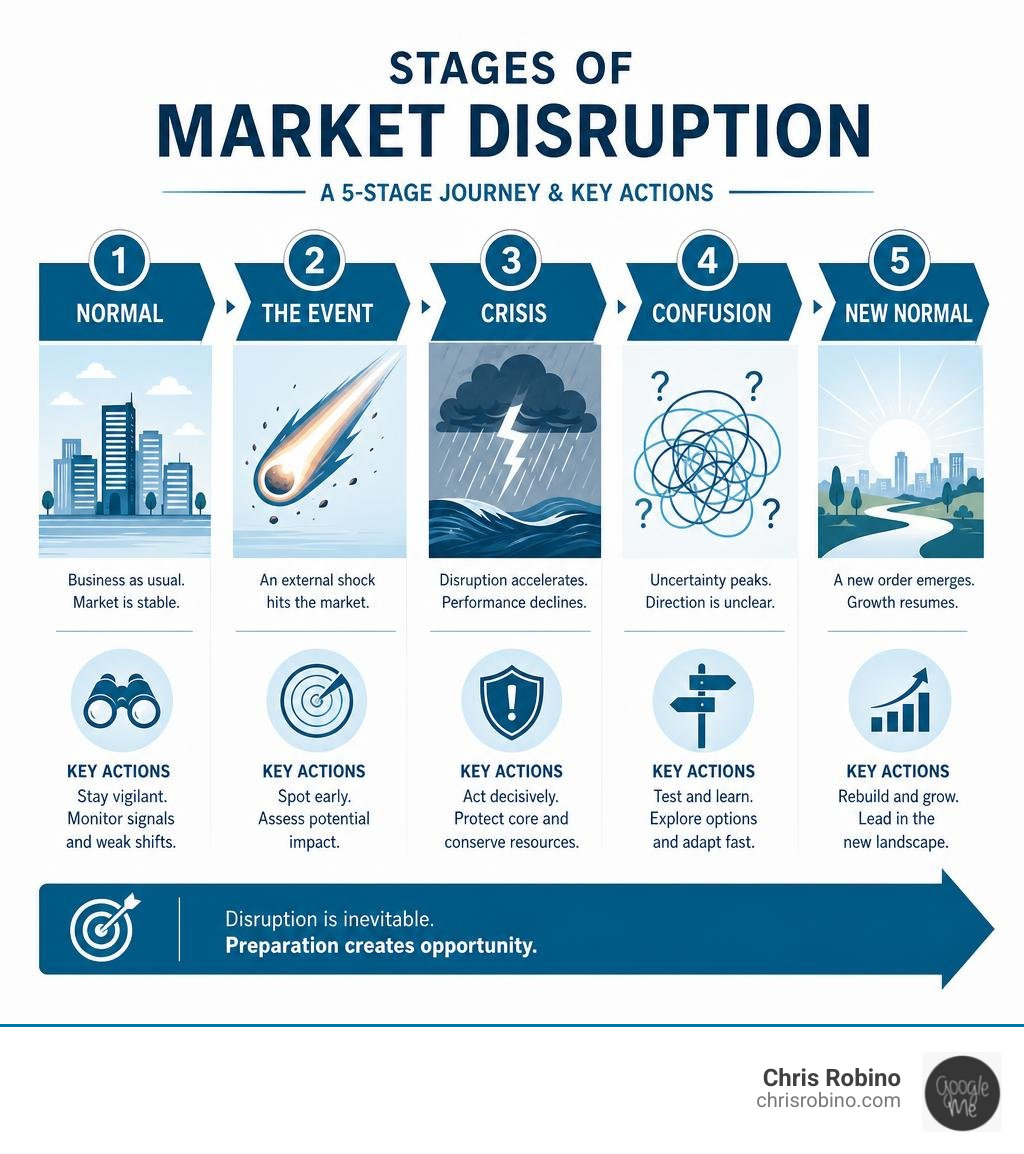
Key Market disruption strategy vocabulary:
Designing a Winning Market Disruption Strategy

To build a strategy that works, we cannot rely on guesswork. We must look beyond our daily operational checklists to analyze macro-environmental forces. When we design a market disruption strategy, we start by mapping the competitive and external landscape using structured frameworks like PESTLE (Political, Economic, Social, Technological, Legal, and Environmental) and Porter’s Five Forces.
By systematically scanning the periphery, we identify emerging trends, regulatory shifts, and technological breakthroughs before they become mainstream. This practice is called white space discovery—the process of finding unserved customer pain points and commercial gaps. Engaging in this level of research and validating our concepts with real-world customer data ensures we are not just experimenting blindly, but executing a calculated play. For a deeper dive into predicting these shifts, explore how to analyze and adapt using the right strategic toolsets in Surviving Market Disruption: Predict and Adapt Fast.
What is a Market Disruption Strategy?
The concept of disruptive innovation, originally coined by Clayton Christensen, is often misunderstood. Many people use “disruption” to describe any successful startup or high-tech product. However, true disruption has a very specific mechanism.
According to Christensen’s model, a disruptor enters the market not by offering a superior product to mainstream customers, but by offering a simpler, cheaper, or more convenient alternative.
A complete market disruption strategy requires three core components:
- An Enabling Technology: A technological driver (like cloud computing, mobile connectivity, or generative AI) that makes the product or service radically cheaper or easier to use.
- An Innovative Business Model: A new way of creating, delivering, and capturing value that makes it unprofitable for incumbents to compete.
- An Coherent Value Network: A supportive ecosystem of partners, suppliers, and distributors aligned with the new business model.
When we design these elements together, we create a self-sustaining engine of growth. To explore how this fits into your broader corporate direction, read about our foundational Business Innovation Strategies.
New-Market vs. Low-End Disruption
Disruptive strategies generally fall into two categories: low-end disruption and new-market disruption. Understanding where your opportunity lies determines your entire operational approach.
| Dimension | Low-End Disruption | New-Market Disruption |
|---|---|---|
| Target Audience | Overserved, price-sensitive customers at the bottom of the mainstream market. | Non-consumers who previously lacked the money, skill, or access to use the product. |
| Value Proposition | “Good enough” performance at a significantly lower price point. | Simpler, more convenient, and highly accessible solutions. |
| Incumbent Response | Incumbents happily flee upmarket to protect their higher-margin segments. | Incumbents ignore the segment because the target market seems non-existent or tiny. |
| Historical Example | Early PC manufacturers displacing high-cost mainframe computers. | Transistor radios in the 1950s opening up portable music for teenagers. |
In low-end disruption, we target customers who do not want to pay for premium features they do not use. Interestingly, this approach can even help businesses navigate macroeconomic pressures. For example, discover how entering the low-end market can buffer supply chains and pricing pressures in Can Low-End Disruption Help You Outflank Tariffs? | California Management Review.
Conversely, new-market disruption focuses entirely on non-consumption. It turns non-customers into customers by removing barriers to entry, such as high costs, complexity, or geographical limitations.
Business Model Innovation: The Engine of Disruption

Technology alone rarely disrupts a market. The real catalyst is business model innovation—rethinking how we structure our cost configuration and value delivery. Incumbents are optimized to deliver high-margin products to their most profitable customers. When a disruptor introduces a business model with lower gross margins but higher asset velocity, the incumbent’s financial math makes it nearly impossible for them to respond.
We must design our business models to rewrite the economic rules of the industry. This means questioning industry defaults. Why do we charge this way? Who holds the power in our supply chain? Can we leverage an asset-light model to keep overhead incredibly low?
To learn how to restructure your organization’s value creation, read The Art of Business Model Innovation: Why It’s Your Next Big Move. By deliberately engineering these business model shifts, we build a strategic advantage that competitors cannot easily copy.
Enterprise SEO: A Key Growth Strategy for Large Companies
For large enterprises, market disruption often requires dominating digital visibility at scale. Implementing robust enterprise SEO strategies is critical for maintaining market leadership and capturing new demand. Unlike smaller businesses, large companies must manage thousands of pages, complex site architectures, and deep brand authority.
To perform well, enterprise SEO strategies must focus on:
- Programmatic Content Creation: Scaling high-quality, structured content across thousands of landing pages to capture long-tail search intent without manual bottlenecks.
- Technical SEO at Scale: Ensuring flawless crawlability, optimizing XML sitemaps, and maintaining fast page speeds across massive domains to help search engines index critical pages efficiently.
- Internal Link Architecture: Strategically distributing domain authority from high-performing landing pages to newer, disruptive product offerings.
- Global and Multi-brand Management: Aligning localized content and hreflang tags across international subdomains to capture global market share seamlessly.
By integrating enterprise SEO into your broader digital strategy, large organizations can build a sustainable, organic moat that protects market share from emerging disruptors.
Executing Your Market Disruption Strategy: Frameworks and OKRs
Execution is where great ideas either scale or die. To execute a disruptive strategy without losing our footing, we recommend a strict portfolio allocation model. Typically, we advise dedicating 70% of resources to protecting and optimizing the core business, 20% to adjacent growth, and 10% (or up to 30% for highly ambitious firms) to high-risk, high-reward disruptive experiments.
To keep these initiatives on track, we pair them with Objectives and Key Results (OKRs) and agile practices. Rather than measuring traditional lagging indicators like quarterly revenue during the early stages, we focus on leading indicators and “time-to-learn.”
Our key metrics should measure:
- Traction and Engagement: Activation rates, customer retention, and organic referral loops.
- Velocity: How quickly we run experiments, gather customer feedback, and iterate on the product.
- Resource Efficiency: The cost to acquire a customer versus their lifetime value within the new segment.
Using this disciplined approach ensures we don’t fall victim to “goal fog” or waste capital on unproven ideas. For a complete blueprint on setting up these systems, check out our Business Innovation Strategy Complete Guide. You can also discover how to build these capabilities internally through Innovation Strategy Development and by establishing structured Accelerate Your Ambition: A Guide to Business Innovation Programs.
How Incumbents Can Defend Against Disruptive Threats
If you are an established leader in your space, how do you defend against a nimble disruptor? The challenge is asymmetric motivation. Your existing customers want you to build sustaining innovations—better, faster, more expensive versions of what you already sell. If you listen only to them, you will leave your flank wide open.
To survive, incumbents must overcome organizational inertia and internal antibodies. The most effective defense strategies include:
- Creating Autonomous Business Units: Set up a separate entity with its own cost structure, culture, and performance metrics. This unit must have the freedom to cannibalize your core business if necessary.
- Early Acquisitions: Identify and acquire emerging disruptors before they reach mainstream scale, taking care to preserve their unique culture post-acquisition.
- Ambidextrous Capabilities: Learn to simultaneously exploit your existing business model while exploring new, disruptive models in parallel.
To understand the mathematical and strategic reasons why incumbents fail to respond—and how to avoid those traps—read Chapter 17: Disruption Theory and Response – The Strategy Engine: Business Models, Unit Economics & Moats.
Additionally, we must recognize that external shocks—like regulatory shifts, environmental changes, or technological breakthroughs—often trigger broader industry transformations. To understand how these external forces reshape entire markets, explore Disruptive Market Shift: Conceptualization, Antecedents, and Response Mechanisms. For real-world lessons on what happens when an established player fails to adapt quickly enough, read our post on a Firm That Has Failed in Its Disruptive Technology Innovation.
Common Pitfalls and Anti-Patterns to Avoid
When organizations attempt to launch a market disruption strategy, they often stumble into predictable traps. Here are the most common anti-patterns we see and how you can avoid them:
- Goal Fog: Launching innovation initiatives without clear, measurable learning objectives. The Fix: Define 1–2 key strategic OKRs focused entirely on customer discovery and early traction.
- Boiling the Ocean: Trying to build a perfect, fully featured product for the mainstream market on day one. The Fix: Start with a bare-minimum offering that solves a single, acute problem for an underserved niche.
- Change Fatigue: Overwhelming your teams with constant operational pivots without building cultural buy-in. The Fix: Pair your business objectives with clear communication, transparent milestones, and supportive leadership.
- Relying on Outdated Tech: Trying to build tomorrow’s business models on top of yesterday’s rigid legacy systems. The Fix: Keep an eye on Future Business Technology Trends to ensure your infrastructure can scale with your ambition.
- Going It Alone: Assuming you have to build every capability in-house. The Fix: Learn The Secret Sauce of How Firms Use Cooperative Strategies to Innovate to share risks and pool resources.
Navigating these pitfalls requires experienced guidance. If you are struggling to build momentum, read about Why Your Business Needs an Innovation Strategy Consulting Firm Right Now.
Conclusion
Market disruption is not a matter of luck. It is a disciplined system of spotting unmet needs, testing bold ideas quickly, and scaling what works before the competition can react. Whether you are a fast-moving startup looking for a market foothold or an established enterprise defending your market share, having a clear, actionable market disruption strategy is essential for long-term survival.
By focusing on non-consumption, innovating your business model, and utilizing agile execution frameworks, you can turn industry shifts into your greatest competitive advantage. To see how we help organizations turn these complex strategic visions into market victories, read more about our work in From Vision to Victory: The Power of Tech Strategy Consulting.
Ready to design your own path to deliberate disruption? Partner with a leading technology innovation consulting firm to design your disruption roadmap and let us help you build the future of your industry.