

Why Starting a Technology Consulting Business Is One of the Best Moves You Can Make in 2026
Starting a technology consulting business puts you in one of the fastest-growing markets in the world right now.
Here’s a quick snapshot of what that looks like:
| Key Fact | Detail |
|---|---|
| Global IT consulting market size (projected 2028) | $253.2 billion |
| Market growth rate | 7.5% CAGR |
| Operational efficiency gains for clients | 20-30% on average |
| AI and cloud consulting share of revenue by 2027 | 40%+ |
| SMBs using IT consulting: faster time-to-market | 25% faster |
The opportunity is real. And you don’t need a team of 10,000 to capture a piece of it.
More businesses than ever need help navigating cloud migrations, AI adoption, cybersecurity, and legacy modernization. But many of them can’t afford — or don’t want — a massive global firm. They want a sharp, focused expert who actually listens and works within their budget.
That’s exactly where a solo founder can win.
This guide walks you through everything you need to launch, position, price, and grow your own tech consulting practice — from defining your core services to landing clients and measuring results.
I’m Chris Robino, a digital strategy leader and AI and search expert with over two decades of experience helping organizations — from early-stage startups to established enterprises — build and scale their technology consulting business capabilities. I’ll share the frameworks and strategies I’ve used and observed to help you build something that lasts.
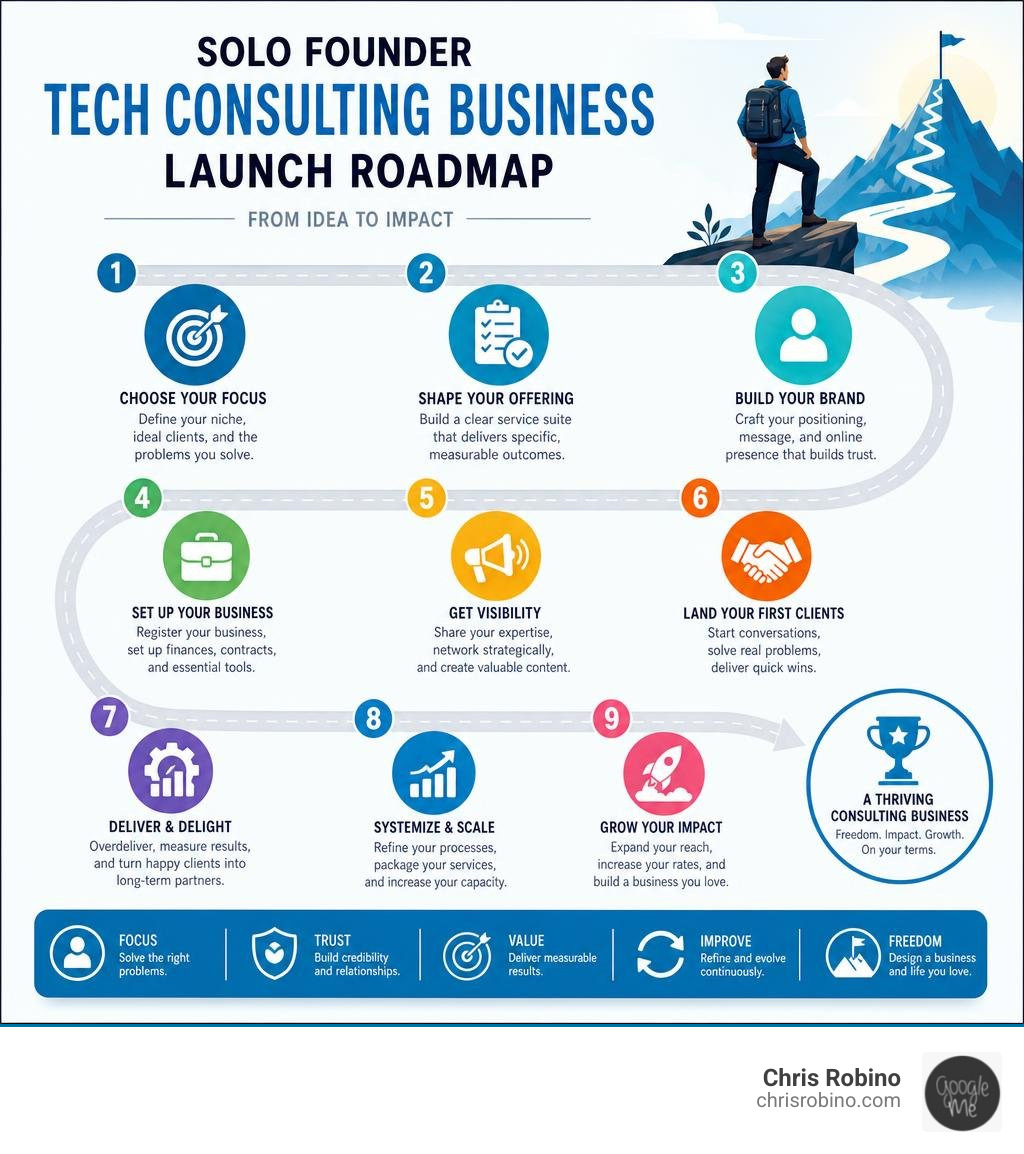
Technology consulting business vocabulary:
Launching and Positioning Your Technology Consulting Business

When we set out to build a technology consulting business, the first step is defining exactly what we do—and what we do not do. A common trap for solo founders is trying to be everything to everyone.
To position ourselves effectively, we must understand the core difference between general IT services and technology consulting. General IT services are typically transactional and operational. They focus on maintaining existing infrastructure, running help desks, and fixing broken hardware.
Technology consulting, however, is strategic. We advise organizations on how to use technology as a lever to achieve high-level business objectives. Instead of just installing a database, we help clients determine which database architecture aligns with their long-term scalability goals and execute that vision.
As a solo founder, you are positioned as a boutique consultancy. This is a massive advantage. While global enterprise firms have thousands of resources, they also come with rigid processes, high overhead, and slower decision-making cycles.
| Feature | Boutique Consultancies | Global Enterprise Firms |
|---|---|---|
| Agility | Extremely high; rapid pivots and custom solutions | Moderate to low; standardized frameworks |
| Client Relationship | Direct access to the principal consultant | Account managers and rotating junior staff |
| Pricing Flexibility | High; tailored to specific client budgets | Low; rigid rate cards and high minimums |
| Best Suited For | SMBs, fast-growing startups, niche enterprise projects | Multi-national corporations requiring massive scale |
To succeed, we need to build a reputation as a trusted tech consultant by targeting specific industries where we have deep domain expertise. By focusing on a niche, we can outcompete larger players who offer generic services. If you want a deeper look at how the landscape is structured, check out our Information Technology Consulting Firms Complete Guide.
To build immediate credibility, we should also focus on establishing a strong digital foundation. If you are starting out, aligning with an innovative technical business consulting methodology or partnering with a reputable technology innovation consulting firm can help you establish the frameworks required to win high-value clients.
Defining Your Core Technology Consulting Business Services
The services we offer should reflect both our expertise and current market demands. In 2026, clients are looking for comprehensive support to navigate rapid digital shifts. Our core offerings should generally fall into these high-value categories:
- Systems Integration: Connecting disparate legacy platforms, SaaS applications, and APIs to ensure seamless data flow across the organization.
- Software Development: Crafting bespoke web, mobile, and enterprise applications that solve unique operational bottlenecks.
- Cloud Migration: Moving workloads securely to hybrid or public clouds, optimizing infrastructure costs, and eliminating on-premises vulnerabilities.
- Cybersecurity Consulting: Conducting vulnerability audits, designing threat mitigation roadmaps, and ensuring compliance with modern privacy regulations.
- AI Implementation: Moving beyond simple prototypes to build production-scale AI systems, utilizing Retrieval-Augmented Generation (RAG), fine-tuned LLMs, and autonomous workflows.
For a deeper dive into structuring these offerings, explore our guide on IT consulting services and information technology consulting services.
How to Structure Your Technology Consulting Business Pricing
Determining how to charge for our expertise is one of the most critical decisions we will make. If we price too low, we hurt our credibility; if we price too high without clear value, we lose the deal. The most common pricing models in our industry include:
- Hourly or Time-and-Materials (T&M): Best for projects with shifting scopes. While simple, it limits our earning potential to the hours we can physically work.
- Fixed-Fee Project Pricing: We charge a single, flat fee for a clearly defined set of deliverables. This rewards our efficiency—the faster we work, the higher our margin.
- Retainers: Clients pay a recurring monthly fee to secure a set number of hours or ongoing advisory support. This provides predictable, recurring revenue.
- Value-Based Pricing: Pricing is based on the financial impact or ROI we generate for the client. If we save a company $500,000 in operational costs, charging a $50,000 fee is an easy sell.
As a solo founder, a hybrid model often works best: starting with fixed-fee discovery phases, transitioning into implementation, and wrapping up with a monthly advisory retainer. Learn more about aligning your pricing with strategic value by reading about business and technology consulting.
Scaling Operations and Modernizing Client Systems
To help our clients scale, we must first understand how to scale ourselves. Growing a business is not the same as scaling it. Growth means adding revenue at the cost of adding equal resources (like hiring more staff). Scaling means increasing revenue exponentially while keeping resource growth linear through systems, automation, and smart frameworks.
In our consulting work, we help clients achieve this by modernizing their legacy systems. Many businesses are held back by outdated, monolithic software that acts as a liability rather than an asset. We can step in as a fractional CTO or a business transformation consultant to guide them through:
- Replacing manual workflows with cloud-based automation tools.
- Refactoring outdated application architectures.
- Moving from rigid, expensive third-party APIs to open-source or custom-built solutions.
If you are guiding complex transformations, our Senior Business Transformation Consultant Guide 2026 offers key operational blueprints.
Measuring Success and Client ROI
We cannot manage what we do not measure. To retain clients and build a portfolio of compelling case studies, we must define clear Key Performance Indicators (KPIs) at the start of every engagement.
We divide these into two distinct categories:
- Business-Centered KPIs: These focus on bottom-line financial metrics. Examples include Return on Assets (ROA), sales conversion improvements, cost-per-acquisition reductions, and overall operational cost savings.
- IT-Centered KPIs: These focus on technical performance. Examples include Mean Time to Resolution (MTTR), system availability/uptime, page load speeds, and reduced software deployment times.
By demonstrating a direct link between our technical implementations and the client’s financial growth, we solidify our position as a strategic partner rather than an expense. For practical tips on establishing these measurement frameworks, explore Tech Consulting Solutions Navigating the Digital Frontier with Expert Guidance.
Enterprise SEO and B2B Marketing Strategies for Solo Founders
As a solo founder, you don’t have a massive sales team to cold-call prospects. Instead, you need a highly efficient inbound marketing engine. This is where B2B SEO and content marketing become your best friends.
Because B2B search volumes are typically lower but carry much higher buyer intent, we should focus our efforts on long-tail keywords. For example, instead of trying to rank for a highly competitive term like “IT support,” we should target highly specific queries like “legacy software modernization for logistics firms.”
Our SEO strategy should also be paired with a strong LinkedIn presence. Since 4 out of 5 LinkedIn members drive business decisions at their companies, publishing consistent thought leadership posts, sharing client success stories, and engaging with industry trends can position us directly in front of buyers.
To maximize your inbound lead generation, consider how a digital business consultant structures high-performing search strategies. Building a search-optimized web presence specifically tailored to your target audience is the most reliable way to consistently grow your technology consulting business.
Staying Ahead of Evolving Tech Trends in 2026
The technology landscape of 2026 is moving at a breakneck pace. To remain competitive, we must continuously update our skill sets and service offerings. The most dominant trends shaping our industry today include:
- Agentic AI: Moving past simple generative AI chatbots to build interconnected, autonomous agent workflows that can execute complex business processes without constant human intervention.
- Cybersecurity Risks in AI: As AI usage scales, it introduces entirely new attack surfaces. Cybersecurity consulting is no longer just about firewalls; it is about securing data pipelines and model inference points.
- Hybrid Cloud Optimization: As cloud costs rise, businesses are looking for cloud-agnostic architectures that allow them to run workloads seamlessly across different environments to prevent vendor lock-in.
To stay current, we should build strategic alliances with major cloud providers and continuous learning networks.
Conclusion

Launching a technology consulting business as a solo founder is a challenging but incredibly rewarding journey. By focusing on high-value strategic services, positioning yourself as an agile boutique partner, and leveraging smart inbound marketing strategies, you can build a highly profitable business that delivers massive value to your clients.
At ChrisRobino.com, we centralize the emerging tech and media insights you need to navigate this fast-changing landscape. Whether you are looking to refine your digital strategy, build production-ready AI tools, or design a clear roadmap for your business growth, we are here to help.
Are you ready to take the next step and turn your technology expertise into a thriving consulting practice?
Launch your project with Chris Robino today and let’s build what’s next together.