

What Is Technical Consulting (And Why It Matters)?
Technical consulting is a specialized service where expert advisors help organizations solve complex technology challenges — from strategy and system design all the way through to implementation and ongoing support.
Here’s a quick breakdown of what it covers:
| Aspect | What It Means |
|---|---|
| What it is | Expert guidance on IT, software, and tech strategy |
| Who it’s for | Businesses facing tech decisions, system upgrades, or digital transformation |
| What it delivers | Unbiased analysis, actionable roadmaps, and hands-on implementation support |
| Key service areas | AI strategy, cybersecurity, project management, system modernization, audits |
| Why companies use it | To fill skill gaps, reduce risk, and make better tech decisions faster |
The technology landscape moves fast. Companies face constant pressure to modernize legacy systems, adopt AI responsibly, defend against cybersecurity threats, and deliver projects on time and on budget. Most internal teams simply don’t have the bandwidth — or the specialized expertise — to handle all of it.
That’s where technical consultants come in.
They bring an outside perspective, deep technical knowledge, and a structured process to help organizations cut through the noise and act with confidence. As one practical framing puts it: most “technology problems” are actually systems problems — unclear ownership, brittle workflows, and decisions made without a shared view of reality.
Whether you’re a startup evaluating your first tech stack or an enterprise navigating a complex cloud migration, the right technical guidance can mean the difference between a costly mistake and a competitive advantage. With B2B buying groups typically involving 6 to 10 decision-makers, having a trusted technical advisor who can communicate clearly across technical and non-technical stakeholders is more valuable than ever.
I’m Chris Robino, a Digital Strategy Leader and AI & Search Expert with over two decades of experience helping organizations — from emerging startups to large enterprises — make smarter technical decisions and drive measurable growth through technical consulting and AI-driven strategies. In this guide, I’ll walk you through everything you need to know, from how the consulting process works to what it costs and how to choose the right partner for your needs.
Technical consulting glossary:
The Core Pillars of Modern technical consulting
In the modern era, technical consulting has moved far beyond “fixing computers.” It is now a strategic engine that drives business growth. We see it as a bridge between high-level business goals and the nuts-and-bolts execution of digital tools. When we engage with a client, we aren’t just looking at the code; we’re looking at the digital transformation roadmap that will carry them through the next decade.

The pillars of this discipline include system modernization, cloud infrastructure optimization, and the streamlining of R&D processes. For many, this also involves digital twin consulting, where we create virtual models of physical systems to predict failures and optimize performance before a single dollar is spent on physical hardware.
Strategic AI Adoption and System Modernization in technical consulting
The “elephant in the room” for every boardroom today is Artificial Intelligence. However, you can’t build a skyscraper on a swamp. Many companies try to layer AI adoption strategies on top of crumbling legacy systems.
Our approach to technical consulting involves:
- Legacy Migration: Moving from “duct-tape and prayer” monolithic systems to flexible, cloud-native architectures.
- Microservices: Breaking down software into smaller, manageable pieces that can scale independently.
- Machine Learning Integration: Not just using AI for the sake of it, but building models that solve specific bottlenecks, like revenue growth management or automated customer service.
By utilizing agile tech consulting, we ensure that these modernizations happen iteratively. This prevents the “big bang” failure where a company tries to change everything at once and ends up with nothing working.
Cybersecurity, Risk Assessment, and Compliance
In an age where data is more valuable than oil, security cannot be an afterthought. We help organizations embed security enterprise-wide so it enables business rather than restricting it. This involves rigorous IT audits using SWOT analysis (Strengths, Weaknesses, Opportunities, Threats) to prioritize action plans.
We guide businesses through complex regulatory frameworks such as:
- ISO 27001 & NIST: The gold standards for information security management.
- EU AI Act & DORA: New regulations that demand transparency and risk management in AI and financial digital resilience.
- Vulnerability Assessments: Proactively finding the “unlocked doors” in your network before a hacker does.
technical consulting for Project Management and MOA
One of the most overlooked areas of technical consulting is the human element—specifically, how projects are managed. We often work within the framework of the PMO (Project Management Office) and MOA (Project Owner Assistance).
- Stakeholder Coordination: In B2B environments, where 6-to-10 decision-makers are involved, we act as the “translator” between the IT department and the C-suite.
- Drafting Specifications: We help you write the “blueprints” so that when you hire a supplier, you get exactly what you need without “scope creep.”
- Change Management: Technology is easy; people are hard. We prepare changeover plans and migration scenarios to ensure your team actually uses the new tools we implement.
Navigating the Technical Consulting Landscape: Process and Career Outlook
Engaging a consultant shouldn’t feel like a gamble. It should be a data-driven journey with a clear beginning, middle, and end. Whether you are looking for business and technology consulting or a specific tech consultant for a one-off project, the process remains largely the same.
The Lifecycle of a Technical Engagement
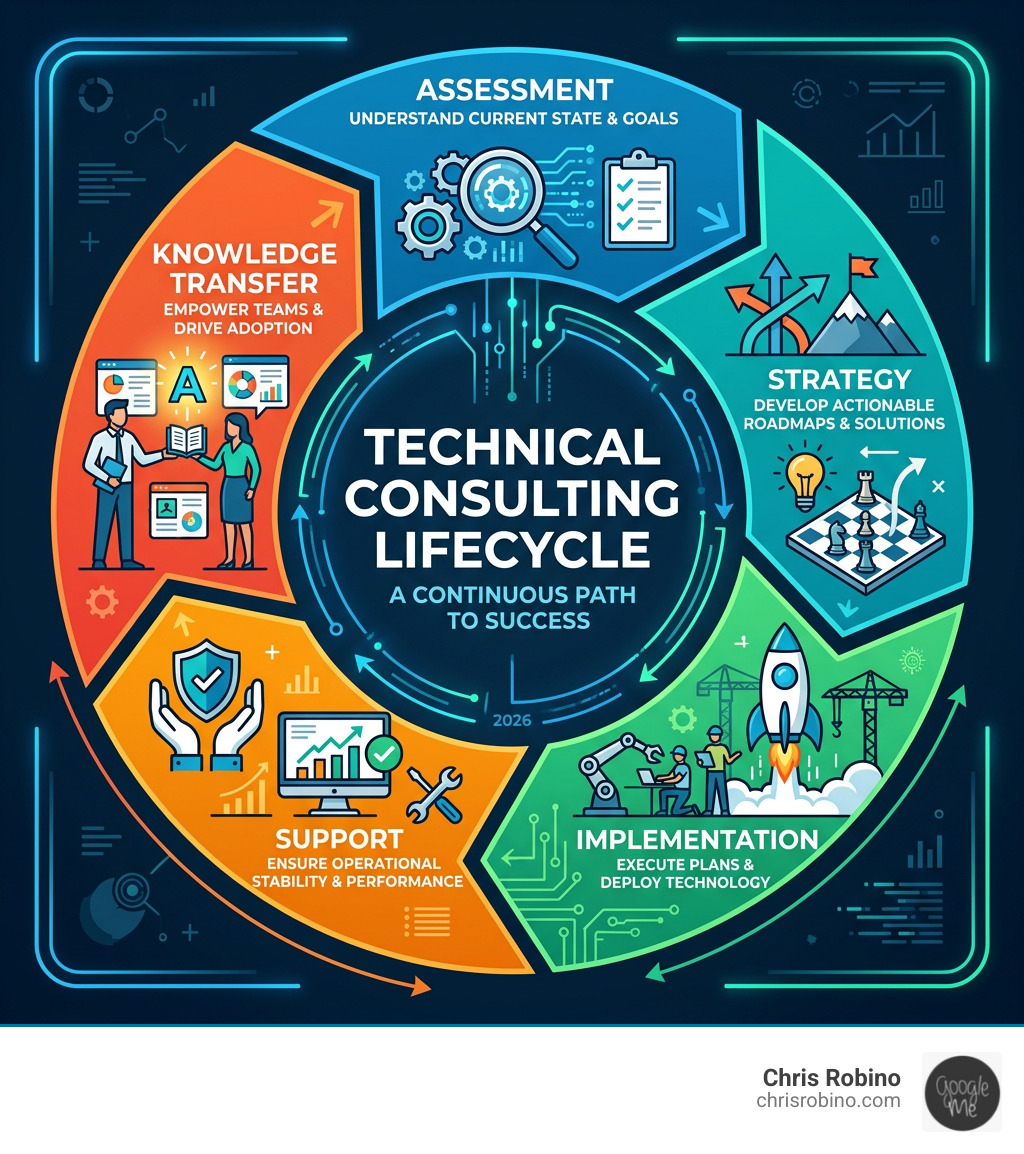
A successful engagement follows a structured path to ensure no detail is missed:
- Initial Assessment & Workshops: We start by listening. We conduct exploratory meetings to understand your specific pain points and business goals.
- Unbiased Analysis: Unlike internal teams who might be “too close” to the project, we provide a realistic, “brutally honest” look at your current stack.
- Solution Design & Roadmap: We don’t just tell you what’s wrong; we provide a prioritized feature list and a step-by-step implementation plan.
- Execution & Knowledge Transfer: We support the implementation but, more importantly, we empower your team. Our goal is to make ourselves obsolete by transferring our knowledge to your staff.
| Pricing Model | Best For… | Pros | Cons |
|---|---|---|---|
| Hourly Rate | Small, undefined tasks | Extreme flexibility | Hard to budget long-term |
| Project-Based | Clear deliverables (e.g., an Audit) | Predictable costs | Less flexibility for changes |
| Monthly Retainer | Ongoing support/Strategic advice | Priority access to experts | Requires consistent work volume |
Qualifications and Essential Skills for Success
If you’re looking to enter this field, the bar is high but the rewards are significant. Industry research shows that 66% of professionals have a bachelor’s degree, while 15% hold a master’s.
Key skills for success include:
- Technical Expertise: Deep knowledge in areas like cloud computing, IoT, or AI strategy consulting.
- Business Intelligence: The ability to analyze data to drive better business decisions.
- Customer Service & Communication: You must be able to explain complex tech to a CEO who doesn’t know what a “containerized microservice” is.
- Certifications: Credentials like ITIL (Information Technology Infrastructure Library) or specialized cloud certifications add immense credibility.
Market Trends and Salary Expectations
The demand for technical consulting is skyrocketing. According to the Bureau of Labor Statistics, jobs for computer and information systems managers are expected to grow by 15% through 2032—much faster than the average for all occupations.
Industry salary research indicates that the average total pay for a technical consultant in the US is approximately $125,941 per year. This typically includes a base salary of around $101,516 plus additional compensation for bonuses or profit-sharing.
As we look toward 2026 and beyond, the role of the emerging tech consultant will only become more vital. We are moving into an era where “Internet search results are the #1 channel where decision-makers find new B2B products,” making digital innovation consultancy a necessity for any firm that wants to be found and trusted online.
SEO Strategies for Large-Scale Technical Entities
For large organizations, technical consulting often extends into the realm of search visibility. When you are a global player, your SEO strategy must focus on scalability and authority. Enterprise-level SEO requires a different set of tactics to manage vast amounts of data and complex site architectures.
- Technical SEO Fixes: Large sites often suffer from “crawl bloat.” We prioritize fixing site speed, mobile-friendliness, and structured data so search engines can actually find your high-value content. This involves optimizing crawl budgets and ensuring that deep-linked pages are accessible to search bots.
- Content for the Buyer’s Journey: We create long-form, human-written content (over 1,000 words) that targets the awareness, consideration, and decision stages. For large firms, this means building comprehensive topic clusters that establish topical authority across diverse service lines.
- High-Authority Backlinks: In the B2B space, one link from a reputable industry journal is worth more than a thousand spammy comments. We focus on digital PR and guest posting to build real-world authority, ensuring your brand is cited by the most influential voices in your industry.
- GSO (Generative Search Optimization): As AI search platforms like Perplexity and ChatGPT become the norm, we help you optimize your content to be cited and remembered by these “answer engines.” This includes using structured data to provide context and targeting the specific, high-intent questions asked by B2B decision-makers.
- Data-Driven Decision Making: Large entities must leverage BigQuery and advanced analytics to track keyword attribution across the entire funnel, ensuring that SEO efforts align with actual revenue growth.
Selecting the Right Technical Consulting Firm
Choosing a partner is a major decision. You aren’t just buying hours; you’re buying an insurance policy against technical failure. Here is our checklist for finding the right fit:
- Check for “Real-World” Experience: Has the consultant actually built systems, or do they just use MBA frameworks? Look for “battle-tested” experts.
- Relatability: Can they speak your language? If they can’t explain their strategy without using 50 acronyms, they probably won’t be able to align your team.
- Transparency: Avoid firms that offer “monthly retainers without deliverables.” You should know exactly what you are paying for every month.
- Strategic Fit: Do they understand your industry? A consultant who specializes in AR/VR business might not be the best fit for a deep-sea engineering project.
At ChrisRobino.com, we pride ourselves on being a single portal for streamlined communication. We believe that clarity comes first, then strategy, and finally execution. If you’re ready to stop guessing and start growing, we invite you to explore our technical innovation consulting services.
The future of your business depends on the technical decisions you make today. Make sure they are the right ones.
For more insights into high-level consulting, check out our Tech Industry Consultant Guide 2026 or learn about our specific IT consulting services.