

Navigating the Landscape of a Business innovation accelerator
When we look at the modern landscape of innovation, a Business innovation accelerator acts as a high-velocity engine for growth. Unlike traditional incubators, which might provide long-term office space and general support, accelerators are typically “sprints.” They are fixed-term, cohort-based programs that include seed investment, connections, and a public pitch event or “demo day.”
The funding models within these programs vary significantly. Some offer equity-free grants, while others provide “blended finance”—a mix of grant money and equity investment. For example, the EIC Accelerator provides up to €2.5 million in grants for innovation activities (covering Technology Readiness Levels 5 to 8) and can add up to €15 million in equity investment for scaling. This structure is designed to de-risk high-potential projects that might be too “early” or too “deep tech” for traditional venture capital.
Beyond the money, the true value lies in mentorship and networking. We often see that a single introduction to a strategic partner or a seasoned industry mentor can save a startup years of trial and error. This is where Innovation Advisory Services become essential, helping founders align their internal capabilities with the rigorous demands of these high-stakes programs.
SEO Strategies for Large-Scale Innovation Hubs
For large enterprises, SEO is not merely about generating traffic; it is about capturing the “share of voice” in emerging markets and establishing topical authority. A Business innovation accelerator provides the perfect content engine for this objective. Large companies should focus on “Topic Clusters” rather than isolated keywords. By creating a central pillar page about their innovation program and linking it to detailed sub-pages about specific cohort technologies—such as carbon capture or bioinformatics—they signal to search engines that they are a comprehensive authority in those verticals.
Furthermore, large companies must leverage E-E-A-T (Experience, Expertise, Authoritativeness, and Trustworthiness). Documenting the progress of deep-tech projects within the accelerator creates high-value, original content that naturally attracts high-quality backlinks from academic institutions and industry publications. This organic link-building strategy is far more effective for enterprise-level domains than traditional outreach, as it builds a moat of digital authority that is difficult for smaller players to replicate.
Core Components of a Business innovation accelerator
To succeed, you must understand the technical language accelerators use. Most programs focus on Technology Readiness Levels (TRL). If your business is at TRL 5 (technology validated in a relevant environment) or TRL 6 (demonstrated in a relevant environment), you are in the “sweet spot” for many European and global accelerators.
The core components usually include:
- Grant Funding: Non-dilutive capital to reach specific milestones.
- Equity Investment: Capital in exchange for company shares, often used for market entry and scaling.
- Mentorship: Access to “Entrepreneur-in-Residence” (EiR) figures who have “been there, done that.”
- Structured Learning: Workshops on everything from IP protection to financial modeling.
Developing a Business Innovation Strategy Complete Guide is a vital first step before applying. You need to know exactly how the accelerator’s resources will plug into your long-term roadmap.
Key Success Factors for High-Stakes Programs
Why do some companies thrive while others fall into the 92% rejection pile? In our experience, the difference comes down to three things: disruptive potential, team expertise, and market traction.
The EIC Accelerator, for instance, received over 6,728 applications between 2021 and 2023, but only 521 were funded. To be in that 8%, your innovation cannot just be “incremental.” It must be disruptive—something that creates a new market or displaces existing leaders.
Furthermore, evaluators look for:
- Multidisciplinary Teams: A mix of technical genius and commercial “hustle.”
- Market Traction: Evidence of interest, such as Letters of Intent (LoIs) or pilot programs.
- High-Risk, High-Gain Profiles: Projects that are too risky for banks but have massive upside if they succeed.
Integrating an AI-Driven Innovation Complete Guide into your pitch can demonstrate that you are leveraging cutting-edge tools to solve these high-stakes problems.
Sector Priorities: AI, Deep Tech, and Climate Innovation
Accelerators today are not sector-agnostic; they follow global trends and government priorities. Currently, there is a massive push toward “Deep Tech”—technologies based on tangible engineering innovation or scientific discoveries.
Key priority sectors include:
- Healthcare: Precision medicine, monoclonal antibodies, and AI-driven diagnostics.
- Climate Tech & Net-Zero: Solutions for carbon farming, renewable energy, and circular economy models.
- Artificial Intelligence: Specifically Human-Centric Generative AI and quantum computing.
- Defense: EUDIS and other EU-wide initiatives are increasingly looking for dual-use technologies that serve both commercial and defense markets.
We also see programs like the SDG Innovation Accelerator focusing specifically on young professionals (35 and under) who are embedding Sustainable Development Goals into corporate strategy. This shows that innovation isn’t just about the “what,” but also the “how” and “why.”
Strategic Preparation and Overcoming Challenges

Preparation is the bridge between a good idea and a funded venture. Most founders underestimate the sheer volume of documentation required. A typical full proposal for a top-tier business innovation accelerator isn’t just a pitch deck; it’s a 20-page technical document, a 3-minute video pitch, a detailed financial plan, and an Freedom to Operate (FTO) analysis.
Using a Digital Innovation Consultancy Complete Guide can help you organize these moving parts into a cohesive narrative that speaks the language of both technologists and investors.
Scaling Digital Visibility: SEO for Enterprise Innovation
Large companies operating a Business innovation accelerator must address technical SEO to ensure their innovation portals are discoverable. A common pitfall for enterprise sites is “crawl budget” waste. When a corporation launches hundreds of pages for new cohorts and pilot projects, search engine bots may fail to index the most critical content if the site architecture is too deep. Implementing a flat site structure and using dynamic XML sitemaps is essential for ensuring that every new breakthrough is indexed immediately.
Additionally, large-scale SEO requires the use of structured data (Schema markup). By tagging accelerator events, job openings within startups, and investment news with specific Schema types, companies can earn “Rich Snippets” in search results. This increases the click-through rate (CTR) from high-intent users, such as potential venture partners or top-tier engineering talent. For a large organization, this technical precision ensures that their innovation efforts contribute directly to the parent brand’s digital equity.
Crafting a Winning Proposal for a Business innovation accelerator
A winning proposal is a blend of storytelling and hard data. You need to quantify your impact. Instead of saying “our software is fast,” say “our solution reduces processing time by 40% for SMEs, saving an average of €12,000 per year.”
Key elements of the proposal package:
- The 20-Page Form: An expansion of your initial short proposal, detailing the work plan and impact.
- Pitch Deck: Usually 10-15 slides focusing on the problem, solution, market size, and team.
- Financial Plan: Clear revenue projections and a breakdown of how the grant/equity will be spent.
- Letters of Intent (LoIs): Proof that real customers want what you are building.
For large companies looking to optimize their SEO and digital presence, we recommend focusing on “long-tail” keywords related to their specific niche within the innovation ecosystem. This ensures that when partners or talent look for a Business innovation accelerator in a specific field, your program is the first they find. A Technology Innovation Consulting Complete Guide can provide the framework for this level of detailed preparation.
Avoiding ‘Innovation Theater’ in Corporate Programs
“Innovation theater” is a term we use to describe programs that look great on LinkedIn but produce zero tangible results. This usually happens when an accelerator lacks leadership support or a clear path to commercialization. To avoid this, large companies should integrate their SEO and content strategies with their actual business outcomes. If a project fails to reach a pilot stage, the content generated around it should still serve as a “lesson learned” resource, maintaining the domain’s topical authority even if the specific venture is retired.
To ensure your program (or your participation in one) is effective, look for:
- Leadership Buy-in: Are executives actually reviewing the projects?
- Structured POC Development: Is there a clear process for moving from a Proof of Concept (POC) to a pilot?
- Cultural Transformation: Is the organization learning to embrace “smart failure” and evidence-based decision-making?
For example, a major pharmaceutical subsidiary ran 12 innovation projects across two cycles. They retired 2, transferred 4 to the core business, and persevered with 6. This is a healthy portfolio approach. It shows they weren’t just “playing” at innovation; they were making hard business decisions. Our AI Strategy Consulting Ultimate Guide delves deeper into how to avoid these pitfalls by aligning tech with core business goals.
Leveraging Alumni Networks and Follow-on Funding
The end of an accelerator program is actually just the beginning. The most successful founders are those who treat the “alumni network” as a lifelong resource. These networks provide access to follow-on funding and introductions to Series A and B investors.
At Chris Robino, we emphasize that scaling requires a continuous connection to domain experts. Whether it’s post-program coaching or navigating the complexities of international expansion, having a Technology Innovation Consulting Firm in your corner can make the difference between a successful exit and a “zombie” startup.
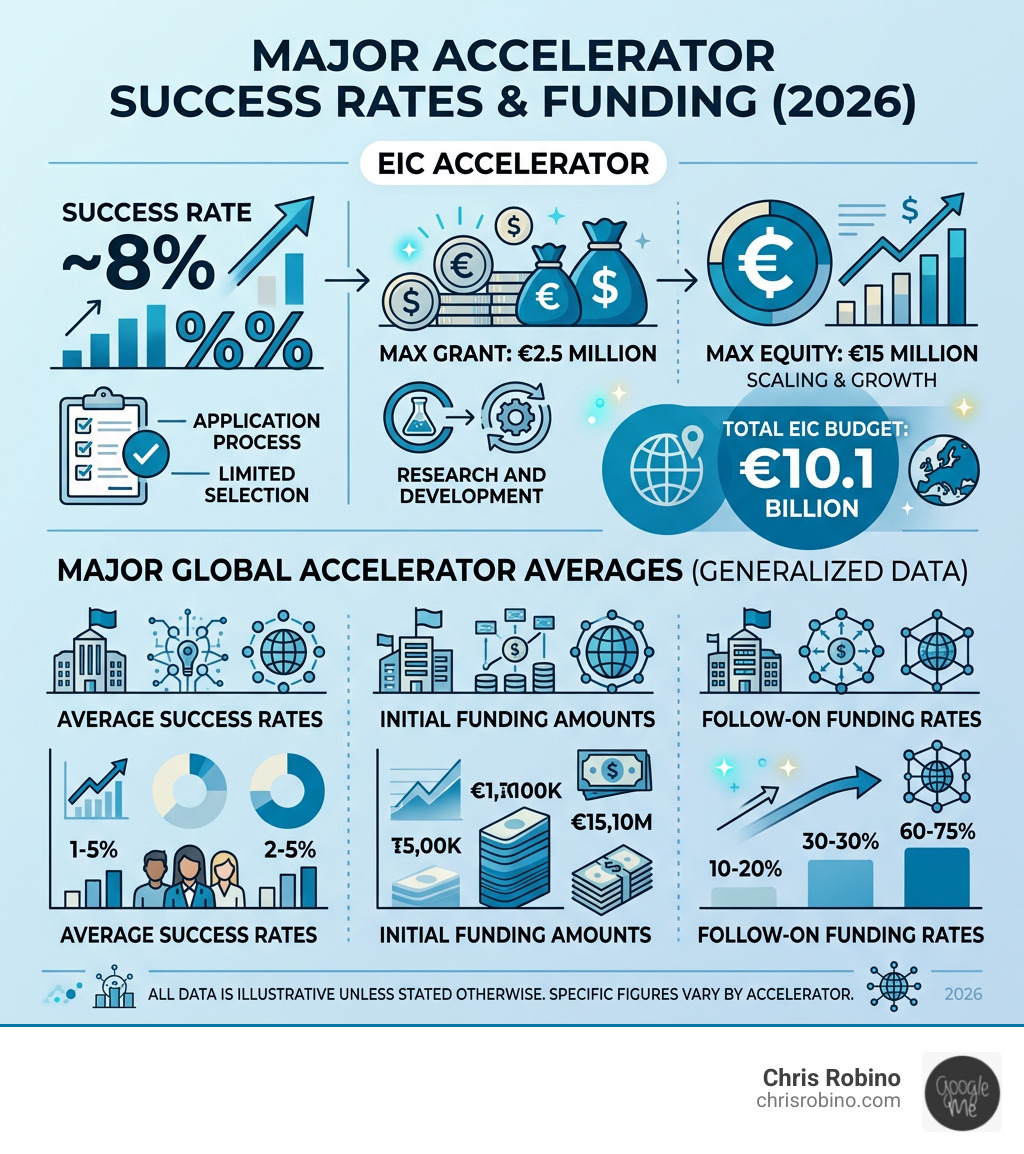
Key Statistics to Remember:
- EIC Accelerator Success Rate: ~8%
- Max Grant: €2.5 Million
- Max Equity: €15 Million
- Total EIC Budget: €10.1 Billion
By focusing on disruptive deep tech, building multidisciplinary teams, and preparing a rock-solid business plan, you can navigate the competitive world of the Business innovation accelerator and turn your ambition into a market-leading reality.
Ready to take the next step? Explore our Technology Innovation Consulting Firm services to see how we can help you scale.