
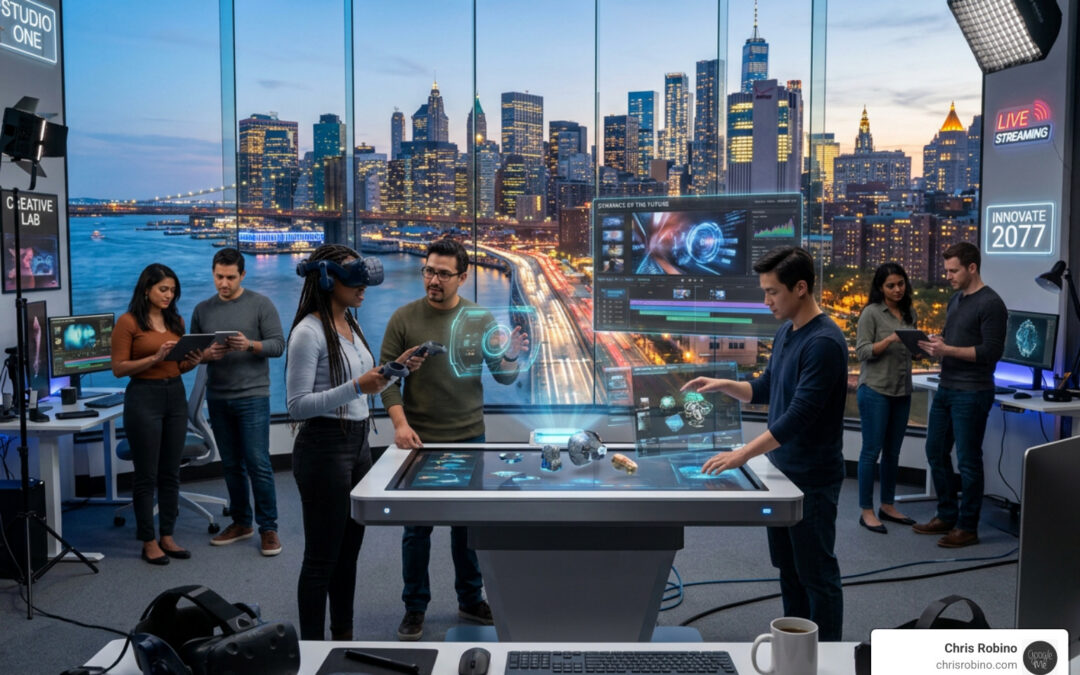
Why Future Media Innovation Is Reshaping Everything You Know About Content
Future media innovation is transforming how content is created, distributed, and consumed — faster than most organizations can keep up. For large-scale organizations, this necessitates a shift in SEO strategy—moving from simple keyword targeting to building comprehensive topical authority that AI search engines can recognize and trust.
Here are the key trends defining it right now:
- Agentic AI — autonomous systems handling content creation, curation, and personalization
- Immersive tech (VR/AR) — spatial experiences replacing passive viewing
- Blockchain — transparent rights management and automated creator payments
- 5G and edge computing — real-time, low-latency media at massive scale
- Platform disruption — AI search summaries and declining social referral traffic reshaping audience access
The numbers tell a clear story. AI equity investment hit $124.3 billion in 2024, up from $64 billion in 2020. Meanwhile, 87% of newsrooms report being fully or somewhat transformed by generative AI. And Facebook referral traffic to news sites has dropped 67% in just two years.
This isn’t gradual evolution. It’s a fundamental restructuring of the media industry — from how stories are told to how creators get paid. The organizations winning right now aren’t the ones with the biggest budgets. They’re the ones adapting fastest, building smarter workflows, and meeting audiences where they actually are.
I’m Chris Robino, a Digital Strategy Leader and AI & Search Expert with over two decades of experience helping organizations navigate exactly these kinds of shifts in future media innovation — from AI-driven content systems to intelligent search strategies. In this guide, I’ll break down the trends, tools, and strategic moves that matter most right now.
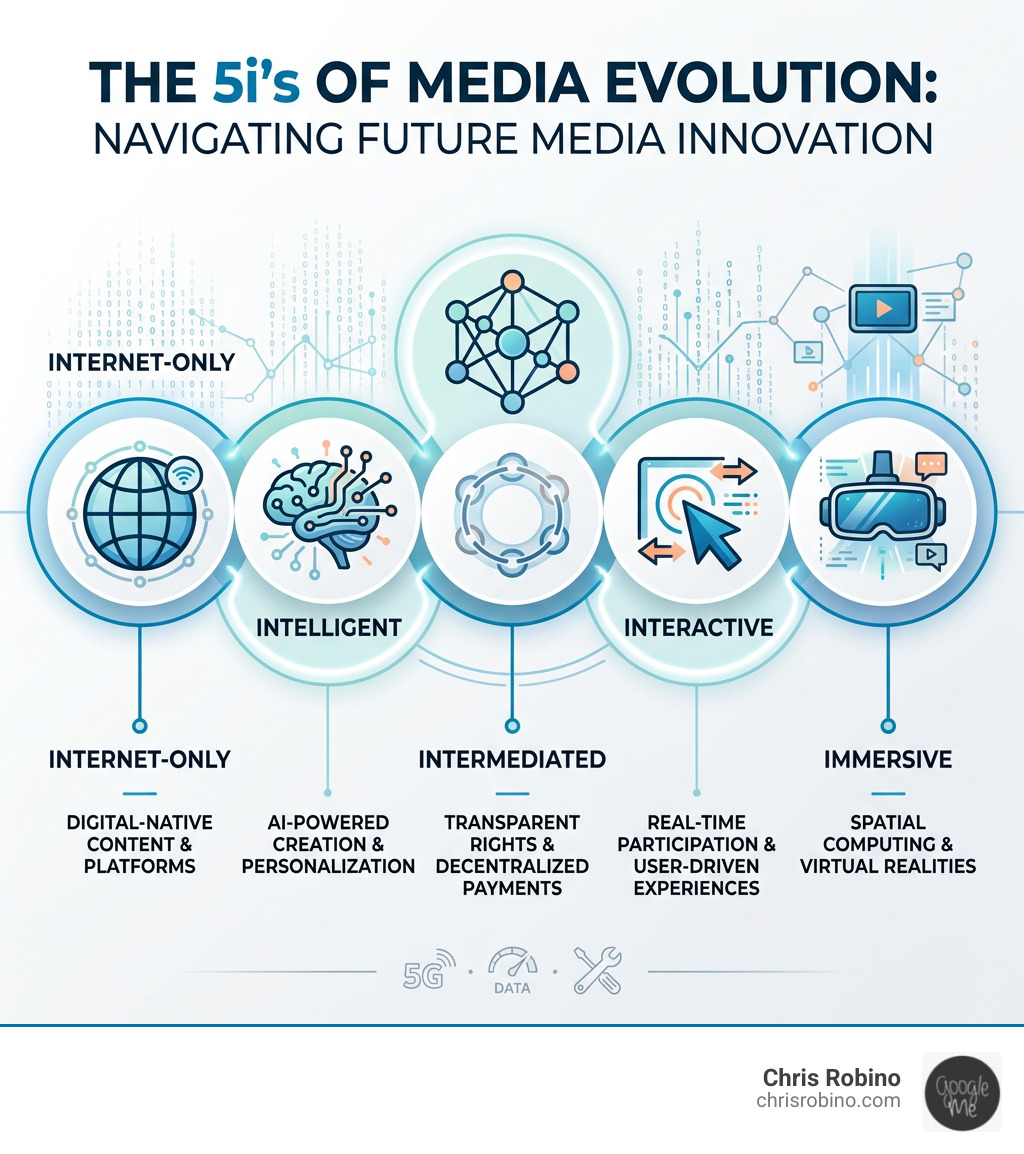
Future media innovation vocabulary:
The Core Technologies Driving Future Media Innovation
The bedrock of future media innovation is no longer just “digital”—it is a complex interplay of high-speed connectivity and cognitive computing. We are moving away from a world where media is broadcast to a passive audience and into an era where it is “served” to individuals through a sophisticated, internet-only architecture.
The shift toward internet-only IP distribution is perhaps the most significant structural change. By 2030, it is estimated that more than half of UK households will exclusively watch TV over the internet. This transition allows for “time-addressable” media, where content isn’t just a static file but a dynamic stream that can be updated or personalized in real-time.
| Feature | Traditional Broadcast | Internet-Only (IP) Distribution |
|---|---|---|
| Delivery | Satellite/Cable Hardware | Cloud-based IP Networks |
| Latency | Low (Real-time) | Historically High (Now being reduced) |
| Personalization | None (One-to-Many) | Hyper-personalized (One-to-One) |
| Interactivity | Limited (Red Button) | Fully Immersive & Participatory |
| Data Loop | Delayed/Estimated | Real-time First-party Data |
To power this, we are seeing massive investments in edge computing, which is projected to reach a market value of $155.9 billion by 2030. By processing data closer to the user, media companies can deliver real-time ad optimization and interactive features without the lag that typically ruins the user experience.
Agentic AI and Personalization in Future Media Innovation
We have moved past the era of simple recommendation algorithms. We are now entering the age of the Scientific research on the agentic workforce. Agentic AI differs from standard Generative AI because it doesn’t just “create” content; it “acts.” These autonomous agents can plan and execute multi-step workflows, essentially serving as virtual coworkers within a media organization.
In AI in Broadcasting, this means:
- Automated Journalism: AI tools can now generate news stories at a speed to rival broadcast, allowing human reporters to focus on deep-dive investigative work.
- Format Personalization: 75% of news leaders are exploring text-to-audio AI, while 70% are looking at AI-generated summaries to help audiences consume news in their preferred format.
- Back-end Automation: 60% of publishers consider back-end automation “very important” for survival, using AI to handle everything from metadata tagging to subtitle generation.
From an enterprise SEO perspective, these autonomous systems are becoming essential for managing large-scale metadata and schema deployments, ensuring that massive content libraries remain discoverable by both human users and AI crawlers. Platforms like Netflix and Spotify are already using these systems to ensure that no two users see the same homepage. This level of Innovation in Media Companies is no longer a luxury; it’s a requirement for retention.
Immersive Experiences: VR, AR, and the 5G Backbone
The “Immersion” factor of the 5i’s is where the physical and digital worlds finally merge. More info about immersive topics shows how spatial computing and 360-degree video are turning viewers into participants. Whether it’s a virtual concert where you can walk among the performers or an AR-enhanced educational tool that brings a textbook to life, the goal is “contextual awareness.”
For these experiences to feel “real,” we need the ultra-low latency provided by 5G. New Tech 2024 strategies emphasize that 5G is not just about faster downloads; it’s about “contribution.” It allows broadcasters to stream high-quality, multi-angle live events from the field without the need for massive satellite trucks.
We are also seeing the rise of haptic robotics and “binaural sound,” which adds a physical and directional layer to media consumption. Imagine watching a nature documentary where you don’t just see the lion—you hear exactly where it is in the grass behind you.
Blockchain and the New Era of Digital Trust
As AI makes it easier to create “deepfakes” and “AI slop,” the industry is turning to Scientific research on content provenance to rebuild trust. The C2PA standard, co-founded by major media players, creates a “digital nutrition label” for content.
In our work on Digital Media Transformations in Human Communication, we see blockchain and distributed ledger technologies serving three vital roles:
- Tamper-proof Tracking: Verifying the authenticity of articles, images, and videos.
- Royalty Automation: Using smart contracts to ensure that when a piece of content is used, the creator is paid instantly and fairly.
- Misinformation Defense: Creating a permanent, transparent registry of digital assets so audiences know exactly where their news came from.
This level of transparency is essential in an AI-powered future where 69% of creators are already worried about their work being used to train AI without their consent.
Strategic Adaptation: Thriving Amidst Industry Disruption
The media landscape is currently defined by what we call “referral chaos.” For years, publishers relied on the “social contract” where platforms like Facebook and Google sent them traffic in exchange for content. That contract is being torn up.
Media Production Industry Trends 2025 highlights that 74% of digital leaders are worried about the decline in referral traffic. With Google’s “AI Overviews” and zero-click searches now accounting for roughly 60% of queries, the traditional SEO model is breaking. Users get the answer they need directly on the search page and never click through to the publisher’s site.
To counter this, large companies must adopt an “Entity-First” SEO approach. This involves leveraging their existing brand authority to become the primary data source for AI models. By focusing on high-quality, original research and technical SEO optimizations like advanced schema markup, large enterprises can maintain visibility even as traditional click-through rates fluctuate.
Navigating the “Creator-fication” of News and Media
One of the most fascinating shifts in future media innovation is the rise of the individual. Scientific research on parasocial relationships explains why audiences often trust a single influencer more than a century-old news institution.
The “Creator-fication” of news means that:
- News Influencers are the new anchors: 37% of adults under 30 now regularly get their news from influencers on TikTok and YouTube.
- The Talent Exodus: Star journalists are leaving traditional newsrooms to build their own empires on Substack, where they can earn millions through direct fan support.
- Community over Reach: Successful media brands are focusing on Audience Development Media Ultimate Guide strategies that prioritize deep engagement and “authentic storytelling” over raw click counts.
We recommend that media organizations stop fighting the creator economy and start integrating it. This means hiring creators as “internal influencers” and using their unique voices to reach younger audiences who find traditional “voice-of-god” journalism unrelatable.
Economic Shifts: Bundling, Subscriptions, and Adtech
The “cheap streaming era” is officially over. As Scientific research on streaming revenue trends shows, streaming revenue is finally set to overtake pay TV in the U.S. this year. However, this comes at a cost to the consumer, with rising monthly bills leading to “subscription fatigue.”
The response is a return to “The Bundle.” We are seeing:
- Skinny Bundles: Smaller, cheaper packages of channels that target specific interests.
- Performance CTV: Connected TV advertising is becoming a “performance powerhouse,” with 121 million U.S. CTV households expected by 2027. Advertisers are moving away from “buying a show” to “buying an audience” with precise ROI measurement.
- Ad-supported Tiers: Most major streamers now offer a “cheaper” version with ads, which has become a massive driver of growth.
Our Media Industry Guide 2025 suggests that the next frontier is microtransactions. Imagine paying 25 cents to read a single high-quality article or $1 to watch a single live sports event, rather than being forced into a $15 monthly commitment.
The Role of Collaboration in Future Media Innovation
No single company can solve the challenges of future media innovation alone. This is why initiatives like Future Media Hubs are so critical. These international networks allow public and commercial organizations to share knowledge and run experiments in a “Sandbox” environment.
At Chris Robino, we believe that Digital Transformation for Media must be a collaborative effort. By partnering with startups and using an “ethical AI framework,” companies can innovate without losing the trust of their audience. Key collaboration opportunities include Game Hubs, News Hubs, and Next Generation Hubs focusing on the youth audience problem.
The future belongs to the “fluid” organization. As noted in recent industry signals, the ability to act and adjust is now more valuable than the ability to predict. We must move beyond rigid business models and embrace a state of continuous reinvention.
Final Thoughts: The Path Forward
Future media innovation is not just about the latest gadget or the newest AI model. It is about a fundamental shift in the relationship between the creator and the consumer. It is about moving from “passive” to “participatory.”
To thrive in this new landscape, we must:
- Embrace the 5i’s: Ensure our content is Internet-only, Intelligent, Intermediated, Interactive, and Immersive.
- Prioritize Digital Trust: Use tools like C2PA and blockchain to prove our content is authentic.
- Diversify Revenue: Look beyond simple ads to bundles, licensing, and direct fan support.
- Foster Collaboration: Join hubs and networks to share the cost and risk of innovation.
The media industry is at a pivotal moment. The “hype” is real, but the “hubs” of innovation are where the actual work is being done. If you’re looking for an Emerging Technology Consultant to help you navigate this transition, we’re here to help you turn these trends into a sustainable strategy.
Explore more of our guides: