

What Corporate Digital Transformation Really Means (And Why It Can’t Wait)
Corporate digital transformation is the deliberate, company-wide process of embedding digital technology into every part of how a business operates, competes, and delivers value — fundamentally changing not just its tools, but its culture, strategy, and identity.
In the modern enterprise, this transformation is increasingly defined by how a company is discovered and perceived in the digital marketplace. A critical, yet often overlooked, component of this journey is the integration of advanced SEO strategies. For large companies, SEO is no longer just a marketing tactic; it is a core business function that dictates market share and brand authority in an increasingly crowded digital landscape.
Here’s a quick breakdown of the transformation spectrum:
| Term | What It Means |
|---|---|
| Digitization | Converting analog info to digital (e.g., scanning paper records) |
| Digitalization | Using digital tools to improve existing processes |
| Digital Transformation | Rewiring the entire organization around digital capabilities to change how value is created |
| Search-First Transformation | Aligning digital assets with user intent to ensure the brand is the primary answer in the digital ecosystem |
These concepts are not interchangeable. Confusing them is one of the most common mistakes leaders make. The stakes are real. An estimated 90% of all organizations are currently undergoing some form of digital transformation. Yet most are capturing only a fraction of the value they expect. Companies globally have reported capturing just 31% of expected revenue gains and 25% of expected cost savings from their transformation efforts.
This isn’t a technology problem. It’s a strategy, culture, and execution problem. For large-scale enterprises, the challenge is magnified by technical debt and organizational silos that prevent digital initiatives—like enterprise SEO—from scaling effectively.
Digital transformation isn’t a one-time IT project with a finish line. It’s a continuous effort to rewire how your organization thinks, works, and competes — because the technology landscape never stops evolving, and neither do your customers’ expectations. If your transformation doesn’t include a robust strategy for organic visibility, you are essentially building a high-tech store in a location no one can find.
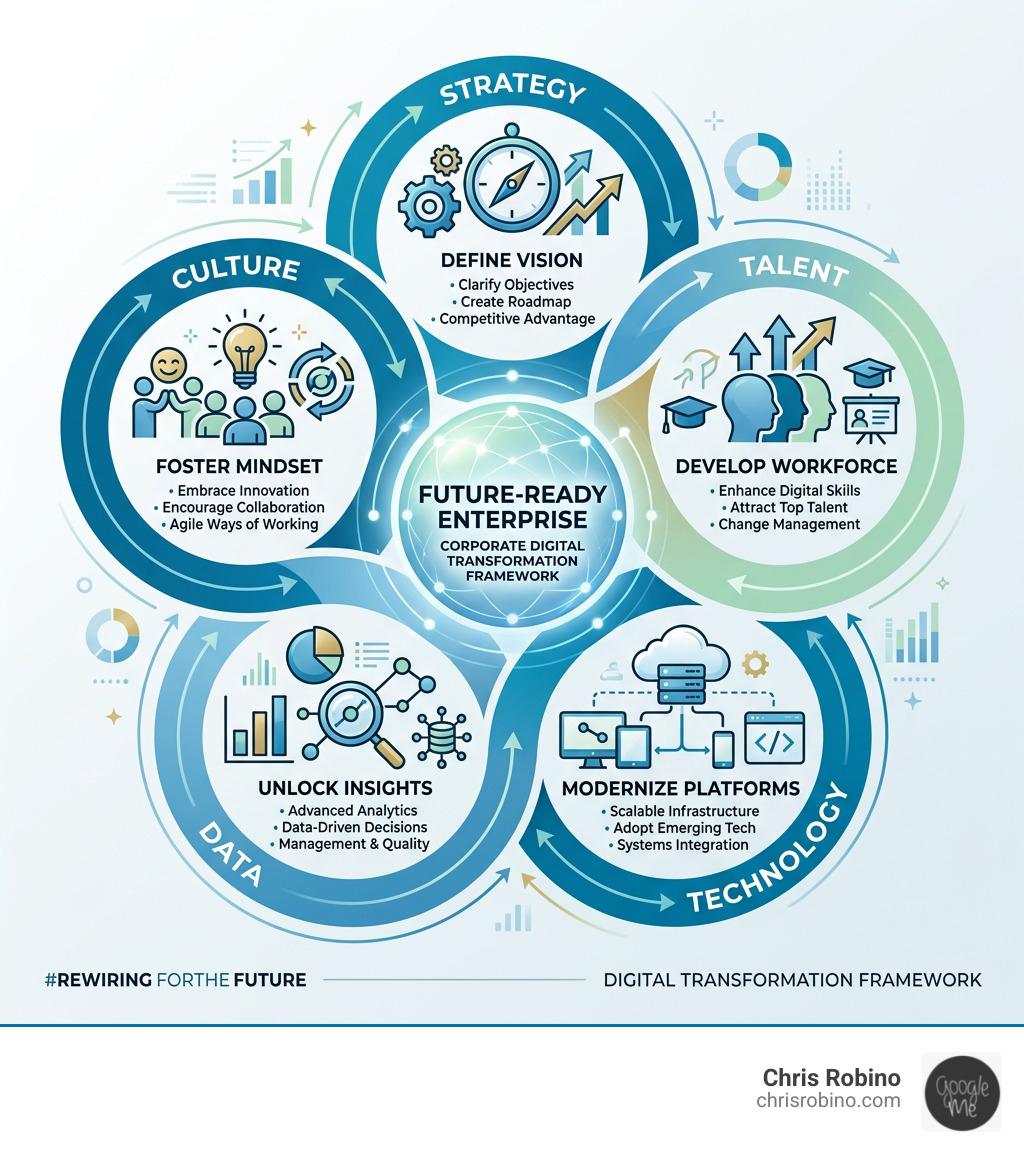
I’m Chris Robino, a Digital Strategy Leader and AI & Search Expert with over two decades of experience guiding organizations — from startups to established enterprises — through the complexities of corporate digital transformation. In this guide, I’ll cut through the noise and give you a clear, actionable framework for making transformation work, with a specific focus on the SEO strategies that drive performance for large-scale organizations.
Learn more about Corporate digital transformation:
The Core Pillars of Corporate Digital Transformation
When we talk about “rewiring” a company, we aren’t just talking about buying new software. We are talking about a fundamental shift in the organizational identity. Successful corporate digital transformation requires moving away from isolated “pilot projects” and toward a holistic focus on entire business domains.
A “domain” is a group of related activities that, when transformed together, provide a complete step-change in value. For example, instead of just adding a chatbot to your website, a domain-led approach would involve transforming the entire “customer journey”—from the first marketing touchpoint to automated fulfillment and AI-driven support.

Focus on Customer Experience and Operational Agility
At the end of the day, every digital journey leads to the customer. Customer experience (CX) is the sum of every interaction a person has with your brand. When three out of four Americans tried new shopping behaviors during the pandemic, loyalty is no longer guaranteed. It is earned through seamless, digitally-enabled experiences.
For large companies, this experience begins on the search engine results page (SERP). If a customer searches for a solution and your enterprise isn’t there, the transformation has failed at the first hurdle. This is why SEO must be integrated into the operational agility of the firm. You can’t provide a modern customer experience if your backend is a mess. Many corporations are held back by legacy system costs, with some spending 70% to 80% of their IT budget just keeping old lights on. This “technical debt” often manifests as slow site speeds, poor mobile optimization, and crawlability issues—all of which kill SEO performance.
Enterprise SEO Strategies for Large Companies
To win at scale, large companies must adopt SEO strategies that go beyond simple keyword optimization. Enterprise SEO requires a focus on infrastructure, governance, and data integration.
- Technical SEO at Scale: Large sites often have millions of pages. Managing crawl budget, implementing robust internal linking structures, and ensuring proper schema markup across a massive footprint is essential. This requires close collaboration between SEO teams and DevOps.
- Content Governance and E-E-A-T: For a large corporation, maintaining a consistent voice and high Experience, Expertise, Authoritativeness, and Trustworthiness (E-E-A-T) is vital. This involves creating centralized content hubs and using topic clusters to establish topical authority in your industry.
- Global SEO and Localization: For multinational enterprises, transformation means managing complex hreflang implementations and localizing content without diluting the brand’s global authority.
- Data-Driven Decision Making: Integrating SEO data with CRM and business intelligence tools allows leaders to see the direct impact of organic search on the bottom line, moving SEO from a “marketing expense” to a “growth engine.”
Strategic Capabilities for Corporate Digital Transformation
To win, we must move beyond the “outsourcing” mindset. You cannot outsource your way to digital excellence. Top-performing companies are those that bring their tech talent in-house.
- In-house Talent: High-performing digital teams can be five times more productive than low-performing ones. This requires a shift in IT talent models, focusing not just on engineers, but on tech-savvy executives and product managers who understand how to bridge the gap between code and commerce.
- Proprietary Assets: While off-the-shelf software is great for standard tasks, strategic differentiation comes from proprietary assets—your own data, custom AI models, and unique software. In SEO, this might mean building custom dashboards that track share of voice against competitors in real-time.
- Scalable Operating Models: We need to move away from rigid, “static” models toward a “digital factory” approach. This involves Digital Strategy Advice that emphasizes cross-functional teams that iterate quickly, learn from failure, and scale what works.
The Role of AI and Emerging Tech in Corporate Digital Transformation
AI is no longer a “nice to have”; it is the engine of modern transformation. From generative AI creating personalized marketing content to neural networks optimizing power plant efficiency, the applications are vast. In the realm of SEO, AI is being used to automate meta-tag generation, predict search trends, and analyze massive datasets to identify content gaps.
However, we must avoid the “shiny toy” syndrome. Transformation should start with a business problem, not a technology. Whether we are implementing Cloud Adoption Strategy to increase scalability or using workflow automation to reduce operating costs, the goal must always be value creation.
Key emerging technologies reshaping the landscape include:
- Generative AI: Automating complex creative and administrative tasks while maintaining SEO standards.
- Predictive Maintenance: Using IoT and AI to fix machines before they break.
- Data Governance: Ensuring data is clean, accessible, and secure so it can be used for decision-making across all digital channels.
Overcoming Roadblocks and Technical Debt
If transformation were easy, everyone would be doing it perfectly. The biggest roadblock is almost always culture. We often say that “culture is the glue” of an organization, but in a transformation, it can also be the friction. Building a resilient IT culture requires leadership empathy and a willingness to break down silos. Leaders must be “future-ready,” meaning they are comfortable with perpetual change rather than seeking a static “end state.” At Chris Robino, we help organizations Accelerate Digital Transformation by addressing these human elements alongside the technical ones.
Implementing and Measuring a Sustainable Roadmap
A roadmap is not a rigid five-year plan; it is a living document. We recommend a “wave-based” rollout. Instead of trying to change everything at once, we focus on high-value domains in successive waves. This allows for quick wins that build momentum and provide the ROI needed to fund the next stage of the journey.
Leadership and Cultural Integration
For corporate digital transformation to succeed, it must be a CEO-level priority. It cannot be delegated solely to the IT department.
- The Change Coalition: We need a group of influential employees from all levels to champion the change. Peer-to-peer influence is often more powerful than top-down mandates.
- The Chief Digital Officer (CDO): In many successful transformations, the CDO coleads the effort with the CEO, ensuring that digital strategy is baked into the business model.
- Agile Principles: Borrowing from the Agile Manifesto principles, we prioritize “working software” and customer collaboration over exhaustive documentation and rigid contracts.
We offer Digital Innovation Consulting to help leaders navigate these shifts, ensuring that employee engagement remains high even as the “old way of doing things” is phased out.
Measuring SEO and Digital Success
How do we know if it’s working? We look at three categories of KPIs: Value Creation (revenue lift, cost savings), Team Health (talent retention, agility), and Change-Management Progress (adoption rates). For large companies, organic search performance is a primary indicator of digital health. Key SEO metrics for the enterprise include:
- Organic Share of Voice (SoV): How much of the digital conversation in your industry do you own compared to others?
- Brand vs. Non-Brand Traffic: Is your transformation helping you reach new customers (non-brand) or just serving existing ones (brand)?
- Technical Health Score: Are your enterprise systems supporting or hindering your visibility?
Research shows that organizations that combine a clear digital strategy with aligned tech investments and strong change capabilities see a significant market cap lift—up to 5% higher than their peers.
Real-World Success and ROI Analysis
Real-world examples of successful transformation include:
- Mining: A global company used AI and predictive maintenance across 100+ solutions to boost productivity and unlock over $1 billion in EBIT.
- Energy: A power producer used neural networks to analyze plant data every 30 minutes, optimizing efficiency and reducing emissions.
- Retail: A physical media rental company successfully transitioned into a global streaming giant by using big data for hyper-personalization and a search-first content strategy that dominated organic results.
For more on how to scale these wins, check out The Digital Growth Playbook.
Sustaining Momentum in a Perpetual Journey
The most important thing to understand about corporate digital transformation is that it never ends. Technology will continue to evolve—from the cloud to AI to whatever comes next. The goal is to reach a “future-ready” state where your organization is designed for continuous innovation and maximum visibility.
At Chris Robino, we don’t just help you “get digital.” We help you become digital. We move you From Legacy to Leading Edge by focusing on the core competencies that allow for long-term survival and growth.
As a leading Technology Innovation Consulting Firm, we provide the insights and strategic framework necessary to ensure your transformation isn’t just a buzzword, but a competitive engine. Ready to start rewiring? Let’s get to work.