

Why Finding the Right SaaS Content Marketing Firm Changes Everything
The right SaaS content marketing firm can be the difference between content that sits unread and content that fills your pipeline with qualified enterprise demos and trials. For large companies, scaling organic growth requires sophisticated, high-impact SEO strategies that go beyond basic keyword targeting.
Here are the top enterprise SEO strategies that perform well for large companies:
| Strategy | Best For |
|---|---|
| Programmatic SEO | Scaling landing pages for thousands of integrations or use cases |
| Hub-and-Spoke Architecture | Dominating high-volume, competitive industry terms |
| Digital PR & Link Reclamation | Maintaining enterprise domain authority at scale |
| Product-Led Content | Converting high-intent enterprise buyers directly from search |
The content marketing landscape has shifted dramatically. In March 2025, only 40.3% of U.S. Google searches resulted in an organic click – down from 44.2% the year before. AI tools like ChatGPT, Perplexity, and Google’s AI Overviews are now intercepting queries that used to send buyers straight to your blog.
At the same time, B2B buyers are doing more independent research than ever. According to Gartner, they spend only 17% of their time actually talking to vendors. The other 83%? Reading, comparing, and forming opinions – often without ever speaking to your sales team.
This means the content your agency produces isn’t just a marketing asset. It’s your first sales conversation.
Most SaaS companies realize this too late. They hire an agency that optimizes for traffic and blog output, then wonder why pipeline hasn’t moved six months in. Large enterprises need a partner that understands how to scale complex site architectures and capture high-intent search volume.
This guide cuts through that noise. It covers how to evaluate agencies in 2026, what services actually matter now, and which strategies drive the strongest results for large-scale SaaS companies.
I’m Chris Robino, a digital strategy leader with over two decades of experience in SEO, AI search, and content strategy. I’ve worked with everyone from early-stage tech startups to established enterprises on the exact challenge this guide addresses – finding a SaaS content marketing firm that drives measurable revenue, not just rankings. I’ll share what I’ve learned so you can make a faster, smarter decision.
Must-know saas content marketing firm terms:
- saas content marketing
- how to use case studies in saas content marketing
- saas content marketing roi metrics
How to Evaluate a SaaS Content Marketing Firm in 2026
Evaluating a saas content marketing firm in 2026 requires looking past standard metrics like monthly word count or vanity keyword rankings. Because traditional search engine algorithms have evolved alongside AI discovery engines, your evaluation criteria must focus on how an agency bridges the gap between pure traffic and actual pipeline, especially at the enterprise level.
An effective evaluation looks at their service mix, pricing transparency, and, crucially, their approach to generative engine optimization (GEO). We need to ask: Does this agency understand how modern buyers find software? If their strategy is still built purely on “writing 10 blog posts a month and praying for Google rankings,” they are operating in 2022, not 2026.
Traditional SEO vs. Generative Engine Optimization (GEO)
Traditional SEO is no longer the only game in town. With search fragmentation accelerating, buyers are bypassing the traditional search engine results page (SERP) entirely. Instead, they are asking ChatGPT, Gemini, and Perplexity for software recommendations.
This shift has made Generative Engine Optimization (GEO) a core pillar of modern content strategy. GEO is the practice of optimizing your content so that large language models (LLMs) can easily read, understand, and cite your brand as the definitive answer.
To achieve this, a modern agency must focus on semantic clarity, structured data, and off-site citation outreach. It is no longer enough to rank on page one of Google; your brand must be the source of truth that the AI summarizes. If you want to understand how these two worlds merge, check out our analysis on Beyond the Buzz: A Deep Dive into SaaS Content Marketing Agencies.
Balancing AI Efficiency with Human Domain Expertise
With nearly three-quarters of global organizations using AI for content creation, the internet is flooded with generic, AI-generated noise. Google has pushed back hard against this “scaled content abuse,” penalizing sites that publish low-effort, automated articles without human oversight.
The best agencies do not ban AI; instead, they use it to accelerate research and drafting while relying on human experts for the heavy lifting. This is where the E-E-A-T (Experience, Expertise, Authoritativeness, Trustworthiness) framework comes in.
An effective content process must be interview-based. Writers should interview your internal product experts, developers, and customers to extract genuine, hard-to-replicate insights. This creates a “content moat” that AI cannot copy.
As we outline in The Ultimate Guide to SaaS Content Marketing Roles and Responsibilities, managing this delicate balance requires clear editorial workflows. For large companies, this means establishing rigorous editorial governance to maintain brand voice across thousands of pages.
Measuring Pipeline and Revenue ROI Over Vanity Metrics
If an agency boasts about “increasing organic traffic by 300%,” your immediate question should be: But did it drive demos?
In SaaS, traffic is a vanity metric. What matters is pipeline attribution, sales-qualified lead (SQL) generation, and customer acquisition cost (CAC) reduction. The average ROI from content-led SEO for B2B SaaS companies is an impressive 702%, with a break-even time of just seven months—but only if you target the right keywords.
A pipeline-focused agency targets high-intent, bottom-of-funnel (BOFU) keywords (e.g., “alternative to [alternative product]” or “best [category] software for enterprise”). They track how many readers convert into trial signups and how that content influences the lifetime value (LTV) of the customer.
To see how we measure these critical numbers, read The Definitive Guide to SaaS Content Marketing ROI Metrics. You can also see these principles in action through real-world SaaS Case Studies.
Top Specialized Services Offered by a SaaS Content Marketing Firm
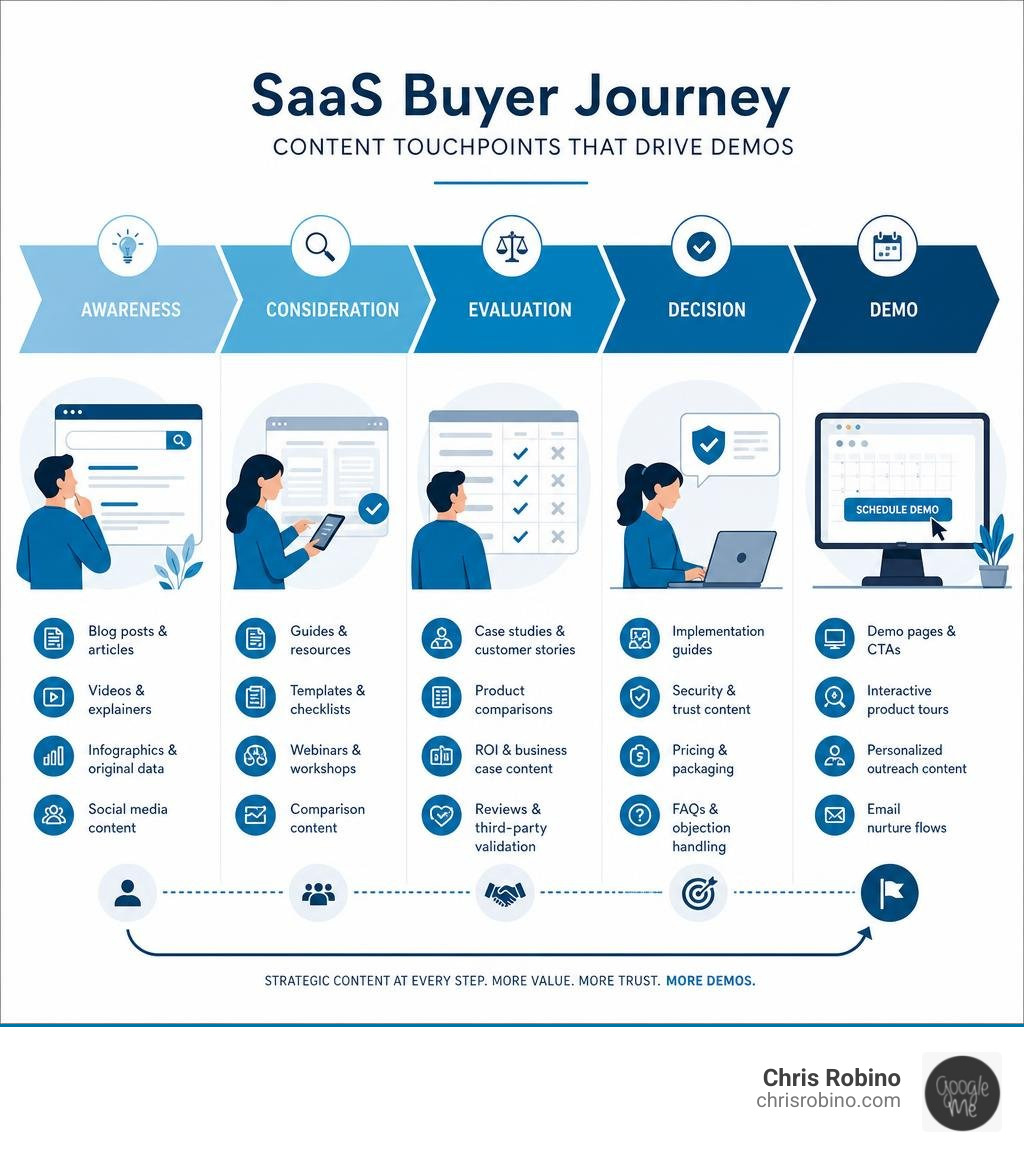
A full-service saas content marketing firm provides a suite of specialized services designed to support the entire buyer journey. Rather than offering one-size-fits-all packages, the top agencies match their capabilities to your specific growth bottlenecks, particularly when scaling SEO strategies for large companies.
Core Services of a Modern SaaS Content Marketing Firm
While writing remains a core output, the surrounding ecosystem of services is what actually drives distribution and authority:
- Product-Led SEO: Creating content that naturally weaves your software into the narrative as the obvious solution to the reader’s problem.
- Link Building & Digital PR: Securing high-authority contextual placements and brand mentions to boost domain authority and search visibility.
- Content Repurposing: Turning a single high-performing blog post into social media snippets, video scripts, or newsletter campaigns.
- Thought Leadership: Developing original research, opinion pieces, and deep industry insights that position your leadership team as market visionaries.
For companies looking to scale their video presence alongside written content, integrating SaaS Video Marketing is essential. Large enterprises require a partner that combines elite copywriting with technical go-to-market expertise to manage complex, multi-channel campaigns.
Choosing Between an In-House Team and a SaaS Content Marketing Firm
Should you hire an agency or build an in-house content team? The answer usually comes down to your current growth stage, budget, and timeline.

For many SaaS companies, partnering with an agency is faster, cheaper, and more effective than building an entirely in-house team from scratch. Consider the trade-offs:
| Metric | In-House Content Team | SaaS Content Marketing Firm |
|---|---|---|
| Average Annual Cost | $150,000 – $300,000+ (Salaries, benefits, tools) | $36,000 – $120,000+ (Fixed retainer) |
| Ramp-Up Time | 3 to 6 months (Hiring, onboarding, training) | 2 to 4 weeks (Onboarding and strategy kickoff) |
| Specialized Talent | Limited to the skills of 1–2 generalists | Direct access to SEO strategists, editors, and writers |
| Pricing Models | Fixed overhead (Hard to scale down during lean times) | Flexible monthly retainers or sprint-based models |
For large companies, a hybrid model often works best: an in-house content director managing brand strategy while partnering with an external firm to execute high-volume, technical SEO campaigns. For a deeper look at planning your long-term organizational structure, our comprehensive SaaS Content Marketing Guide breaks down the hiring process step-by-step.
Red Flags and Proven Frameworks for Long-Term Growth
As you shop for a saas content marketing firm, watch out for these major red flags:
- Ranking Guarantees: No agency controls Google’s algorithm or LLM training cycles. Anyone promising “#1 rankings in 30 days” is likely using black-hat tactics that will get your site penalized.
- Opaque Editorial Processes: If they cannot explain how they verify facts, capture your brand voice, or prevent AI plagiarism, run away.
- Focusing Only on Volume: Publishing 30 low-quality articles a month is far worse than publishing 4 highly researched, interview-backed pieces that actually convert.
Instead, look for agencies that lead with data-driven frameworks, transparent reporting, and deep case studies. Partners that align their success metrics directly with client revenue are essential for driving sustainable, long-term growth.
No matter which path you choose, content marketing is a compounding asset. It typically takes 90 to 180 days to see meaningful pipeline traction, but once the momentum builds, it becomes your lowest-cost acquisition channel.
If you are ready to stop guessing and start building a predictable, AI-ready organic growth engine, let’s talk. You can book a direct session with me via our SaaS Content Marketing Consultant page to audit your current strategy and map out a clear path to market dominance.