
What Are Interactive Media Experiences — and Why Do They Matter?
Interactive media experiences sit at the crossroads of technology, storytelling, and human behavior — and they’re reshaping how we create, share, and consume content across every platform.
Quick answer for researchers and practitioners:
| What You Want to Know | The Short Answer |
|---|---|
| What are interactive media experiences? | Digital experiences where audiences actively participate — through choices, movement, or input — rather than passively consuming content |
| What disciplines does the field cover? | Human-computer interaction, multimedia engineering, design, media studies, media psychology, and sociology |
| Where is the leading academic forum? | The ACM International Conference on Interactive Media Experiences (IMX) |
| What platforms are used? | Mobile apps, web browsers, VR/AR hardware, and hybrid installations |
| What’s driving innovation right now? | Generative AI, Gaussian splatting, 8K-3D VR, and browser-based narrative tools |
| Where is the field heading? | IMX 2026 in Athlone, Ireland (June 9–11, 2026) |
From a browser-based story about a diamond waking inside a coal seam, to a multi-user VR walk inside Leonardo da Vinci’s Last Supper, the range of what counts as an interactive media experience has never been broader — or more technically demanding.
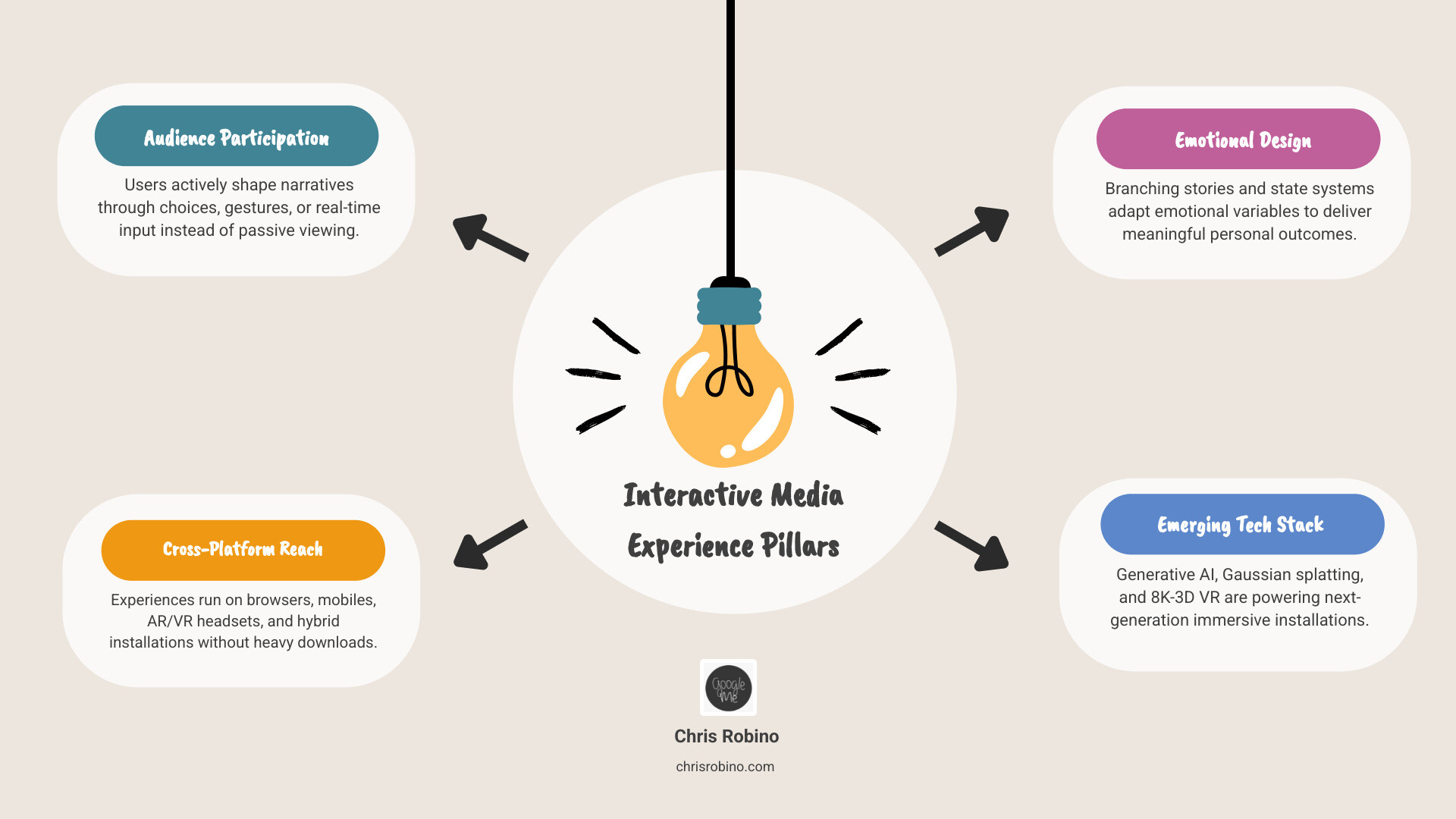
The field has evolved steadily from its roots in interactive television research, growing into a richly multidisciplinary space where engineers, artists, psychologists, and designers all have a seat at the table. What makes it exciting — and complicated — is that the audience is no longer just watching. They’re making choices that change outcomes, navigating 3D environments, and even shaping AI-generated narratives in real time.
But with that ambition comes real friction: device fragmentation, app store gatekeeping, accessibility gaps, and the challenge of keeping experiences running long after launch.
This guide cuts through the noise and maps the full landscape — from academic history to hands-on technical implementation.
I’m Chris Robino, a digital strategy leader with over two decades of experience helping organizations navigate emerging technology, AI-driven systems, and evolving search landscapes. My work sits at the intersection of strategy and execution — the exact space where interactive media experiences come to life. In the sections ahead, I’ll walk you through everything from the research foundations of the field to the tools and platforms shaping its future.
Easy interactive media experiences word list:
- cross platform content
- digital content creation tools
- digital media transformations in human communication
Introduction to Interactive Media Experiences and Academic Evolution

At its core, an interactive media experience is any digital encounter where the user’s actions directly influence the content, pacing, or visual environment. This is not a new concept, but the academic and practical frameworks supporting it have shifted dramatically.
To build an experience that truly connects, we have to look beyond simple coding. The field relies on a mix of human-computer interaction (HCI), multimedia engineering, design, media studies, media psychology, and sociology. These disciplines help us understand how users process visual information. For example, research shows that content with visuals increases information retention by 78%, and humans retain 65% of visual information compared to just 10% of what they hear. When we design interactive spaces, we are leveraging these psychological patterns to create deep, memorable connections.
Tracing the History from EuroITV to Modern Interactive Media Experiences
The academic path of this industry is a story of expanding horizons. What we now recognize as the premier international forum for this research—the ACM International Conference on Interactive Media Experiences (IMX)—began with a much narrower focus.
Originally, the community gathered around EuroITV (Interactive TV) and later ACM TVX. In those early days, the primary challenge was figuring out how viewers would interact with broadcast television through remote controls or basic on-screen menus.
As digital technology leaped forward, the limitations of “television” fell away. The conference evolved into ACM IMX, sponsored by SIGCHI (the ACM Special Interest Group on Computer-Human Interaction) in cooperation with SIGMM and SIGWEB. Today, the academic focus covers everything from online streaming platforms to virtual reality and AI-driven installations. Understanding this history helps us see where the industry is going, a topic we explore further in From Hubs to Hype: Navigating the Landscape of Media Innovation.
Core Platforms and Technical Implementation of Immersive Art
When designing interactive media experiences, choosing the right platform is the first critical decision. Creators must balance the depth of the experience with how easily the audience can access it.
| Platform | Accessibility | Technical Constraints | Best Use Case |
|---|---|---|---|
| Web Browser | Extremely High (No downloads, instant access) | Limited GPU access, restricted file sizes | Fast-loading interactive narratives, educational tools |
| Mobile App | Medium (Requires download, app store search) | Battery drain, device fragmentation | Location-based AR, ongoing daily interactions |
| Dedicated VR/AR | Low (Requires expensive, specialized hardware) | High rendering demands, physical space limits | Deeply immersive, multi-user physical exhibitions |
Mobile vs. Browser-Based Delivery for Interactive Media Experiences
Mobile devices are incredibly powerful tools for interactive art because they are already woven into our daily routines. They come equipped with cameras, accelerometers, gyroscopes, and touch screens. However, requiring users to download a custom application creates immediate friction.
Because of this, browser-based delivery has become highly attractive. It bypasses app stores entirely, resolving data cost concerns for audiences who may not want to download large files. To see this in action, we can look at the open-source project Carbon Trace. This project demonstrates how to build an immersive visual art piece that is also highly accessible.
Instead of relying on heavy frameworks, it uses Canvas 2D for pixel-level rendering and libraries like PixiJS for GPU-accelerated displacement maps at 60fps. Combined with GSAP for animation timelines and Howler.js for multi-channel audio mixing, it delivers a rich experience directly inside a mobile browser. Crucially, it uses a two-layer system: the visual canvas is hidden from screen readers, while a semantic DOM overlay handles keyboard navigation and aria-live announcements, ensuring WCAG AA compliance. We dive deeper into these hybrid architectures in Integrating Media Tech: Your Blueprint for Connected Experiences.
Narrative Systems, State Management, and Emotional Resonance
Traditional linear media tells a story from start to finish. Interactive stories, on the other hand, rely on state-managed and criteria-based systems to build emotional resonance.
A classic example of this is Hana Feels, an interactive story that models mental health. The system tracks quantifiable variables like health, stress, and communication levels based on player choices. Rather than relying on simple branching paths, the narrative checks these cumulative variables to determine how the main character behaves and which of the three endings the player reaches.
For more complex systems, developers use custom state managers. In the open-source project The Shadow of the Czar, the game uses a manager-based architecture. A specialized criteria system acts like a database query engine, checking over 40 narrative states before triggering specific dialogue, music, or visual transitions. This level of control allows developers to create stories that feel deeply responsive and personal. For more on how these systems are evolving, check out Beyond the Screen: Predicting the Next Wave of Digital Media.
Overcoming Device Fragmentation and App Store Barriers
If you do choose to build a custom mobile app, prepare to navigate the complex world of app store policies and long-term maintenance.
Apple charges an annual developer fee of ninety-nine dollars, while Google Play requires a lower, one-time fee. The approval process can add weeks or months to your schedule, which is a major bottleneck for time-sensitive exhibitions. Furthermore, app stores reserve the right to remove applications at any time—a serious risk for political or counter-cultural art.
Then there is device fragmentation. Your app must run smoothly on a five-year-old budget phone and the latest flagship device. If a user encounters a slow, glitchy interface, they will close it immediately. To succeed, you must optimize your files, plan your app store submissions months in advance, and simplify your layouts for varying screen sizes. We outline these strategic approaches in Augmented Reality Strategy: The New Interface for Innovation.
Future Horizons: Emerging Technologies and the Road to IMX 2026
As we look toward the future, the boundary between physical installations and digital code is dissolving. Immersive technologies are becoming more collaborative, high-fidelity, and intelligent.
Integrating 8K-3D VR, Gaussian Splatting, and Generative AI
We are seeing a massive leap in how 3D environments are rendered and experienced. A prime example of high-fidelity physical art integration is the LAST SUPPER INTERACTIVE project by Franz Fischnaller. This installation uses 8K-3D stereo projection and laser tracking to let up to 160 simultaneous users explore Leonardo da Vinci’s masterpiece from any 360-degree angle, combining a 21-billion-pixel gigapixel image with an architectural reconstruction.
On the consumer side, projects like BurnerSphere on Steam bring physical events to life online. It functions as an interactive VR documentary, blending 360-degree video with real-time social spaces using OpenXR.
Meanwhile, browser-based 3D is getting a major upgrade through Gaussian splatting and AI. The project The Shadow of the Czar uses SparkJS to render photorealistic Gaussian splat environments in real time, featuring adaptive quality profiles that scale down for mobile browsers.
We are also seeing AI shape narratives dynamically. In Anedolia, a web game built with Next.js and Three.js, the narrative content is generated on the fly by Google’s Gemini API based on user interactions. The game pairs this dynamic storytelling with a progressive color system, where restoring color to a grayscale apartment serves as a visual metaphor for emotional recovery. To learn more about how these technologies are changing marketing and design, check out Beyond the Screen: A Marketer’s Guide to VR and AR and Beyond Reality: What’s Next for Immersive Experiences.
Key Trends and Research Directions for IMX 2026 in Athlone
Looking ahead to IMX 2026—which will take place in Athlone, Ireland, from June 9–11, 2026—the academic and creative communities are focusing heavily on the balance between generative and hand-crafted experiences.
As generative AI tools make it incredibly easy to produce content, the research is shifting toward how we maintain artistic intentionality, ethical data practices, and true user agency. The event will bring together the brightest minds in HCI, design, and media psychology to discuss how these emerging tools can serve human connection rather than just creating digital noise.
If you want to stay ahead of these shifts, explore our insights on Augmented Reality Trends.
Ready to Build Your Next Interactive Experience?
Creating a successful interactive media experience requires balancing creative vision with technical reality. Whether you are building a lightweight browser application or a complex, AI-driven 3D environment, we are here to help you navigate the strategy, design, and implementation.