
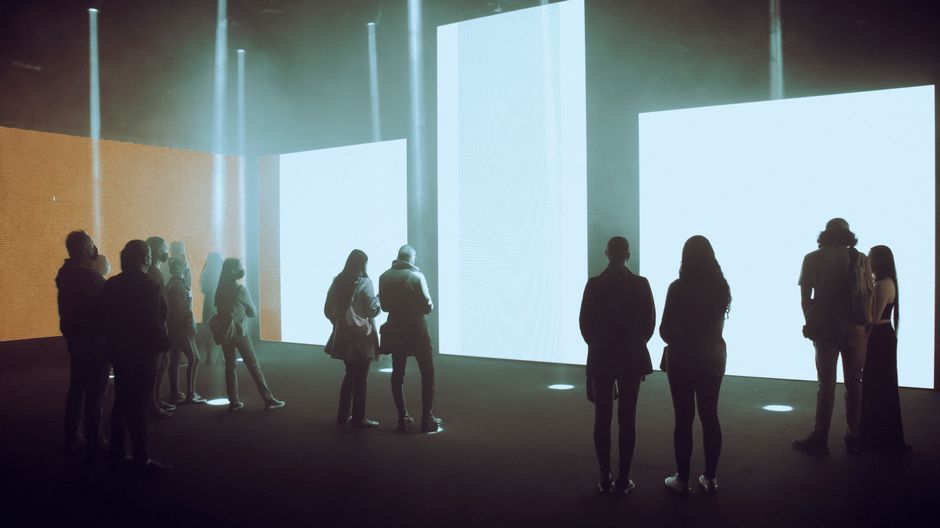
Why Immersive Experience Design Is Reshaping the Way We Engage With the World
Immersive experience design is the practice of creating environments that fully surround and engage participants — blending physical spaces, digital technology, storytelling, and sensory input to make people feel present inside an experience rather than just observing it. In an era where digital noise is at an all-time high, the ability to command total attention through spatial and sensory engagement has become the ultimate competitive advantage for global brands and cultural institutions alike.
Quick answer — what is immersive experience design?
- What it is: Designing environments that engage multiple senses, spark emotion, and invite active participation.
- How it differs from traditional design: Traditional design presents information; immersive design makes you feel part of a story or world.
- Key ingredients: Sensory engagement, spatial storytelling, interactivity, narrative, and transformation.
- Where it’s used: Theme parks, museums, retail, healthcare, live events, sports arenas, brand activations, and more.
- Why it matters now: The market is projected to reach $58.1 billion by 2028, growing at 30.4% annually.
Think about the last time a space made you stop and feel something — not just look at it. That’s immersive design at work. It is the transition from the “Age of Information” to the “Age of Experience.” As we move further into the 2020s, the demand for these experiences is driven by a psychological need for connection and a technological capability that finally matches our imagination.
The concept has been evolving since British designer Alex McDowell first formalized it in 2007. His core idea was simple but powerful: great design goes beyond a screen or keyboard. It shapes how a person experiences the entire world around them. This holistic approach requires a multidisciplinary mindset, combining architecture, psychology, software engineering, and theatrical narrative.
Today, tools like projection mapping, AI-driven narratives, mixed reality, and spatial audio let designers build environments that respond to you — adapting in real time to your choices, movements, and emotions. The line between the physical and digital world isn’t just blurring. In the best immersive experiences, it disappears entirely. This convergence is creating new opportunities for large-scale enterprises to redefine their relationship with their audience, moving from a transactional model to one based on shared memory and emotional resonance.
And audiences have noticed. Five years after the COVID-19 pandemic reshaped how people gather, the hunger for meaningful, in-person experiences has never been stronger. Immersive entertainment venues, interactive museum exhibits, and branded environments are no longer novelties — they’re expectations. For large companies, this shift necessitates a sophisticated approach to both physical design and digital discoverability.
This guide breaks down everything you need to know: the core principles, the technologies, the industries being transformed, and the strategic SEO frameworks that allow large organizations to scale these experiences in a crowded digital marketplace.
I’m Chris Robino — a digital strategy and AI integration expert who has spent over two decades helping organizations navigate emerging technology, including the rapidly expanding world of immersive experience design. In this guide, I’ll cut through the complexity and give you a clear, practical foundation for understanding and applying these ideas.
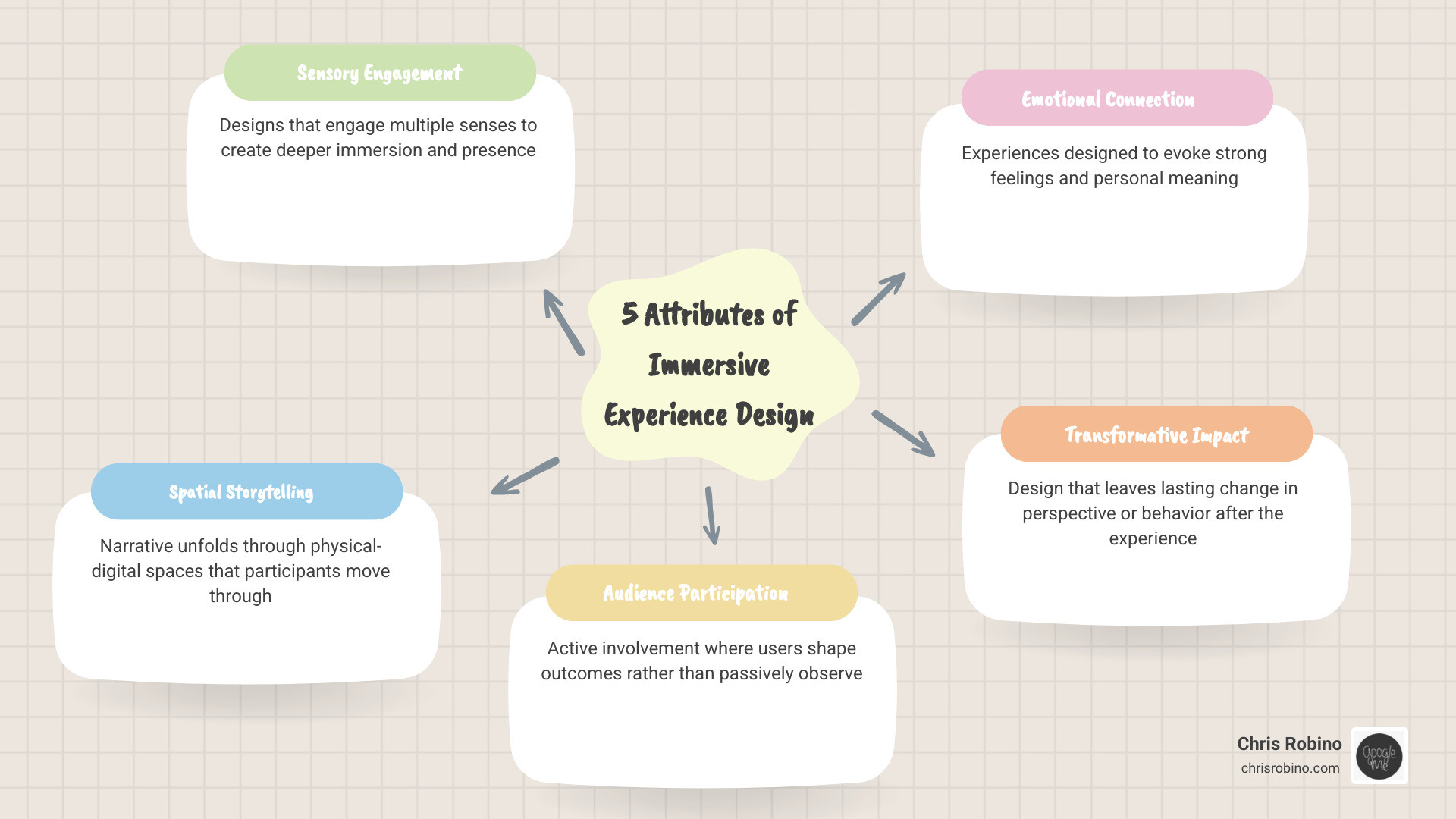
Immersive experience design vocab to learn:
Core Principles of Immersive Experience Design

At its heart, immersive experience design is about moving the user from the role of a spectator to the role of a protagonist. As we move through 2026, the industry has solidified around five key attributes identified by researchers at Gensler. For an experience to be truly immersive, it must be sensory and emotionally engaging, participatory, set in a distinctive location, story-driven, and transformative.
The goal is to create memories that stick long after the guest leaves the venue. This requires a shift from “delivering an event” to “crafting an experience.” Research into neurobiology shows that it takes roughly 400 repetitions to create a new synapse in the brain, but when done through play and discovery, it only takes 10 to 20. This is why The design lab approach prioritizes moments of discovery over simple information downloads. By engaging the limbic system through multi-sensory stimuli, designers can bypass the analytical mind and create a direct emotional connection.
Traditional vs. Immersive Design: A Comparison
| Feature | Traditional Design | Immersive Experience Design |
|---|---|---|
| User Role | Passive Observer | Active Participant |
| Interface | Screens, Keyboards, 2D | Spatial, Voice, Haptic, 360° |
| Narrative | Linear (Beginning to End) | Non-linear (User-driven choice) |
| Senses | Sight and Sound | Multi-sensory (Scent, Touch, Motion) |
| Goal | Information/Utility | Presence and Transformation |
The Role of Storytelling and Narrative in Immersive Experience Design
Storytelling is the “connective tissue” of immersion. As expert Margaret Chandra Kerrison notes, technology should feel seamless and organic within the story world rather than being the centerpiece. In immersive experience design, we don’t just tell a story; we build a world. This world-building requires a deep understanding of “environmental storytelling,” where the physical details of a space—the lighting, the textures, the ambient sounds—convey narrative information without the need for explicit text.
This involves “experience mapping,” where every phase—from the moment a guest arrives to their final exit—is designed to hit specific emotional beats like awe, curiosity, or celebration. Unlike a movie, where the director controls the camera, immersive narratives often rely on audience agency. By giving users the power to influence outcomes, we create a deeper psychological connection. To understand how these narratives are evolving, see our exploration of Beyond Reality: What’s Next for Immersive Experiences.
Technologies Powering Modern Immersive Experience Design
While the story is the soul, technology is the engine. Today’s designers use a sophisticated toolkit to blur the lines between reality and simulation. Scientific research on immersive storytelling highlights that hyper-personalization is becoming the new standard. Large companies are increasingly investing in proprietary tech stacks to ensure their immersive offerings are unique and scalable.
Key technologies include:
- Extended Reality (XR): Combining AR, VR, and MR to overlay digital data on the physical world or transport users to entirely virtual ones.
- Spatial Audio: Ambisonic sound systems that move audio around the listener to create a sense of true 3D presence. This is critical for “presence,” as the human ear is highly sensitive to directional cues.
- Projection Mapping: Turning irregular surfaces—like buildings or sculptures—into dynamic video displays, effectively turning the physical world into a digital canvas.
- AI and Computer Vision: Using sensors to track user movement and AI to drive adaptive characters that remember past interactions, creating a truly responsive environment.
- Haptics and 4D Effects: Incorporating wind, temperature changes, scents, and floor vibrations to ground the digital experience in physical reality.
For a deeper dive into how these tools interface with modern business, check out our guide on Augmented Reality Strategy: The New Interface for Innovation.
Industry Applications and Real-World Impact
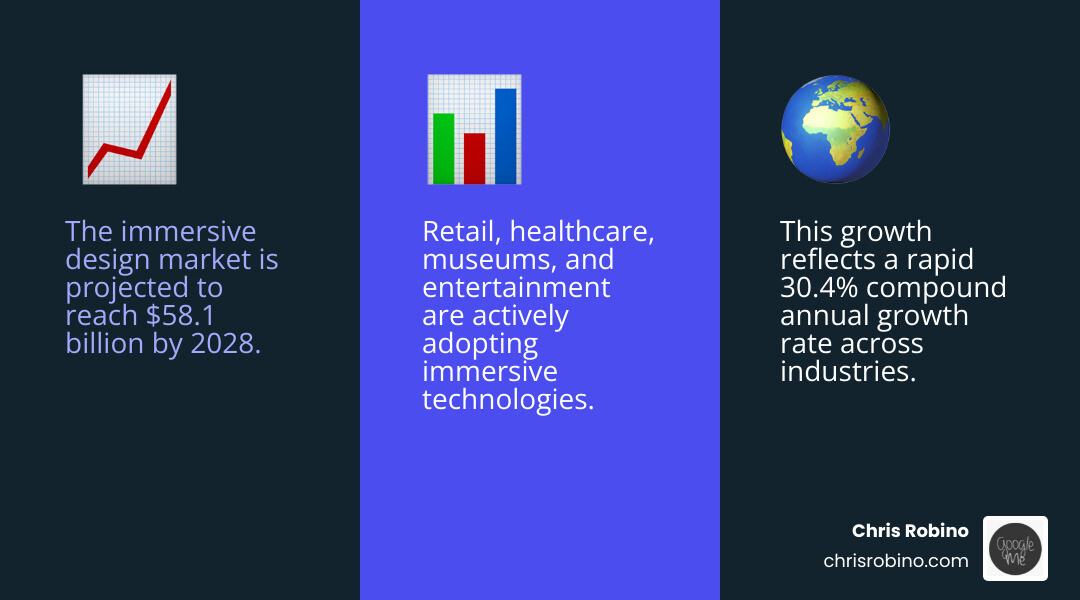
The immersive experience design market is booming, projected to reach $58.1 billion by 2028 with a staggering 30.4% CAGR. We are seeing this transformation across every major sector:
- Retail: Brands are moving away from simple transactions to “retailtainment.” Check out Beyond the Mirror: Augmented Reality’s Retail Revolution for examples of how AR is changing the shopping journey.
- Healthcare: Immersive simulations are used for surgeon training and patient therapy, providing high-stakes environments without the real-world risk. This includes VR for pain management and AR for real-time surgical overlays.
- Themed Entertainment: Large-scale venues like the Sphere in Las Vegas or Meow Wolf locations demonstrate the massive public appetite for shared, immersive wonder. These venues serve as the “R&D labs” for the broader industry.
- Corporate Events: Companies are using interactive simulations and “zombie adventure” games to foster teamwork and deep learning, replacing traditional slide-based presentations with active participation.
- Museums & Culture: Domes and projection-mapped galleries are revitalizing institutions like the Smithsonian and the Statue of Liberty Museum, turning history into a living environment that resonates with younger, digitally-native audiences.
Educational Pathways for Future Designers
As the industry matures, educational institutions are launching specialized programs to train the next generation of “creative technologists.” For example, the Master of Science in Immersive Experience Design at ASU is a 36-credit-hour program that covers everything from designing digital worlds to the ethics of spatial computing. These programs bridge the gap between traditional art schools and technical engineering colleges.
These programs are often STEM-designated, reflecting the technical rigor required to master programming fundamentals, interactive art, and media installations. Students are taught to lead with empathy and innovation, ensuring that as they build future cities or digital realms, they consider the social impact and human connection at the core of their work. This academic foundation is essential for maintaining high standards as the industry scales.
Overcoming Challenges in Implementation
Designing for immersion isn’t without its hurdles. The “experimental nature” of these projects often leads to high implementation costs. Designers must also balance the “wow factor” with accessibility standards, ensuring that experiences are inclusive for people with different physical or sensory needs. Inclusivity is not just an ethical requirement but a business necessity for large-scale public installations.
Technology integration is another major challenge. If a motion sensor lags or a projection is misaligned, the “illusion of presence” is broken instantly. Furthermore, designers must be wary of sensory fatigue—the “more is more” approach can overwhelm guests. Successful projects use emotional “rests” between “peaks” to keep the audience engaged without causing burnout. This pacing is a hallmark of professional immersive design.
The Future of Immersive Experience Design and Strategic Growth

Looking toward 2028 and beyond, the future of immersive experience design is inextricably linked with the evolution of AI and the ability of large organizations to maintain visibility in an increasingly complex digital landscape. We are moving toward a world of hyper-personalization where environments don’t just react to a crowd, but to you specifically. Imagine a museum exhibit that adjusts its narrative complexity based on your interests or a retail space that changes its lighting and scent to match your mood.
SEO Strategies for Large Companies in the Immersive Space
For large enterprises, creating a world-class immersive experience is only half the battle; the other half is ensuring it is discoverable. SEO strategies for large companies must evolve to handle the unique demands of immersive content. Unlike traditional text-based pages, immersive experiences often rely on heavy media assets, which can challenge standard search engine optimization frameworks.
1. Scalable Technical Infrastructure and Core Web Vitals Large companies often struggle with legacy systems that hinder the performance of high-fidelity immersive assets. To perform well in search rankings, organizations must prioritize Core Web Vitals, specifically focusing on Largest Contentful Paint (LCP) and Cumulative Layout Shift (CLS). For immersive sites, this means implementing advanced lazy-loading for 3D models and using Content Delivery Networks (CDNs) to serve spatial audio and high-resolution textures from the edge. A fast, stable technical foundation is the prerequisite for any enterprise SEO success.
2. Semantic Search and Topic Authority Search engines are moving away from simple keyword matching toward understanding intent. Large companies should build “topic clusters” around their immersive offerings. For instance, if a brand launches an AR retail experience, they should create a comprehensive ecosystem of content covering AR technology, the future of shopping, and user guides. By establishing authority across a broad topic area, the specific immersive project gains more organic visibility through association.
3. Digital Asset Optimization (DAO) As search engines begin to index 3D objects and AR files (like USDZ or GLB formats), large companies must treat these assets as searchable content. This involves using proper schema markup for 3D models, providing descriptive alt-text for spatial environments, and ensuring that the metadata within these files is optimized for search crawlers. This “Digital Asset Optimization” is the next frontier for enterprise-level SEO.
4. Local SEO for Physical Immersive Venues For companies with physical locations, such as immersive museums or branded pop-ups, local SEO is paramount. This includes managing thousands of local listings at scale, ensuring consistent NAP (Name, Address, Phone) data, and encouraging user-generated content and reviews. High-authority backlinks from local news outlets and cultural blogs can significantly boost the visibility of these physical-digital hybrids.
At Chris Robino, we focus on how these shifts impact AR/VR Business models and broader Digital Transformation for Media. The transition from passive consumption to active immersion, supported by robust SEO strategies, is perhaps the most significant shift in media history.
Whether you are a brand looking to create a memorable activation or a developer building the next generation of spatial systems, the core lesson remains: put the human experience first. Technology and SEO are the tools, but presence, emotion, and transformation are the goals.
Ready to explore how immersive design and strategic SEO can transform your organization?